
Solving a Rubik’s Cube often looks like pure magic to the untrained eye. However, every speedcuber knows that the secret lies in mathematics, pattern recognition, and muscle memory. As we navigate the speedcubing landscape in 2026, accessing the right Rubik's cube algorithms list with easy explanations is easier than ever.
Whether you are picking up a cube for the first time or trying to shave seconds off your personal best, mastering algorithms is the key to success. This comprehensive guide breaks down the essential sequences you need to know. We will take you from the absolute basics to advanced speedcubing techniques, ensuring every step is easy to understand.
🏆 Quick Answer: What is the Best Rubik's Cube Algorithm List?
The best algorithm list depends entirely on your current skill level.
- Beginners should start with the Layer-by-Layer Method, requiring only 5 to 7 basic algorithms.
- Intermediate solvers should learn 2-Look OLL and 2-Look PLL, which adds just 16 algorithms to your repertoire.
- Advanced speedcubers use the full CFOP Method, which includes intuitive F2L, 57 OLL cases, and 21 PLL cases (78 algorithms total).
Understanding Rubik's Cube Notation (The Alphabet of Speedcubing)
Before diving into any Rubik's cube cheat sheet, you must understand speedcubing notation. Algorithms are written using a universal language of letters that represent the six faces of the cube.
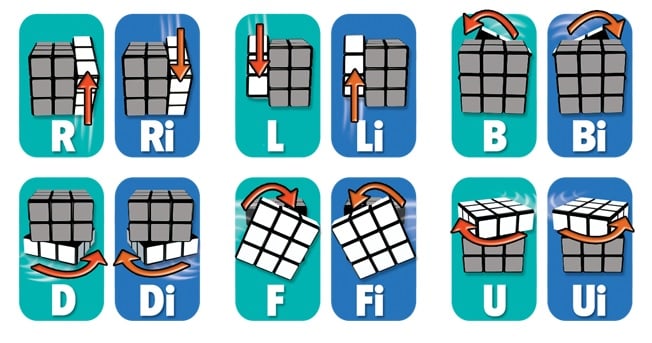
- R (Right): Turn the right face 90 degrees clockwise.
- L (Left): Turn the left face 90 degrees clockwise.
- U (Up): Turn the top face 90 degrees clockwise.
- D (Down): Turn the bottom face 90 degrees clockwise.
- F (Front): Turn the front face 90 degrees clockwise.
- B (Back): Turn the back face 90 degrees clockwise.
Modifiers and Rotations
When you see an apostrophe (like R' or "R prime"), it means you turn that face 90 degrees counter-clockwise. If you see a number 2 (like U2), it means a 180-degree turn in either direction.
Advanced algorithms also use lowercase letters for double-layer turns (e.g., r means turning the right face and the middle slice together). Additionally, whole cube rotations are marked as x, y, and z, allowing you to reorient the cube in your hands without breaking your finger tricks.
The Core Triggers: Your Building Blocks
To make memorizing a massive Rubik's cube algorithms list easier, cubers break sequences down into "triggers." These are short, repeatable finger movements that form the foundation of hundreds of algorithms.
The Sexy Move (R U R' U')
This is the most famous trigger in cubing. You turn the right face up, push the top layer left, bring the right face down, and pull the top layer back. It is heavily used in F2L and beginner corner insertion.
The Sledgehammer (R' F R F')
Often used to pair corners and edges, this trigger involves moving the right face down, pushing the front face right, bringing the right face up, and pulling the front face back.
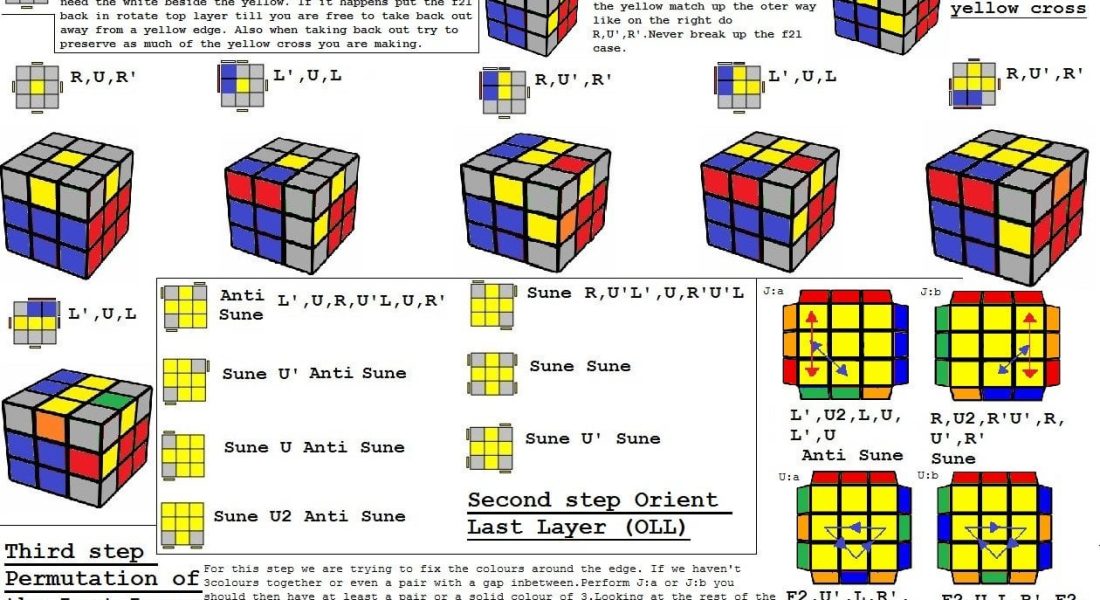
The Sune (R U R' U R U2 R')
The Sune is a fundamental OLL algorithm that orients three corners on the last layer. Once your fingers learn the rhythm of the Sune and its mirror, the Anti-Sune (R U2 R' U' R U' R'), you will suddenly recognize them inside dozens of complex algorithms.
The Beginner Method: Your First Algorithm List
If you are solving the cube for the first time, ignore the massive databases of 119+ algorithms. You only need a beginner Rubik's cube method that solves the puzzle layer by layer.
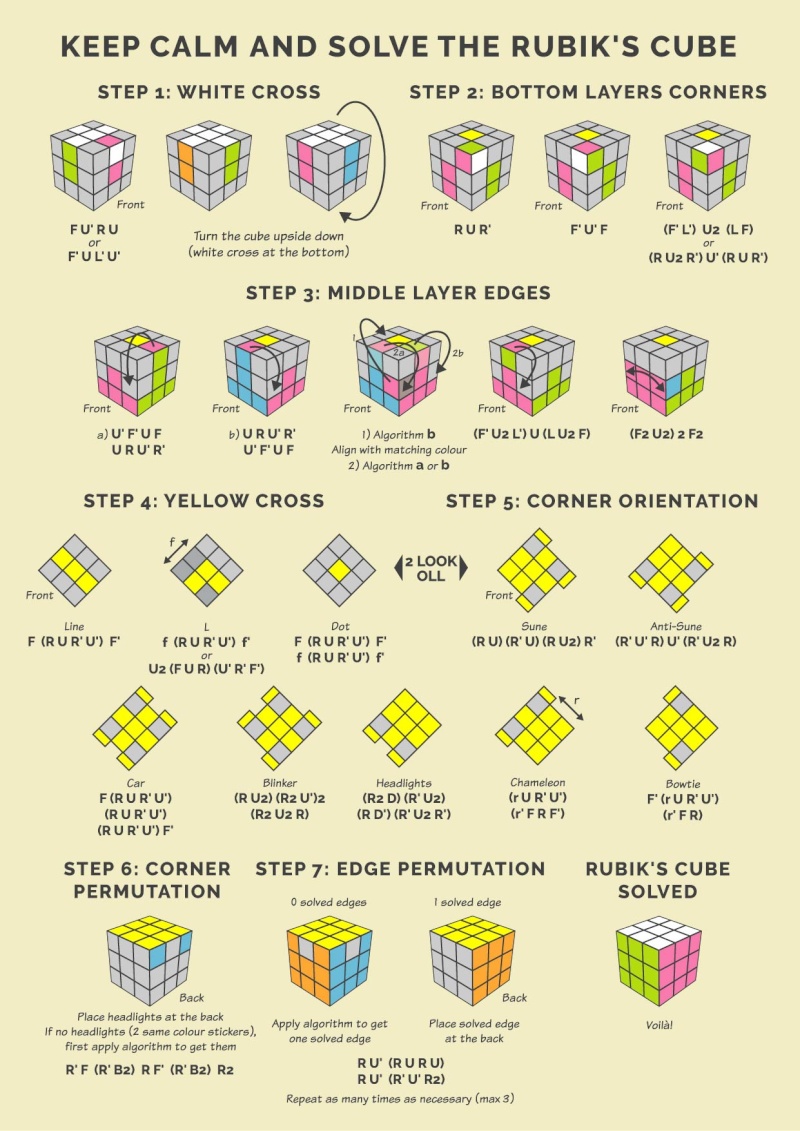
1. The White Cross and First Layer
The first step is entirely intuitive. You build a white cross on the bottom, then insert the white corners using the Sexy Move (R U R' U') repeatedly until the corner drops into its correct slot.
2. The Second Layer Edges
To insert edge pieces into the middle layer, you use two simple algorithms. One moves an edge to the right, and the other moves it to the left.
- Right Insert: U R U' R' U' F' U F
- Left Insert: U' L' U L U F U' F'
3. The Yellow Cross and Last Layer
Next, you orient the yellow edges on top using a simple "F-R-U" trigger: F R U R' U' F'. Finally, you permute the last layer corners and edges using variations of the Sune and a corner-cycling algorithm (U R U' L' U R' U' L).
The CFOP Method: The Gold Standard of Speedcubing
In 2026, the CFOP method (Cross, F2L, OLL, PLL) remains the undisputed king of speedcubing. Invented by Jessica Fridrich, this method condenses the beginner steps into highly efficient, simultaneous movements.
F2L (First Two Layers) – 41 Cases
F2L is the most crucial step for lowering your solve times. Instead of solving the first layer corners and second layer edges separately, you pair them up in the top layer and insert them together.
While there are 41 standard F2L cases, experts strongly recommend learning F2L intuitively rather than memorizing a list. By understanding how to "hide" corners and manipulate edges, you can solve any F2L pair without relying on rote memorization.
OLL (Orientation of the Last Layer) – 57 Cases
Once your first two layers are complete, OLL ensures the entire top face is yellow. There are 57 different OLL recognition patterns.
To make this manageable, algorithms are grouped by shapes:
- Crosses and Dots: Cases where you have zero or four yellow edges oriented.
- Lines and T-Shapes: Cases featuring distinct linear patterns.
- Squares and P-Shapes: Asymmetrical patterns that require specific setup moves.
Many advanced cubers rely heavily on triggers like the Sune, Sledgehammer, and Headlights to execute these 57 cases with blistering speed.
PLL (Permutation of the Last Layer) – 21 Cases
The final step of CFOP is PLL, where you move the oriented yellow pieces into their correct solved positions. There are exactly 21 PLL algorithms, and they are usually named after letters or shapes.
- A-Perms (a and b): 3-cycle corner swaps.
- U-Perms (a and b): 3-cycle edge swaps using the M-slice (e.g., M2 U M U2 M' U M2).
- T-Perm: A classic adjacent corner and edge swap (R U R' F' R U R' U' R' F R2 U' R').
- H-Perm and Z-Perm: Algorithms that swap opposite or adjacent edges simultaneously.
2-Look OLL and 2-Look PLL: The Perfect Bridge
Memorizing 78 algorithms all at once is a recipe for burnout. This is why the speedcubing community universally recommends 2-Look OLL and 2-Look PLL as a bridge between the beginner method and full CFOP.
Master 2-Look OLL (10 Algorithms)
Instead of solving the yellow face in one step, you break it into two looks:
- Orient the Edges: Use one of 3 simple algorithms (like the "Dot," "Line," or "L-shape" algorithms) to form a yellow cross.
- Orient the Corners: Use one of 7 algorithms (mostly Sune and Anti-Sune variations) to make the rest of the face yellow.
Master 2-Look PLL (6 Algorithms)
Similarly, you break the permutation step into two manageable chunks:
- Permute the Corners: Use an A-Perm to solve all four corners relative to each other.
- Permute the Edges: Use a U-Perm, H-Perm, or Z-Perm to finish the cube.
By learning just these 16 algorithms, you can solve the last layer efficiently while gradually memorizing the full OLL and PLL lists at your own pace.
Advanced Algorithms: Stepping into ZBLL and Beyond
For solvers aiming for sub-15 second averages in 2026, standard CFOP might not be enough. This is where advanced algorithm sets like ZBLL (Zborowski-Bruchem Last Layer) come into play.
What is ZBLL?
ZBLL is an incredibly advanced method that allows you to solve the entire last layer in one single look, provided the top cross is already oriented. It completely skips the PLL step.
However, the cost of this efficiency is a massive memorization burden. There are 493 ZBLL algorithms to learn. Most world-class cubers only learn specific subsets of ZBLL (like COLL or ZBLS) to handle common cases while falling back on standard PLL for the rest.
Alternative Methods: Roux and ZZ
While CFOP dominates, methods like Roux and ZZ have dedicated followings. Roux relies heavily on block-building and M-slice moves, utilizing CMLL (Corners of the Last Layer) algorithms. ZZ focuses on edge orientation first, allowing for completely rotation-less F2L solving.
Expert Tips for Memorizing Algorithms Fast
Having a Rubik's cube algorithms list with easy explanations is only half the battle. You must transfer that knowledge from your brain to your fingers.
- Learn in Small Batches: Never try to learn more than 2 or 3 algorithms in a single day. Practice them until they become pure muscle memory.
- Focus on Finger Tricks: An algorithm is only as fast as your finger tricks. Learn how to execute moves like U2 with a single flick of your index finger rather than regripping the cube.
- Use Algorithm Trainers: In 2026, interactive web tools and flashcard apps are essential. They use spaced repetition to test your recognition speed and algorithm recall.
- Practice Daily: Consistent daily practice of 15 minutes is vastly superior to a single three-hour cram session once a week.
Frequently Asked Questions (FAQ)
How many algorithms do I need to know to solve a Rubik's Cube?
To solve the cube using a beginner method, you only need to memorize 5 to 7 basic algorithms. However, to become a competitive speedcuber using the CFOP method, you will eventually need to learn around 78 algorithms (Full OLL and PLL) alongside intuitive F2L.
What is the "Sexy Move" in cubing?
The "Sexy Move" is a popular, humorous nickname for the trigger sequence R U R' U'. It is one of the most fundamental building blocks in cubing, used extensively in F2L pairings, beginner corner insertions, and even complex OLL algorithms.
Is CFOP better than the Roux method?
Neither method is objectively "better"; it depends on your turning style. CFOP is more algorithm-heavy and relies on high TPS (turns per second) and ergonomic finger tricks. Roux relies more on intuition, block-building, and M-slice moves, resulting in lower move counts but requiring high look-ahead skills.
How long does it take to memorize full OLL and PLL?
For an average cuber practicing consistently, it takes about 2 to 3 months to fully memorize and execute all 57 OLL and 21 PLL algorithms. The key is to learn 2-Look OLL and PLL first, which immediately improves your times while you slowly absorb the remaining cases.
Conclusion
Mastering the Rubik's Cube is a deeply rewarding journey that blends spatial reasoning with physical dexterity. By utilizing a structured Rubik's cube algorithms list with easy explanations, you remove the frustration from the learning process.
Start with the beginner method, transition smoothly into 2-Look OLL and PLL, and eventually conquer the full CFOP method. Remember that every world record holder started exactly where you are right now—staring at a scrambled puzzle, learning their very first algorithm. Grab your cube, start practicing your triggers, and enjoy the incredible world of speedcubing in 2026!
References
- Rubik's Cube Mastery — Complete Rubik's Cube Algorithms Library and Interactive Practice Guides, 2025
- Cubzor — Algorithm Cheatsheet: Printable Rubik's Cube Reference for Speedsolving, 2026
- SolveTheCube — Comprehensive Algorithms Guide for the CFOP Method, 2025
- Ruwix — Rubik's Cube Algorithms, Mathematical Properties, and Notation Guide, 2024
- SolvingRubiksCube — Complete Database of Speedcubing Algorithms and Learning Paths, 2026
- CubeMaster — Complete OLL, PLL, F2L, and ZBLL Guide with 3D Animations, 2026
- SpeedSolving Puzzles Community — Neverending List of Algorithms Compilation for Advanced Solvers, 2025
- The Official Rubik's Cube — 3×3 Solution Guides and Official Tutorials, 2026
