Welcome to the future of cubing! As we navigate through 2026, the landscape of puzzle solving has evolved significantly, blending traditional mechanical mastery with cutting-edge digital tools. If you are holding a scrambled Rubik's Cube and feeling overwhelmed by the jumble of colors, you are not alone. However, the secret to unlocking your potential lies not just in dexterity, but in understanding the universal language of the cube: notation.
This comprehensive guide is designed specifically for beginners who want to master Rubik's cube notation practice exercises. Whether you are a student in downtown Austin, a hobbyist in Tokyo, or a parent looking for an educational activity for your child in London, this article will provide the structured path you need. We will move beyond simple definitions and dive into actionable practice exercises that leverage both physical intuition and modern AI-driven simulators. By the end of this read, you will possess the foundational knowledge required to solve your first layer, understand algorithms, and transition smoothly into speedcubing methods like CFOP.
Why Notation is the Gateway to Speedcubing Mastery
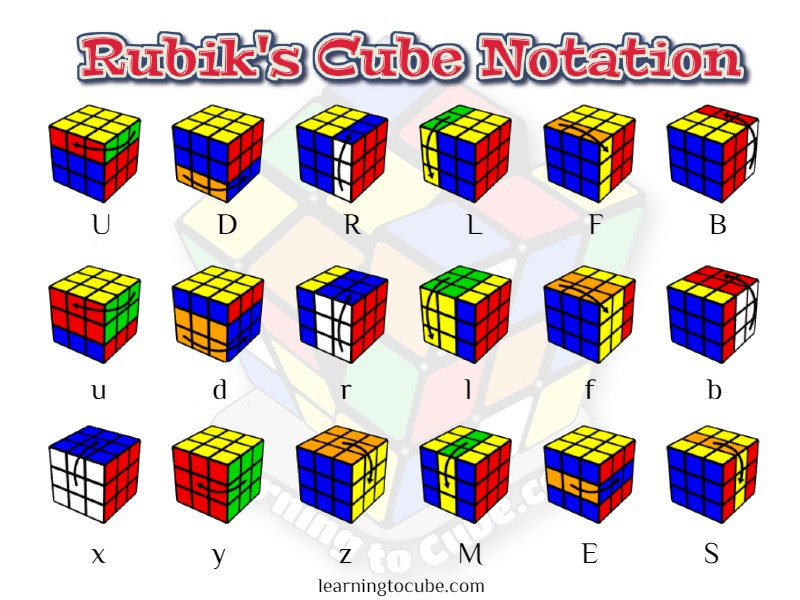
In the world of competitive cubing, notation is the bridge between confusion and clarity. Without it, learning algorithms is akin to trying to learn a new language without an alphabet; you would have to describe every single movement verbally, which is impossible for the complex sequences used in advanced methods. For a beginner, mastering notation is the first major milestone toward becoming a speedcuber. It allows you to follow tutorials, access online communities, and track your progress objectively.
The Universal Language of Cubes
Imagine trying to explain a specific trick to a friend using only hand gestures while they are holding a cube. It would be chaotic and inefficient. Notation solves this by providing a standardized system where R means "Right face clockwise," and F' means "Front face counter-clockwise." This standardization ensures that a tutorial viewed in New York can be perfectly replicated in Sydney. In 2026, this consistency remains the backbone of global cubing culture.
Building Muscle Memory Through Repetition
One of the most effective Rubik's cube notation practice exercises involves more than just reading; it requires execution. When you write down an algorithm like R U R' U' (often called the "Sexy Move"), you are encoding a pattern into your brain. Repeatedly performing this sequence builds muscle memory, allowing your fingers to execute the moves automatically without conscious thought. This automation is critical for reducing solve times as you advance from the Beginner's Method to faster techniques.
Avoiding Common Beginner Pitfalls
Many beginners make the mistake of skipping notation practice and trying to memorize entire solutions by rote. While this might work for a single solve, it fails when the cube is scrambled differently. Understanding why a move works—based on its notation—allows you to adapt. For instance, knowing that U2 rotates the top layer 180 degrees helps you visualize the outcome even if you haven't done that specific scramble before.
Decoding the Alphabet: Essential Face Moves and Modifiers
Before you can practice effectively, you must internalize the core symbols. Think of these letters as the verbs in the sentence of cubing. There are six primary faces, each represented by a single capital letter.
The Six Fundamental Faces
The foundation of all notation rests on these six directions:
- R (Right): Turn the rightmost layer clockwise.
- L (Left): Turn the leftmost layer clockwise.
- U (Up): Turn the top layer clockwise.
- D (Down): Turn the bottom layer clockwise.
- F (Front): Turn the front face clockwise.
- B (Back): Turn the back face clockwise.
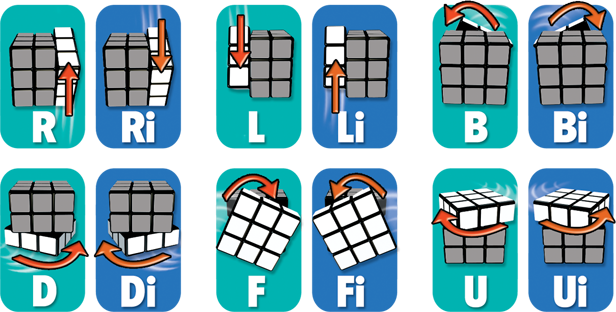
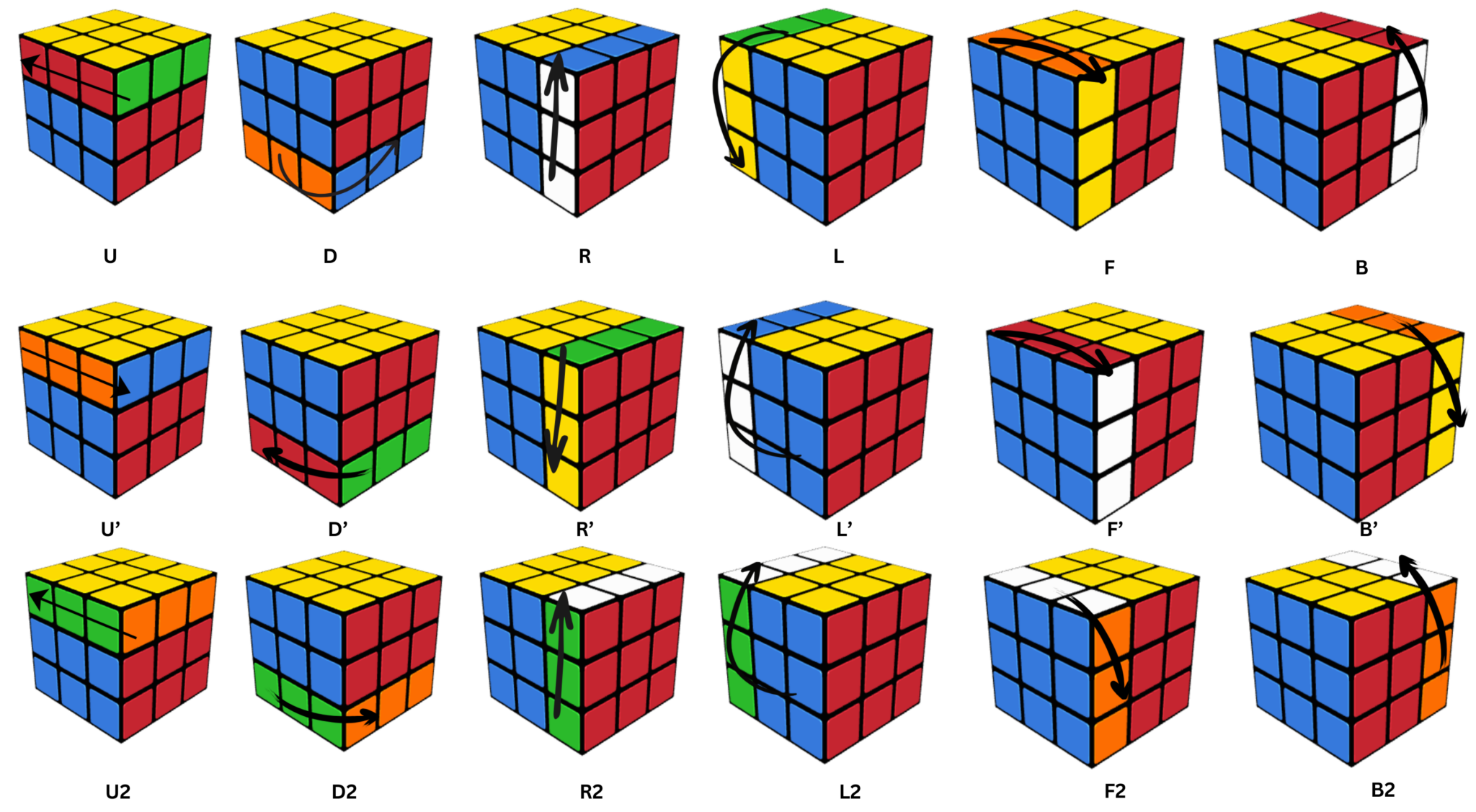
When you see a letter alone, such as F, it always implies a 90-degree clockwise turn. This is the default setting unless modified. Visualizing yourself looking directly at the face you are turning is crucial. If you look at the Up face to perform a U turn, you are moving the top layer away from you. If you rotate the whole cube instead, the direction changes relative to your view.
The Power of the Prime Symbol (')
The apostrophe ' is perhaps the most important modifier for beginners. It indicates a counter-clockwise turn. So, R' means turn the Right face counter-clockwise. A common rule of thumb is that if R is forward, R' is backward. This simple addition doubles the versatility of the basic letters, allowing you to undo moves or create specific cycles.
Consider the famous "Sexy Move": R U R' U'. This four-move sequence is the building block for dozens of algorithms. Notice how the prime symbols appear in reverse order compared to the non-prime moves. This symmetry is a hallmark of efficient cube algorithms. Practicing this specific sequence until it feels natural is a recommended practice exercise for anyone starting today.
Understanding Double Turns (2)
The number 2 after a letter signifies a 180-degree turn. For example, R2 means turn the Right face twice (or 180 degrees). This move brings the same stickers back to their original positions but flips the orientation of the edge and corner pieces involved. While less frequent in the very first steps of the Beginner's Method, understanding R2 is essential for creating checkerboard patterns and solving later layers efficiently.
Advanced Notation Concepts: Wide Moves, Slices, and Rotations
Once you have mastered the basics, you will encounter more complex symbols as you explore different solving methods like Roux or CFOP. These advanced notations expand your toolkit significantly.
Wide Moves: Turning Multiple Layers
Standard notation only turns one outer layer. However, sometimes you need to turn two layers simultaneously. This is denoted by the lowercase 'w' (wide).
- Rw: Turn the Right face AND the Middle layer together clockwise.
- Lw: Turn the Left face AND the Middle layer together clockwise.
Wide moves are indispensable for larger cubes (like 4×4 or 5×5) and are increasingly used in 3×3 speedcubing to execute certain OLL and PLL cases faster. For a beginner aiming for sub-30 second solves, incorporating wide moves into your notation practice can streamline the F2L (First Two Layers) stage.
Slice Moves: The Hidden Layers
Between the outer faces lie the middle slices. These are denoted by specific letters that do not correspond to outer faces:
- M (Middle): The slice between Left and Right.
Mturns it like the Left face (clockwise when looking at the left side). - E (Equatorial): The slice between Up and Down.
Eturns it like the Down face. - S (Standing): The slice between Front and Back.
Sturns it like the Front face.
These moves are often tricky for beginners because they require rotating the entire cube or holding it in a specific orientation to execute correctly. A great practice exercise is to isolate these moves: hold the cube steady and practice M, M', M2 repeatedly to feel the difference in resistance and movement compared to outer layer turns.
Whole Cube Rotations: x, y, and z
Sometimes, an algorithm is easier to remember if you rotate the entire cube rather than twisting individual faces. These are denoted by lowercase Roman letters:
- x: Rotate the whole cube like an R move (right face turns away).
- y: Rotate the whole cube like a U move (top face turns away).
- z: Rotate the whole cube like an F move (front face turns away).
Using these rotations can simplify complex algorithms, making them easier to memorize and execute under pressure during competitions. Many modern solvers and apps, such as those found on Cubzor, allow you to toggle these views to help you visualize the spatial relationships better.
Step-by-Step Notation Practice Exercises for Absolute Beginners
Theory is useless without application. To truly master Rubik's cube notation practice exercises for beginners, you need a structured routine. Here is a progressive workout plan designed to build your skills from day one.
Exercise 1: The Single Face Drill
Goal: Build muscle memory for basic clockwise and counter-clockwise turns.
Instructions:
- Hold the cube with the White center facing you (F) and the Yellow center on top (U).
- Perform F five times. Count aloud: "One, two, three, four, five."
- Perform F' five times.
- Repeat this for all six faces (R, L, U, D, B) for ten seconds each.
Why it works: This isolates the motor function of your fingers, ensuring you don't confuse F with F' due to muscle fatigue later in a solve.
Exercise 2: The "Sexy Move" Loop
Goal: Internalize the most fundamental algorithm in cubing.
Algorithm: R U R' U'
Instructions:
- Start with a solved cube.
- Execute the sequence slowly, saying each letter out loud: "Right, Up, Right Prime, Up Prime."
- Watch what happens to the corners. They cycle in a circle.
- Increase your speed gradually until you can do 10 repetitions in a row without stopping.
Pro Tip: Try doing this with your eyes closed once you are comfortable. This forces your brain to rely entirely on tactile feedback and notation memory.
Exercise 3: The Opposite Pair Challenge
Goal: Understand the relationship between opposite faces and double turns.
Algorithm: R2 L2 U2 D2 F2 B2 (The Checkerboard)
Instructions:
- This exercise involves turning every face 180 degrees.
- Perform R2, then L2, then U2, and so on.
- Observe how the cube transforms into a checkerboard pattern.
- Reverse the process (
B2 F2 D2 U2 L2 R2) to return to the solved state.
Benefit: This teaches you the concept of parity and how double turns affect piece orientation, a key concept for later stages of solving.
Exercise 4: Digital Simulation with AI Tools
Goal: Leverage technology for instant feedback.
In 2026, relying solely on a physical cube is no longer necessary. Tools like Cubzor offer free AI-assisted scanners and 3D simulators.
- Open a browser-based cube simulator.
- Use the "Practice Online" feature to generate random scrambles.
- Attempt to solve the first layer using only the notation you have learned.
- Use the "Step-by-step playback" feature to compare your moves with the solver's solution. Did you miss a prime symbol? Did you turn the wrong face? The simulator highlights these errors instantly.
Integrating Notation into the Beginner's Solving Method
Notation isn't just for practicing isolated moves; it is the instruction manual for the entire solving process. The Beginner's Method is the most logical entry point for learning how notation applies to actual solving.
Stage 1: The White Cross
This stage relies heavily on visualizing F, B, L, and R moves to bring edge pieces into position without disrupting the centers. You will use notation to ensure you aren't accidentally moving the completed cross.
- Exercise: Create a white cross on the bottom. Then, practice moving edges around the perimeter using only U and D turns, ensuring the side colors match the center pieces.
Stage 2: White Corners
Here, you introduce corner pieces. Algorithms like R U R' U' become essential for inserting corners without breaking the cross.
- Exercise: Place a white corner piece above its destination slot. Practice the insertion algorithm until the corner snaps perfectly into place with the correct orientation. Focus on the U and U' moves to align the side colors before dropping the piece in.
Stage 3: The Middle Layer (F2L Basics)
This is where L, R, F, and B combinations shine. You learn to pair an edge and a corner and insert them simultaneously.
- Exercise: Learn the two main cases for inserting middle layer edges: one where the target edge needs to go to the right, and one where it goes to the left. Memorize the distinct algorithms for each case, paying close attention to the direction of the U turn before and after the insertion.
Stage 4: Yellow Cross and Last Layer
While full OLL (Orientation of Last Layer) and PLL (Permutation of Last Layer) are advanced, understanding the notation behind the "2-Look" versions is vital for beginners aiming for sub-30 solves.
- Exercise: Practice the "Z-perm" or "T-perm" notation slowly. Break them down:
R U R' U'followed byR' F R2 U' R' U' R U R' F'. Say the letters as you move. This verbal reinforcement cements the sequence in your long-term memory.
Leveraging Modern Technology for Faster Progress
The year 2026 marks a golden age for cubing education thanks to interactive 3D simulators and AI-powered solvers. These tools transform passive reading into active, immersive learning.
Interactive Algorithm Trainers
Websites like 8gwifi.org and SolveTheCube offer clickable interfaces where every move animates on a virtual cube. Instead of guessing what F2 B2 does, you click the button, and the cube twists in real-time. This visual confirmation is invaluable for beginners who struggle to visualize 3D rotation from 2D text.
- Feature to Use: Look for the "Camera-assisted input" or "Drag to inspect" features. These allow you to manipulate the virtual cube exactly as you would a physical one, bridging the gap between screen and reality.
AI Scanners for Troubleshooting
Stuck on a specific step? Don't guess. Use an AI Cube Solver Scanner.
- Take a photo of your scrambled cube using your phone.
- Upload it to the scanner.
- The AI analyzes the color configuration and generates a step-by-step solution.
- Follow the solution, but pay attention to the notation provided. If the solver says
R U R' U', pause and ask yourself, "Why did it choose this move?" This critical thinking accelerates your understanding of algorithm logic.
Community Resources and Local Clubs
Don't forget the human element. In many cities, from Chicago to São Paulo, there are local cubing clubs that meet weekly. These gatherings are perfect for Rubik's cube notation practice exercises performed in groups. Explaining notation to someone else is the fastest way to solidify your own knowledge. Check local community boards or social media groups for "Cube Meetups" near you.
The Psychology of Notation: Overcoming Cognitive Load
One of the most significant hurdles for beginners is not the physical dexterity required to twist the cube, but the cognitive load associated with remembering where pieces are and how they move. Notation acts as a cognitive scaffold, externalizing the memory burden. Instead of trying to hold a complex mental image of the entire cube state, you rely on a concise string of letters. This shift from visual-spatial memory to symbolic memory is a game-changer in learning efficiency.
When you practice notation exercises, you are essentially training your brain to recognize patterns rather than isolated facts. For instance, recognizing that R U R' U' creates a specific corner cycle allows you to anticipate the result of the move before you even execute it. This predictive capability is what separates casual solvers from those who begin to think like speedcubers. As you progress through the practice exercises outlined earlier, you will notice a distinct shift in your problem-solving approach. You stop asking, "What do I do next?" and start asking, "How do I get this piece into this position using known sequences?"
It is also important to address the frustration that often accompanies early notation practice. Beginners frequently make errors in direction—turning clockwise when counter-clockwise is needed, or forgetting the prime symbol entirely. These mistakes are not signs of failure; they are natural byproducts of neuroplasticity. Your brain is rewiring itself to handle new motor skills and abstract symbols simultaneously. To mitigate frustration, adopt a "slow and steady" mindset during your drills. Speed is irrelevant in the first few weeks of notation mastery. Focus on perfect accuracy over repetition speed. If you make a mistake, pause, reset, and re-read the algorithm aloud. This deliberate practice ensures that incorrect muscle memory does not take root.
Furthermore, the psychological benefit of mastering notation extends beyond the cube itself. It fosters a sense of discipline and structured learning. When you understand that every letter has a precise meaning, you develop a respect for precision that translates well to other areas of life. In 2026, where information overload is common, the ability to decode and interpret standardized systems efficiently is a highly valuable skill. Rubik's cube notation serves as a microcosm of this broader competency.
Troubleshooting Common Notation Confusions
Even with dedicated practice, certain aspects of notation can trip up beginners. Addressing these common pitfalls head-on can save you weeks of confusion. Let's dive deeper into some of the most frequent sources of error and how to correct them.
The "Face vs. Layer" Ambiguity
A classic beginner mistake is confusing which layer to turn. When you see M (Middle), many assume it refers to the middle row of stickers on the face they are looking at. However, M always refers to the slice between the Left and Right faces. If you are holding the cube with White on top and Red in front, M moves the slice closest to your left hand.
- Correction Strategy: Always identify the axis of rotation before turning. Ask yourself: "Am I turning an outer face or an inner slice?" If the letter is uppercase (R, L, U, D, F, B), it is an outer face. If it is lowercase (m, e, s) or specifically defined as M, E, S, it is a slice. Visualize the cube transparently to see the internal layers.
Prime Symbol Placement and Order
The placement of the apostrophe ' can be tricky, especially in longer algorithms. A common error is placing the prime on the wrong move or omitting it entirely. Remember the golden rule: the prime applies only to the immediately preceding letter.
- Example: In
R U R' U', the firstRis clockwise, theUis clockwise, the secondRis counter-clockwise, and the finalUis counter-clockwise. - Visualization Tip: Use color-coded notation if writing down algorithms. Write
Rin red,R'in blue,Uin green, etc. This visual distinction reinforces the directional difference physically.
Whole Cube Rotations (x, y, z)
While whole cube rotations simplify algorithms, they can disorient beginners who are used to keeping the cube stationary relative to their view. If you rotate the cube using x, the centers change positions relative to your hands, which can feel unnatural initially.
- Practice Drill: Spend five minutes a day practicing only whole cube rotations. Hold a solved cube and rotate it 90 degrees around the x, y, and z axes without changing the orientation of the colors relative to each other. Then, scramble it slightly and try to return it to the solved state using only these rotations combined with standard face turns. This builds spatial awareness regarding how the entire puzzle moves in 3D space.
Building a Personalized Practice Routine
To truly master Rubik's cube notation practice exercises for beginners, you need a routine that fits your lifestyle and learning style. Consistency is far more important than duration. Practicing for 15 minutes every day is significantly more effective than cramming for two hours once a week. Here is a template for a balanced weekly routine tailored for 2026 learners.
Monday & Wednesday: Foundation Drills
Focus exclusively on single-face movements and the "Sexy Move."
- 5 minutes: Single face drills (Exercise 1 from earlier).
- 10 minutes: Repetitive execution of
R U R' U'at increasing speeds. - 5 minutes: Reviewing the definitions of all six faces and their modifiers.
Tuesday & Thursday: Algorithm Integration
Combine notation with actual solving steps.
- 10 minutes: Solve the first two layers using the Beginner's Method, focusing on verbalizing every move.
- 10 minutes: Practice specific OLL cases (like the Yellow Cross) slowly, breaking them down letter by letter.
Friday: Digital Simulation and Speed
Leverage technology for feedback.
- 15 minutes: Use an AI solver app to generate random scrambles. Attempt to solve them using only the notation you know. Record your time and note any notation errors.
- 5 minutes: Watch a speedcuber's solve and try to follow along with the notation commentary, pausing whenever they mention a complex sequence.
Weekend: Creative Exploration
Use notation to experiment rather than solve.
- Create your own mini-algorithms. Try combining
R2andF'to see what pattern emerges. - Challenge yourself to solve a cube blindfolded (if you are ready) using only notation memory, or attempt to create a checkerboard pattern using only double turns.
The Future of Cubing Education: Trends in 2026 and Beyond
As we look toward the future of the hobby, the role of notation in education continues to evolve. In 2026, we are seeing a surge in haptic feedback cubes that vibrate subtly when you perform a move incorrectly according to the intended notation. These devices provide real-time auditory and tactile cues, making the learning curve much steeper for absolute novices. Imagine a cube that hums softly when you execute R correctly but gives a gentle buzz if you accidentally turn it counter-clockwise. Such technologies democratize the learning process, allowing anyone, regardless of their innate spatial reasoning skills, to grasp notation quickly.
Moreover, the integration of augmented reality (AR) is transforming how we visualize notation. With AR glasses becoming more affordable, users can point their device at a physical cube and see floating notation overlays indicating exactly which face to turn and in which direction. This bridges the gap between the digital tutorial and the physical object seamlessly. For beginners, this means they can follow a video tutorial while wearing AR glasses, seeing the virtual arrows guide their physical hands in real-time.
Despite these technological advancements, the core principle remains unchanged: notation is the language of the cube. No amount of haptic feedback or AR can replace the deep understanding gained from manually manipulating the pieces and internalizing the symbols. Technology should be viewed as a powerful enhancer, not a replacement, for traditional practice. The most successful cubers of the future will be those who can fluidly switch between the physical sensation of a turn and the abstract clarity of its notation.
Final Thoughts: Your Journey Begins with a Single Letter
Mastering Rubik's cube notation practice exercises for beginners is not just about learning a set of rules; it is about unlocking a new way of thinking. It is about developing the patience to break down complex problems into simple, manageable steps. Every time you write down R U R' U' or execute a perfect F2, you are building a foundation that will support your growth as a solver for years to come.
Remember that every world record holder started exactly where you are now: confused by a jumble of colors and overwhelmed by a wall of letters. The difference between them and you was simply persistence. They practiced the basics until they were automatic, then moved on to the next layer of complexity. You have the roadmap; you have the tools; now you have the plan.
As you embark on this journey, keep your goals clear but flexible. Whether you aim to solve your first cube in an hour or compete in a local tournament next year, the path starts with understanding the alphabet of the cube. Embrace the mistakes, celebrate the small victories, and enjoy the satisfying click of the pieces falling into place as your notation becomes second nature. The cube is waiting, and the language is yours to learn.
Frequently Asked Questions (FAQ)
Q: How long does it typically take for a beginner to memorize basic notation?
A: Most beginners can memorize the six face letters and the prime modifier within 24 to 48 hours of consistent practice. However, achieving "muscle memory" where you can execute moves without looking takes about 1-2 weeks of daily drill. By the end of the second week, you should be comfortable reading and performing basic algorithms fluently.
Q: Do I need to learn wide moves (Rw) before starting the Beginner's Method?
A: No, you do not need to learn wide moves to start. The standard Beginner's Method relies almost entirely on single-layer turns (R, L, U, D, F, B). Wide moves become essential later when you encounter specific algorithms in advanced methods like Roux or when solving larger cubes, but they are not a prerequisite for your first solve.
Q: Is it better to learn notation by reading text or watching videos?
A: A combination is best. Reading text helps you build the mental framework of the symbols, while watching videos helps you visualize the 3D movement. In 2026, interactive simulators offer the best of both worlds, allowing you to read the notation and watch the animation simultaneously. Start with text to understand the definition, then use video or simulation to see the application.
Q: Can I solve a Rubik's Cube without knowing full notation?
A: Yes, you can solve a cube using the Beginner's Method by memorizing pictures of algorithms rather than their letter codes. However, this limits your ability to learn faster methods (like CFOP) and makes it nearly impossible to access the vast library of online tutorials. Knowing notation is highly recommended for long-term progression.
Conclusion: Unlocking the Puzzle Within
In conclusion, the journey to mastering the Rubik's Cube is as much about mental discipline as it is about manual dexterity. Rubik's cube notation practice exercises for beginners serve as the cornerstone of this journey, providing the structure necessary to transform chaos into order. By dedicating time to understand the alphabet of the cube, practicing fundamental drills, and leveraging modern digital tools, you equip yourself with the skills needed to tackle any scramble.
As we stand in 2026, the resources available to learners have never been more accessible. From AI-driven simulators to global online communities, the barrier to entry has lowered, yet the depth of the challenge remains infinite. The notation you learn today is the key that will unlock thousands of algorithms tomorrow. It is the bridge between confusion and clarity, between frustration and flow.
Take the first step today. Pick up your cube, orient it correctly, and commit to learning just one new letter or sequence. Consistency is your greatest ally. With patience, practice, and the right guidance, you will soon find that the cube no longer looks like a scrambled puzzle, but a canvas waiting for your solution. Happy cubing!