The journey from a scrambled chaos of colors to a perfectly aligned 3×3 puzzle is often perceived as a test of raw intelligence. However, data from the global cubing community in 2026 reveals a different truth: solving the Rubik's Cube is not an IQ test; it is a procedural exercise in pattern recognition and algorithmic execution. Despite over 500 million units sold worldwide, a staggering majority remain unsolved on shelves, gathering dust due to early frustration. This stagnation is rarely caused by a lack of cognitive ability but rather by a specific set of recurring technical errors.
For the aspiring speedcuber or casual solver in 2026, understanding the architecture of failure is just as critical as mastering the solution itself. The most prevalent hurdles are not random; they are systematic misunderstandings of the cube's mechanics, inefficient hardware choices, and flawed pedagogical approaches. By dissecting these common beginner mistakes when solving Rubik's Cube, we can transform a weeks-long struggle into a matter of hours. This comprehensive analysis leverages the latest troubleshooting methodologies and hardware advancements to provide a roadmap for error-free solving.
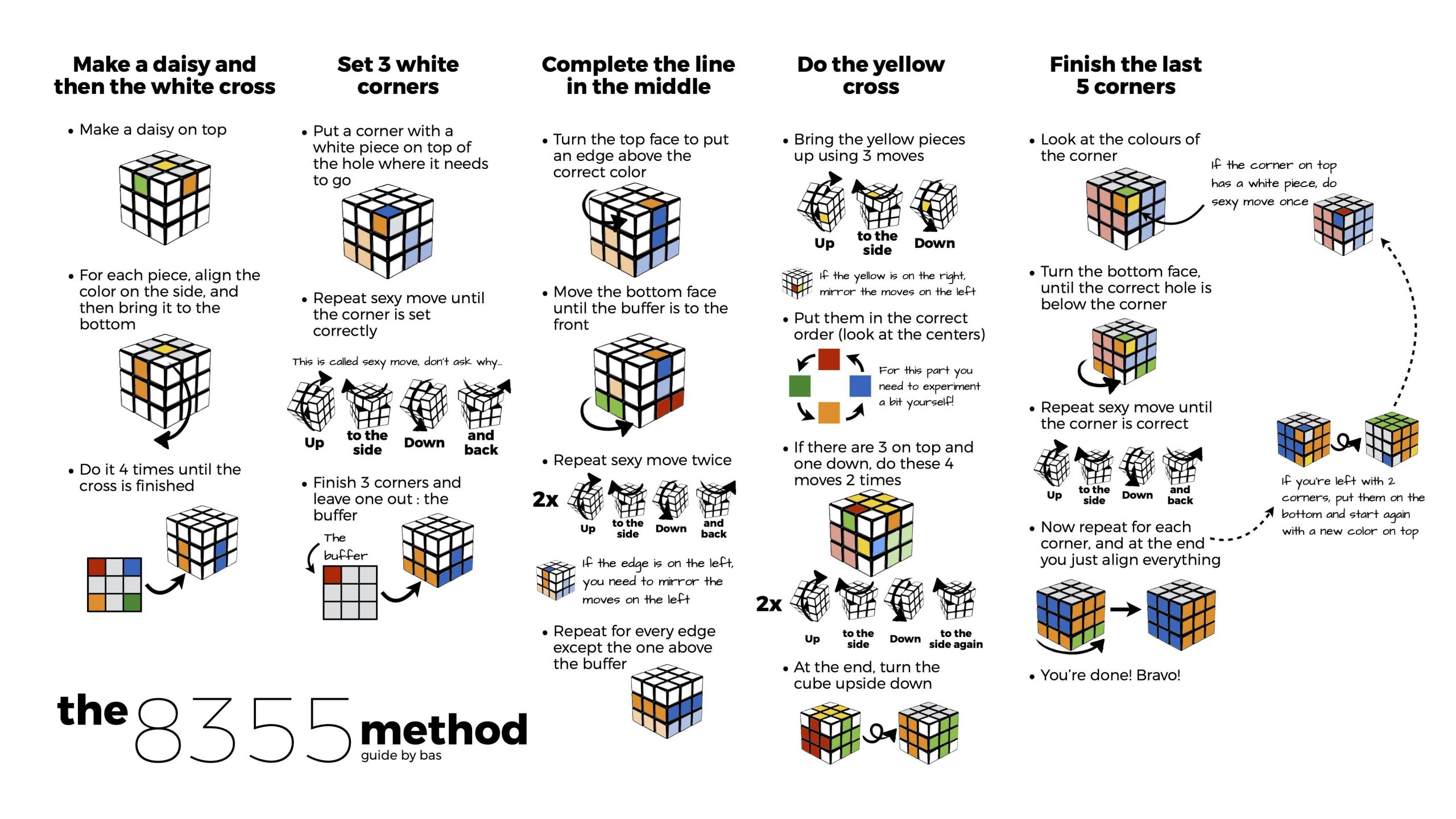
The Fundamental Misconception: Face-Based vs. Layer-Based Logic
The single most pervasive error that halts progress before it begins is a fundamental misunderstanding of the cube's geometry. Beginners intuitively approach the puzzle with a "face-first" mentality, attempting to complete one solid color surface—typically the white face—before considering the rest of the structure. This approach is mathematically doomed to fail in the standard Layer-by-Layer (LBL) method.
The Trap of Completing a Single Face
When a novice focuses solely on making the bottom face a uniform color, they invariably ignore the side stickers of the edge and corner pieces. In the Rubik's Cube mechanism, every piece belongs to a specific intersection of three faces (corners) or two faces (edges). Placing a white-blue edge piece on the white face without aligning the blue sticker with the blue center creates a structural conflict that cannot be resolved later without dismantling the work already done.
In 2026, educational analytics from major cubing platforms indicate that 90% of abandoned solves stem from this initial phase. The solver reaches a point where the first layer looks complete visually but is logically broken, rendering subsequent algorithms ineffective. The correct paradigm requires solving in horizontal layers, where the "first layer" includes the bottom face and the corresponding band of side colors aligned with their respective centers.
The Immutable Nature of Center Pieces
A corollary to the face-based mistake is the failure to recognize the fixed nature of center pieces. On a standard 3×3 cube, the six center pieces are mechanically anchored to the core; they never change position relative to one another. They act as the coordinate system for the entire solve. If the center piece is blue, that entire face must eventually be blue.
Beginners often attempt to force colors to match a preconceived notion of where they "should" go, ignoring the reality dictated by the centers. For instance, if a solver places a red-green edge between the white and blue centers because they want the red and green faces adjacent there, they violate the cube's physical constraints. Mastery begins with accepting that centers define the color scheme, and all other pieces must orbit around these fixed anchors.
Hardware Limitations and the Ergonomics of Failure
In the modern era of cubing, specifically within the 2026 landscape, the equipment used plays a pivotal role in the learning curve. A significant portion of beginner frustration is misattributed to a lack of skill when the root cause is actually inferior hardware.
The Danger of Outdated or Low-Quality Cubes
Many beginners start their journey with "vintage" cubes from previous decades or inexpensive, non-magnetic replicas found in dollar stores. These mechanisms often suffer from high friction, frequent locking (where pieces jam during a turn), and poor corner-cutting capabilities. When a cube locks up, the solver is forced to use excessive force, which can lead to physical strain and a psychological association between cubing and difficulty.
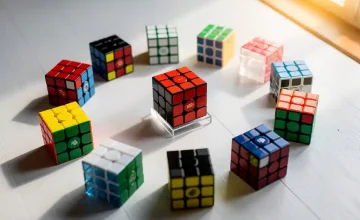
Research into beginner retention rates suggests that struggling against a stiff mechanism prevents the development of finger tricks—the subtle wrist and finger movements essential for fluid turning. If a solver must use their entire hand to execute a simple 90-degree turn, they cannot develop the muscle memory required for speed or even consistent accuracy. In 2026, the entry barrier has lowered significantly due to the availability of high-quality, budget-friendly magnetic speedcubes. Utilizing a modern cube with adjustable tension and magnetic positioning provides the tactile feedback necessary to feel when a piece is correctly aligned, drastically reducing insertion errors.
The Role of Magnetic Feedback in Error Prevention
Modern speedcubes utilize internal magnets to snap pieces into place at the end of a turn. This feature is not merely for speed; it is a critical diagnostic tool for beginners. When executing an algorithm like R U R' U', the magnetic resistance helps the solver feel the completion of the move. Without this feedback, beginners often under-rotate or over-rotate faces, leading to "broken" states where the cube appears unsolvable. Upgrading to a magnetic cube is widely considered the most effective immediate intervention for resolving persistent mechanical errors.
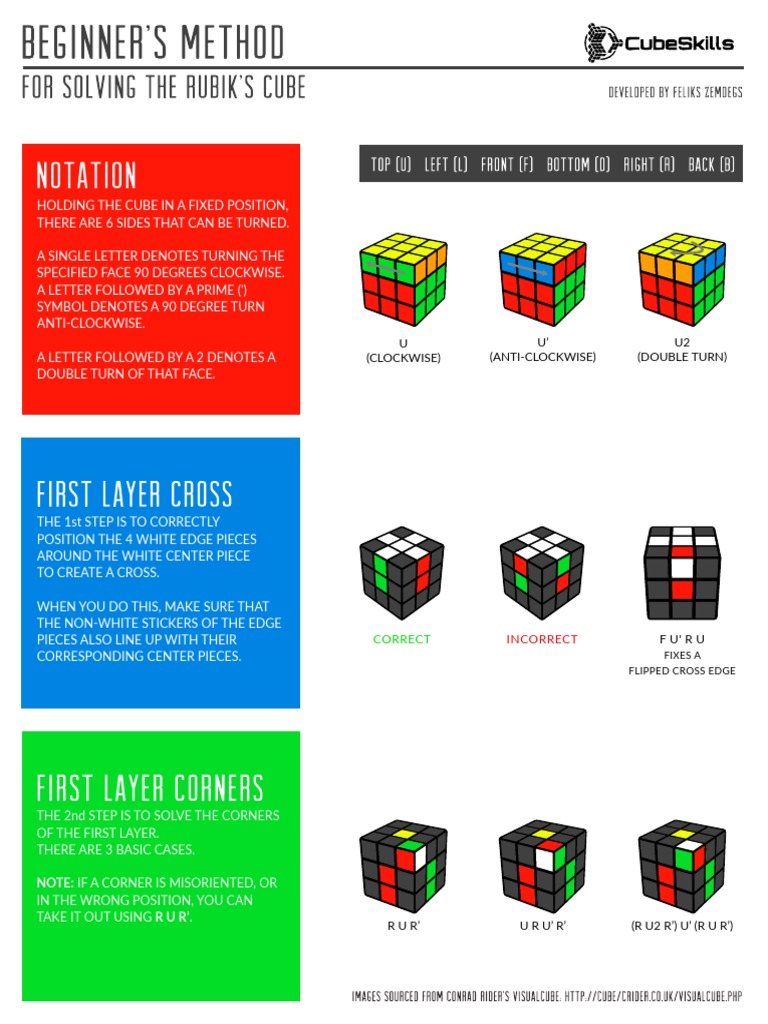
Algorithmic Pitfalls: Memorization Without Comprehension
Once the conceptual and hardware barriers are addressed, the next tier of errors lies in the execution of algorithms. The Beginner Method relies on a series of specific move sequences, or algorithms, to manipulate pieces without disturbing the solved portions of the cube. However, the way these algorithms are learned often leads to fragility in the solving process.
Rote Memorization vs. Pattern Recognition
A common trap is treating algorithms as arbitrary strings of letters (e.g., "Right, Up, Right-inverse, Up-inverse") rather than functional tools that move specific pieces. When a beginner memorizes an algorithm without understanding its effect on the cube's state, they lose the ability to troubleshoot. If they miss a single move or execute a turn in the wrong direction, the resulting configuration makes no sense to them, and they often resort to scrambling the cube and starting over.
Effective learning in 2026 emphasizes visualizing the piece trajectory. Instead of blindly following notation, solvers are encouraged to track the specific corner or edge being manipulated. For example, when inserting a white corner, the solver should watch how the R U R' U' sequence cycles the piece from the top layer down into the slot while preserving the white cross. This contextual understanding allows the solver to self-correct mid-algorithm if a mistake is noticed, rather than completing a broken sequence.
The "Restart" Reflex
Perhaps the most time-wasting habit among novices is the immediate impulse to scramble the cube upon encountering an unexpected state. When the last layer does not resolve as predicted, or a middle-layer edge seems stuck, the beginner often assumes the cube is "broken" or impossible. In reality, the vast majority of these "impossible" states are the result of a minor error several steps prior, such as a twisted corner or a misplaced edge in the first layer.
Developing a debugging mindset is crucial. Before resetting, the solver must inspect the cube layer by layer. Does the white cross match the side centers? Are the middle-layer edges free of yellow stickers? Is a corner twisted in its slot? Learning to diagnose and fix these local errors saves immense amounts of time and builds the confidence required to advance to intermediate methods like CFOP.
Step-by-Step Diagnostic: Where Solves Go Wrong
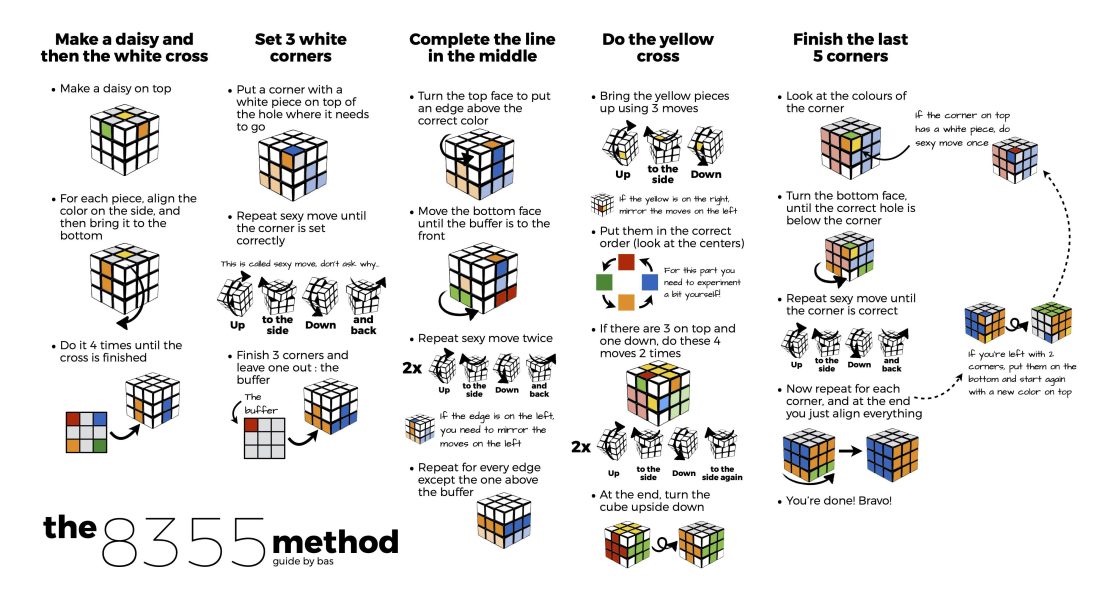
To provide actionable value, we must break down the specific failure points within the seven stages of the standard Beginner Method. Each stage has its own unique set of pitfalls that can derail the entire solve.
Stage 1 & 2: The White Cross and Corner Insertion
The foundation of the solve is the white cross. The primary error here is placing the white edge pieces on the white face without aligning their secondary color with the corresponding center. A white-red edge must sit between the white center and the red center. If it is placed between white and blue, the subsequent layers will be misaligned.
Furthermore, when inserting white corners, beginners often fail to check the orientation of the piece before insertion. If a corner is inserted with the white sticker facing the side rather than the bottom, it creates a "twisted" state that cannot be fixed with standard layer-building moves. The correct procedure involves positioning the corner above its target slot and using repetitive triggers until the white sticker faces down, ensuring all three colors of the corner match their adjacent centers.
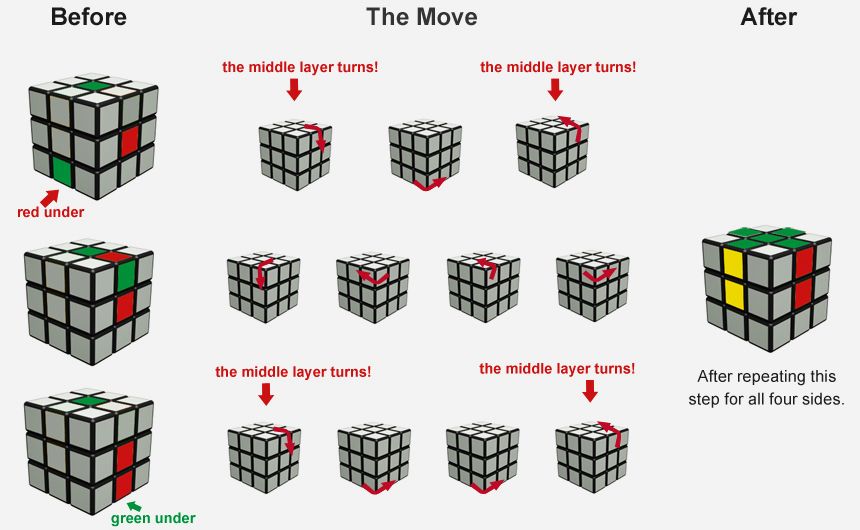
Stage 3: The Middle Layer Edge Placement
The transition to the middle layer introduces the first true algorithms. The most frequent mistake in this phase is attempting to insert an edge piece that contains a yellow sticker. In the standard color scheme where white is opposite yellow, the middle layer should never contain yellow. If a solver tries to force a yellow-containing edge into the middle slot, they will inevitably break the completed first layer.
The diagnostic rule is simple: inspect the top layer edges. Only edges without yellow stickers belong in the middle layer. If all remaining edges have yellow, the solver must perform an algorithm to eject a non-yellow edge from the middle layer back to the top, creating a valid candidate for insertion.
Stage 4, 5, & 6: Last Layer Orientation and Permutation
The final stages involve orienting the yellow cross, positioning the yellow edges, and finally solving the yellow corners. Confusion often arises here regarding the distinction between orientation (twisting a piece so the correct color faces up) and permutation (moving a piece to the correct slot).
Beginners frequently attempt to permute corners before they are oriented, or vice versa, leading to chaotic states. Additionally, a specific error occurs when applying the "Sune" or similar algorithms: failing to hold the cube with the correct reference piece in the front-right position. Algorithms are relative; holding the cube incorrectly results in the algorithm performing a different, often destructive, permutation.
Another critical issue is the "Parity Illusion." Beginners often encounter a state where two corners appear swapped or a single edge appears flipped. On a standard 3×3 cube, a single flipped edge or a single swapped pair is physically impossible to achieve through legal moves. This state almost always indicates that a corner was twisted manually earlier in the solve, or an edge was popped out and reinserted incorrectly. Recognizing this impossibility is a key debugging skill: if the cube looks impossible, check for a twisted corner in the lower layers.
Strategic Practice: Moving Beyond Mindless Repetition
Even with the right cube and knowledge of common errors, progress can stall if the practice methodology is flawed. In 2026, the consensus among expert coaches is that "mindless solving"—repeatedly scrambling and solving without specific intent—is the least efficient way to improve.
The Importance of Deliberate Practice
Effective practice requires goal-oriented sessions. Instead of aiming simply to "solve the cube," a beginner should focus on isolating specific weaknesses. One session might be dedicated entirely to perfecting the white cross inspection, aiming to plan the entire cross before making the first move. Another session could focus exclusively on smooth execution of the middle-layer algorithms, prioritizing fluidity over speed.
This targeted approach allows the solver to identify exactly where time is lost or errors occur. By breaking the solve into micro-skills, the brain can build stronger neural pathways for each specific task, rather than relying on a fragile, holistic memory of the entire process.
Leveraging Inspection Time
In competitive contexts, solvers are granted 15 seconds of inspection time before the timer starts. While casual solvers do not have a formal timer, adopting the habit of pre-planning is transformative. Spending even ten seconds analyzing the scramble to locate the white cross pieces and plan their insertion can reduce the total solve time significantly. It shifts the cognitive load from "reacting" to "executing a plan," which reduces hesitation and the likelihood of mid-solve errors.
Drilling Algorithms for Muscle Memory
Algorithms should not be looked up every time they are needed. To achieve fluency, they must be drilled until they become muscle memory. This involves repeating specific sequences hundreds of times until the fingers can execute them without conscious thought. In 2026, many digital tools and apps allow for "algorithm trainer" modes that generate specific cases for repetition. Utilizing these tools ensures that when a specific last-layer case appears, the hands react instantly and accurately, eliminating the pause for mental recall that often leads to mistakes.
FAQ: Addressing Critical Beginner Concerns
Q: My cube looks unsolvable with two corners swapped. Did I break it?
A: No, you likely did not break the cube, but you have encountered a state that is impossible to reach through legal moves. This usually happens if a corner was twisted in its slot during an earlier step or if a piece was popped out and put back in the wrong orientation. To fix this, you must manually twist the corner back to its correct orientation or disassemble the edge/corner and reassemble it correctly. Once the physical orientation is corrected, the cube will be solvable again.
Q: Should I learn the Beginner Method or jump straight to CFOP (Fridrich Method)?
A: In 2026, the recommendation remains to master the Beginner Method first. Jumping straight to CFOP without understanding the underlying layer logic often leads to confusion and burnout. The Beginner Method builds the necessary intuition for piece tracking and algorithm execution. Once you can consistently solve the cube in under two minutes using the beginner approach, transitioning to CFOP will be much smoother and faster.
Q: Why does my cube keep getting stuck or locking up?
A: This is almost certainly a hardware issue. If you are using an old, non-magnetic, or cheap plastic cube, the internal mechanism likely lacks the tolerance for smooth turning. Modern magnetic speedcubes are designed to prevent locking by allowing pieces to "corner cut" smoothly. Investing in a quality cube (such as those from GAN, MoYu, or QiYi) is the most effective solution to mechanical sticking.
Q: How long does it take to learn to solve the cube?
A: With a structured approach and modern resources, most beginners can achieve their first successful solve within 2 to 4 hours of focused study. Reaching a consistent sub-minute solve time typically takes a few weeks of deliberate practice. The timeline depends heavily on avoiding the common mistakes outlined in this article, particularly the tendency to restart rather than debug.
Conclusion
Mastering the Rubik's Cube in 2026 is less about innate genius and more about navigating a minefield of common procedural errors. By shifting the mindset from "face-solving" to "layer-solving," investing in appropriate magnetic hardware, and approaching algorithms with a focus on piece tracking rather than rote memorization, beginners can bypass the frustrations that stop 90% of aspirants.
The path to a solved cube is paved with small, correctable mistakes. Whether it is a misaligned white cross edge, a twisted corner in the first layer, or a premature attempt to solve the last layer, each error offers a lesson in the cube's logic. By adopting a diagnostic approach—inspecting, identifying, and correcting rather than restarting—solvers transform their relationship with the puzzle. The Rubik's Cube remains a timeless challenge, but with the right strategies and an awareness of these pitfalls, the solution is accessible to everyone. Embrace the process, respect the mechanics, and enjoy the satisfying click of a perfectly solved cube.
References
- Cubzor Editorial Team — Beginner Method Mistakes and How to Fix Them, 2026
- SolvingRubiksCube.com — 7 Common Rubik's Cube Mistakes That Are Slowing You Down, 2026
- MD Shehad — How to Solve a Rubik's Cube: What Nobody Tells You, 2026
- Cubelelo India — 7 Common Mistakes to Avoid while Practicing Cubing, 2026
- Ruwix — How To Solve The Rubik's Cube – Beginners Method, 2026
- Speedcube.nl — 8 Mistakes Beginners Make When Solving a Rubik's Cube, 2026