The journey from a scrambled puzzle to a solved masterpiece begins not with dexterity, but with literacy. In the high-speed world of modern cubing, where world records hover just above three seconds, the ability to read and execute Rubik's Cube notation is the fundamental prerequisite for success. For new solvers entering the ecosystem in 2026, understanding this symbolic language is not merely an academic exercise; it is the key that unlocks thousands of algorithms, tutorials, and competitive strategies used by the global community. Without a mastery of notation, a solver is effectively illiterate in the universal dialect of speedcubing, unable to access the collective knowledge base that has propelled the hobby into a professional sport.
This comprehensive guide serves as the definitive resource for decoding the cryptic letters, apostrophes, and numbers that define cube movements. We will dissect the standardized system recognized by the World Cube Association (WCA), moving from the foundational six face turns to the complex slice moves and wide rotations required for advanced methods like CFOP and Roux. By internalizing these mechanics, new solvers transition from guessing moves to executing precise, muscle-memory-driven sequences. Whether you are aiming to solve your first 3×3 or preparing for your first competition, mastering cube move explanations is the critical first step toward efficiency and speed.
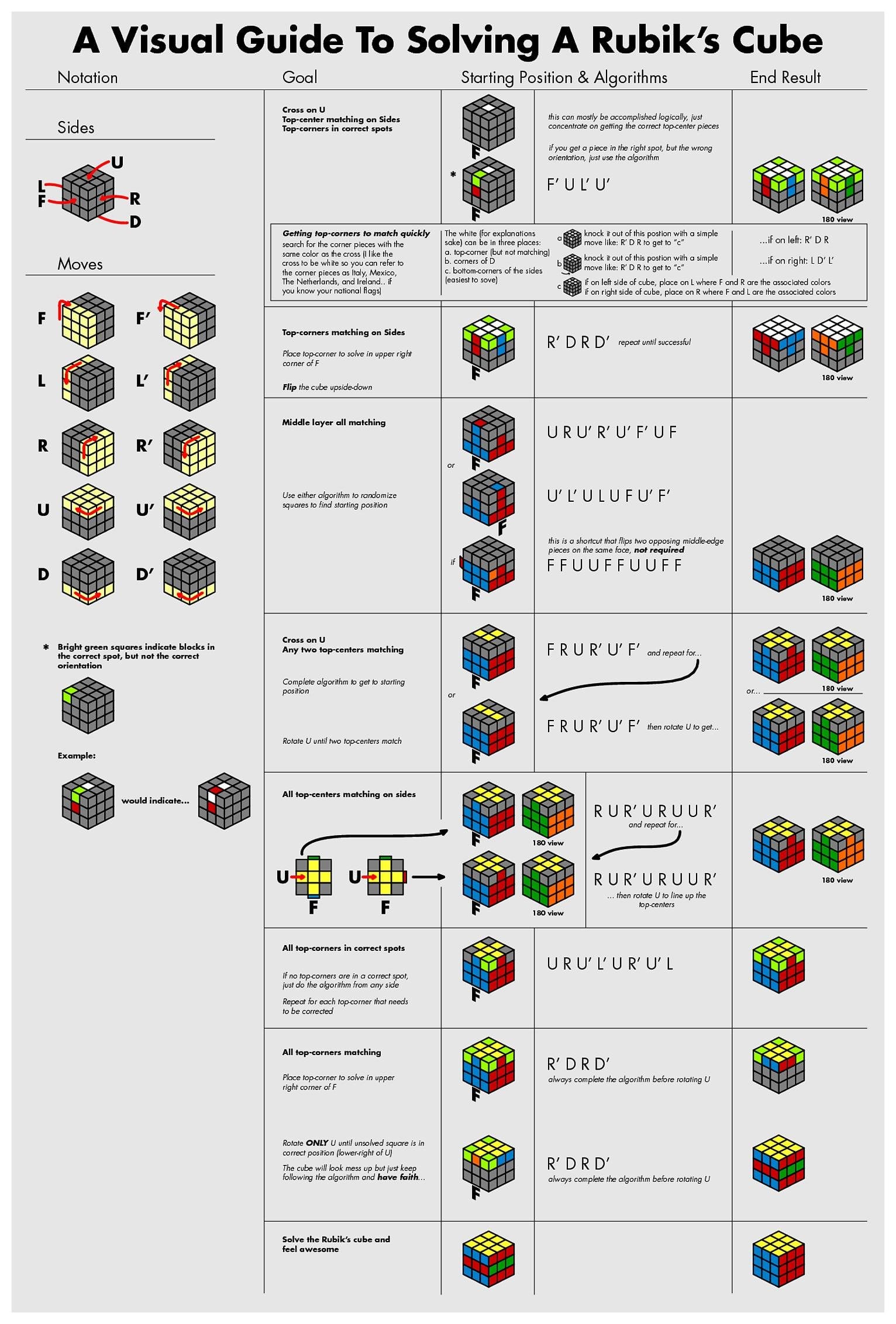
The Universal Language of Cubing: Why Notation Matters
Before diving into the specific mechanics of each turn, it is essential to understand the philosophical and practical necessity of Rubik's Cube notation. Imagine attempting to explain a fifty-move algorithm using only descriptive English sentences: "Turn the right side clockwise, then rotate the top layer to the left, followed by returning the right side to its original position." This method is not only verbose and prone to misinterpretation but also creates a significant barrier to entry for non-native speakers. The standardized notation system solves this by compressing complex physical actions into concise, language-agnostic symbols.
In 2026, the cubing community relies entirely on this compression to share knowledge instantly across borders. A solver in Tokyo can read an algorithm sheet published in Berlin and execute the exact same moves without confusion. This universality is why notation matters; it transforms solving from a localized trial-and-error process into a global, collaborative science. When we write R U R' U', we are utilizing a shorthand that replaces thirty words with four characters, allowing the human brain to recognize patterns rather than parse sentences. This efficiency is the backbone of modern speedcubing, enabling the rapid memorization of hundreds of algorithms required for methods like CFOP (Cross, F2L, OLL, PLL).
Furthermore, notation provides a permanent record of solutions. In competitive settings, scrambles are generated algorithmically and distributed as strings of notation. Judges and competitors alike rely on this standard to verify scrambles and reconstruct solves. For the new solver, learning this language is akin to learning musical notation; once the symbols are understood, the "music" of the cube can be played fluently. The system is designed to be intuitive relative to the solver's perspective, ensuring that the instructions remain consistent regardless of how the cube is oriented in space, provided the reference frame is established correctly.
Mastering the Six Fundamental Face Turns
At the heart of all cube manipulation lie the six basic face turns. These are the building blocks upon which every algorithm, from the simplest beginner method to the most advanced blindfolded technique, is constructed. Each face of the 3×3 Rubik's Cube is assigned a single uppercase letter based on its position relative to the solver. It is crucial to remember that these directions are relative, not absolute. If you rotate the entire cube, the "Right" face changes physically, but the notation "R" always refers to the face currently on your right.
The Primary Letters and Their Meanings
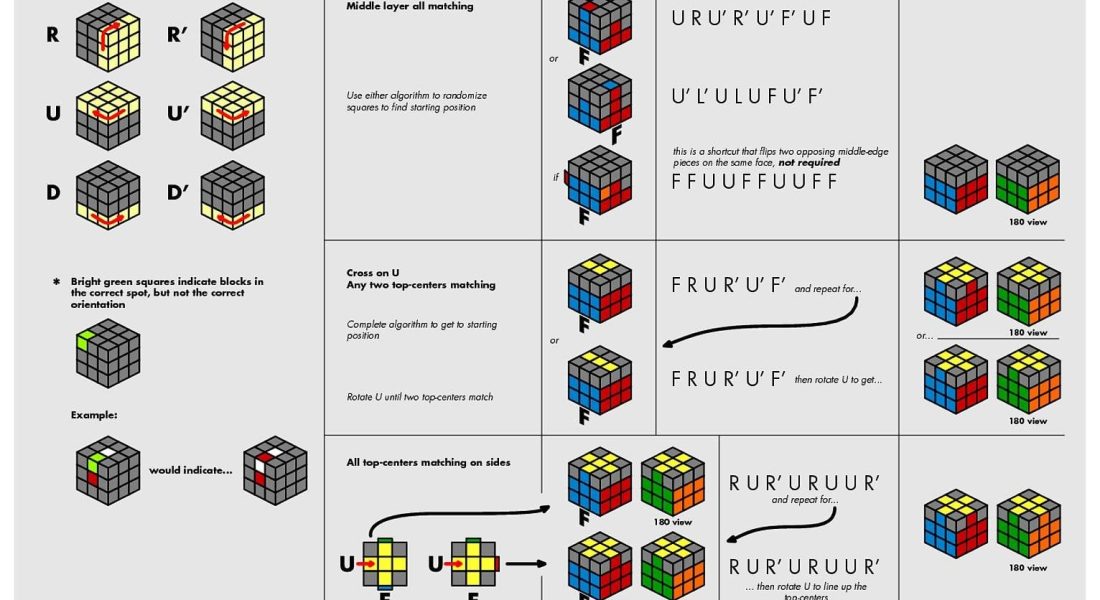
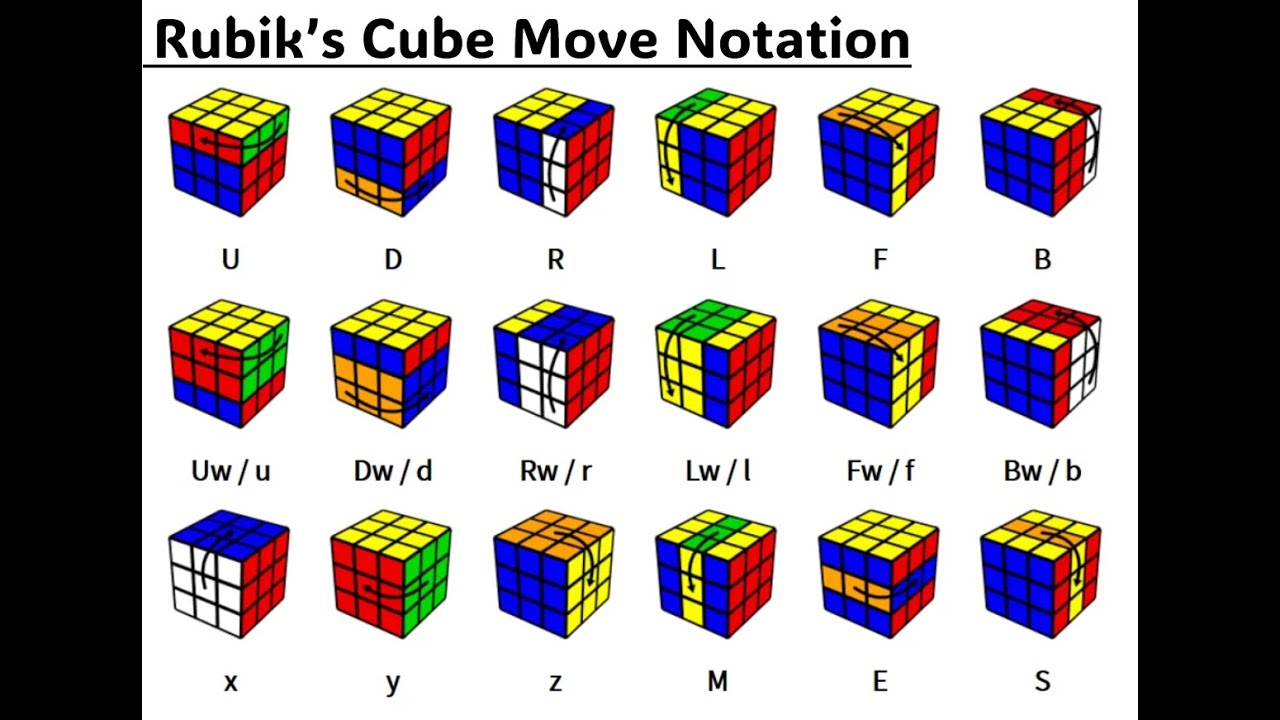
The standard notation assigns the following letters to the six faces:
- R (Right): The face on the right-hand side of the cube.
- L (Left): The face on the left-hand side of the cube.
- U (Up): The top face of the cube.
- D (Down): The bottom face of the cube.
- F (Front): The face directly facing the solver.
- B (Back): The face opposite the Front, located at the rear of the cube.
When a solver encounters a standalone letter, such as R, it instructs them to turn that specific face 90 degrees clockwise. This direction is determined by looking directly at the face in question. For example, an R move requires the solver to look at the Right face and turn it clockwise. Conversely, a B move requires looking at the Back face and turning it clockwise, which, from the solver's front-facing perspective, appears to be a counter-clockwise motion. This perspective-based rule is the most common source of error for beginners and must be rigorously practiced until it becomes instinctual.
The Logic of Relative Orientation
The concept of relative orientation cannot be overstated. In the early stages of learning Rubik's Cube notation and move explanations, new solvers often struggle with the B (Back) and L (Left) moves because they require mental rotation. When executing a B move, one must imagine standing behind the cube or simply visualize the back face rotating clockwise from that vantage point. Similarly, the L move turns the left face clockwise when viewed from the left side.
To aid in retention, many experts suggest a mnemonic device: always turn the face as if you are tightening a screw on that specific side. If you were holding a screwdriver against the center cap of the Right face, a clockwise turn would tighten it. This physical analogy helps bridge the gap between abstract notation and tactile execution. As solvers progress, this mental visualization fades, replaced by pure muscle memory where the hands react to the symbol before the conscious mind processes the direction.
Modifiers and Variations: Primes, Doubles, and Direction
While the six base letters define which face to turn, modifiers define how to turn it. These small additions to the notation drastically alter the outcome of an algorithm. Understanding these modifiers is essential for reading any tutorial or algorithm sheet accurately. In the context of 2026 speedcubing, precision in these modifiers distinguishes a sub-20-second solver from a sub-10-second competitor.
The Prime Symbol (')
The apostrophe, universally referred to as "prime" in the cubing community, indicates a counter-clockwise turn. When placed after a letter (e.g., R', U', F'), it reverses the direction of the standard move. Therefore, R' means turning the Right face 90 degrees counter-clockwise.
It is vital to pronounce this correctly during practice. Saying "R prime" instead of "R apostrophe" aligns the solver with the global community's terminology. The prime modifier is ubiquitous in algorithms; for instance, the famous "Sune" algorithm is written as R U R' U R U2 R'. Notice the interplay between R and R'; the sequence relies on the cancellation and re-establishment of piece positions through opposing turns. Mastery of the prime move is often the first hurdle for new solvers, as the muscle memory for clockwise turns is naturally stronger. Deliberate practice of prime moves in isolation can significantly accelerate fluency.
The Double Turn (2)
The number 2 following a letter denotes a 180-degree turn, or two quarter-turns. For example, U2 means turning the Up face 180 degrees. A unique characteristic of the double turn is that the direction technically does not matter; turning the face 180 degrees clockwise yields the same result as turning it 180 degrees counter-clockwise. However, in the realm of finger tricks and advanced speedcubing, the direction of a U2 can be specified (e.g., U2 vs. U2') to optimize hand flow and reduce regrips.
For the new solver, the distinction in direction for double turns is negligible. The primary focus should be on executing the half-turn smoothly and quickly. In many beginner algorithms, U2 appears frequently to reorient the cube's layers without disturbing the permutation of other pieces excessively. Recognizing the 2 modifier allows the solver to anticipate a larger, more forceful movement compared to the delicate quarter-turns.
Combining Modifiers
While rare in standard 3×3 algorithms, one might theoretically encounter combinations in specific contexts or larger cubes, though typically, a move is either normal, prime, or double. The clarity of this system ensures that there is no ambiguity: R is 90° clockwise, R' is 90° counter-clockwise, and R2 is 180°. This triad of possibilities for every face forms the complete vocabulary of basic cube manipulation.
Advanced Mechanics: Wide Moves, Slices, and Rotations
As solvers progress beyond the beginner layer-by-layer method, they encounter more sophisticated notation required for advanced techniques and larger cubes (4×4, 5×5, and beyond). These moves involve turning multiple layers simultaneously or manipulating the internal slices of the cube. In 2026, proficiency in these advanced notations is expected for anyone attempting to break into intermediate solving times.
Wide Moves: Turning Two Layers
Wide moves, also known as block turns, involve rotating two layers at once instead of just the outer face. There are two accepted conventions for denoting these moves in modern notation:
- Lowercase Letters: Using lowercase versions of the face letters (e.g., r, l, u, d, f, b). For instance, r means turning the Right face and the middle layer adjacent to it together in a clockwise direction.
- The 'w' Suffix: Adding a 'w' to the uppercase letter (e.g., Rw, Lw, Uw). Thus, Rw is identical to r.
It is important to note a common visual pitfall: the lowercase l can sometimes be mistaken for an uppercase I or the number 1. However, in standard cube notation, I is not a valid move. The w suffix notation is often preferred in formal WCA regulations and digital timers to avoid font-related ambiguities. Wide moves are indispensable for methods like Roux and for solving parity cases on even-layered cubes (4×4, 6×6). They allow for more efficient piece insertion and reduce the total move count of an algorithm.
Slice Moves: The Inner Layers
Slice moves target only the middle layers of the cube, leaving the outer faces stationary. These are denoted by the letters M, E, and S, each corresponding to a specific axis:
- M (Middle): The layer between the L and R faces. The M move follows the direction of the L face (clockwise relative to the Left face). A helpful mnemonic is that M is closer to L in the alphabet than R.
- E (Equator): The layer between the U and D faces. The E move follows the direction of the D face (clockwise relative to the Down face). Remember: E is closer to D (if considering phonetic or positional logic in some systems, but strictly defined as following D).
- S (Standing): The layer between the F and B faces. The S move follows the direction of the F face (clockwise relative to the Front face).
Like face turns, slice moves can be modified with primes (M', E', S') and doubles (M2, E2, S2). These moves are rarely used in the basic beginner method but are critical for advanced F2L cases, OLL parity algorithms, and specific last-layer techniques. They allow solvers to manipulate edge pieces without disrupting the corners, offering a level of surgical precision required for high-level solving.
Cube Rotations: Changing Perspective
Sometimes, the most efficient way to execute an algorithm is to rotate the entire cube rather than turning individual faces. Cube rotations are denoted by the axes x, y, and z:
- x-axis: Rotates the entire cube in the direction of the R face. Think of tilting the cube forward so the Front becomes the Top.
- y-axis: Rotates the entire cube in the direction of the U face. This is a horizontal spin, keeping the Top face on top but changing which side is Front.
- z-axis: Rotates the entire cube in the direction of the F face. This spins the cube like a wheel, keeping the Front face pointing at you but rotating the Top to the Right.
These rotations can also have primes (x', y', z') and doubles (x2, y2, z2). While beginners are often taught to minimize cube rotations to maintain orientation awareness, advanced solvers utilize them extensively to facilitate better finger trick ergonomics. Recognizing when a y rotation is more efficient than a series of U and D moves is a hallmark of an experienced cuber.
From Notation to Execution: Algorithms and Muscle Memory
Understanding the symbols is only half the battle; the true goal is translating Rubik's Cube notation into fluid, rapid physical execution. An algorithm is simply a sequence of these notated moves designed to achieve a specific result, such as orienting the last layer or permuting corners. For new solvers, the transition from reading R U R' U' to performing it effortlessly involves a cognitive shift from analytical processing to motor automation.
Reading Algorithms Efficiently
Algorithms are read from left to right, with spaces often inserted purely for readability and grouping. For example, the T-Perm algorithm is written as:
R U R' U' R' F R2 U' R' U' R U R' F'
A novice might read this as twelve separate instructions. An expert sees it as three distinct "triggers" or blocks: (R U R' U'), (R' F R2), and (U' R' U' R U R' F'). Breaking algorithms down into these recognizable chunks accelerates memorization and execution. In 2026, training tools and apps often highlight these triggers visually to help new solvers develop this pattern recognition skill early.
The Role of Finger Tricks
Notation tells you what to do, but finger tricks determine how fast you can do it. While not part of the written notation itself, the notation implies certain ergonomic flows. For instance, a sequence like R U R' U' is almost exclusively performed using the index fingers for U moves and the thumb/ring finger for R moves, allowing for a continuous, regrip-free motion.
New solvers should analyze the notation of their chosen algorithms to identify opportunities for finger tricks. If an algorithm requires a U2, deciding whether to push with one finger, pull with the other, or perform a double flick can save precious milliseconds. The notation provides the map, but finger tricks provide the vehicle for speed. Practicing algorithms slowly with perfect finger technique is far more beneficial than rushing through them with inefficient wrist movements.
Building Muscle Memory
The ultimate objective of learning move explanations is to reach a state where the notation disappears from conscious thought. Through repetition, the neural pathways associated with specific sequences strengthen. Eventually, seeing R U R' U' triggers the hand movement directly, bypassing the linguistic center of the brain. This phenomenon, known as muscle memory, is what allows speedcubers to solve the cube while listening to music or engaging in conversation.
To build this effectively, new solvers should practice algorithms in varied contexts. Execute them on a solved cube to see the effect, on a scrambled cube to integrate them into a solve, and even mentally visualize them without a cube. The consistency of the notation system ensures that this practice is transferable across different cubes and environments.
Common Pitfalls and Expert Tips for Beginners
Even with a clear guide, new solvers often stumble over specific aspects of Rubik's Cube notation. Identifying these common pitfalls early can prevent frustration and bad habits.
The "Back Face" Confusion
The most frequent error involves the B (Back) move. Because the solver is looking at the Front, turning the Back face clockwise (from the Back's perspective) looks like a counter-clockwise turn from the Front.
- Tip: Always physically rotate the cube to face the Back side when learning B moves, or rigorously visualize the arrow of rotation from behind the cube. Do not guess based on what looks natural from the front.
Lowercase vs. Uppercase Ambiguity
Confusing l (lowercase L) with I or 1 can lead to catastrophic errors in algorithms, especially on larger cubes.
- Tip: Adopt the w suffix convention (e.g., Lw) in your personal notes if handwriting causes confusion. In digital formats, ensure the font clearly distinguishes between lowercase L and uppercase I.
Ignoring Cube Orientation
Beginners often forget that R, L, U, etc., are relative. If they rotate the cube to inspect a piece but forget to update their mental map, they will execute the wrong move.
- Tip: Establish a strict color scheme (e.g., White on Top, Green on Front) and stick to it during practice. Only introduce cube rotations (x, y, z) once the static orientation is mastered.
Overlooking the Prime
Missing a tiny apostrophe can ruin an entire algorithm.
- Tip: When writing down algorithms, make the prime symbol large and distinct. When reading, verbally say "Prime" out loud to reinforce the direction change in your brain.
Frequently Asked Questions (FAQ)
Q: Is Rubik's Cube notation the same for 2×2 and 4×4 cubes?
A: Yes, the core notation (R, L, U, D, F, B) remains identical for the 2×2, 3×3, and the outer layers of larger cubes. However, larger cubes (4×4+) introduce wide moves (r, l, u, d, f, b) and inner slice moves more frequently, as the 3×3 does not have distinct inner slices to turn independently in the same way. The 2×2 simply lacks the center and edge pieces, but the face turn notation applies to the corner layers identically.
Q: How long does it take to memorize all the notation?
A: Most new solvers can grasp the basic six letters and the prime/double modifiers within 30 to 60 minutes of focused study. Mastery, where reading complex algorithms feels as natural as reading text, typically takes 2 to 4 weeks of regular practice. The key is consistent application rather than rote memorization.
Q: Can I create my own notation?
A: While you can for personal use, it is highly discouraged if you intend to learn from existing resources or compete. The World Cube Association (WCA) standard is universal. Deviating from it isolates you from the vast library of global tutorials, algorithms, and community support. Stick to the standard to maximize your learning potential.
Q: What is the difference between M and E slice moves?
A: The M move rotates the vertical middle layer between Left and Right, following the direction of the Left face. The E move rotates the horizontal middle layer between Up and Down, following the direction of the Down face. They operate on perpendicular axes and affect different sets of edge pieces.
Q: Do I need to know slice moves to solve a 3×3?
A: Strictly speaking, no. The standard Beginner Method and even the intermediate CFOP method can be executed entirely with face turns (R, L, U, D, F, B) and cube rotations. However, learning slice moves (M, E, S) is highly recommended for optimizing specific steps, reducing move counts, and preparing for advanced methods or larger cubes.
Conclusion
Mastering Rubik's Cube notation and move explanations is the gateway to unlocking the full potential of this iconic puzzle. In 2026, as the sport continues to evolve with faster hardware and more refined techniques, the importance of a solid foundation in this universal language remains unchanged. By understanding the six basic faces, the modifiers that alter their direction, and the advanced mechanics of slices and rotations, new solvers equip themselves with the tools necessary to tackle any algorithm.
The journey from confusion to fluency is a rite of passage for every cuber. It transforms the cube from a chaotic tangle of colors into a structured grid of logical possibilities. As you practice, remember that every R, U, and F' is a step toward greater speed and understanding. Embrace the notation, refine your finger tricks, and let the universal language of the cube guide you to your next personal best. The cube awaits your command; speak its language fluently, and the solution will follow.
References
- J Perm — Rubik's Cube Move Notation and Advanced CFOP Techniques, 2026
- LearnCube.org — Rubik's Cube Notation Made Easy: A Complete Beginner's Guide, 2026
- Cube Solver — Rubik's Cube Notation Guide: Master Cube Moves & Algorithms, June 2026
- Cube.Academy — Cube Notation: Master Cube Moves and 3×3 Algorithms, 2026
- Cubzor — Beginner's Guide: How to Solve a Rubik's Cube with Interactive Tutorials, May 2026
- SolvingRubiksCube.com — Cube Notation Guide: Understanding R, U, F, Primes & Wide Moves, 2026
- Speedsolving.com Wiki — NxNxN Notation Standards and Community Guidelines, 2026
- Cube Quest — How to Read Rubik's Cube Notation: R, U, F, Primes & Wide Moves, 2026