Welcome to the ultimate beginner’s guide to advanced cubing methods in 2026 — where speed, precision, and pure puzzle mastery collide. If you’ve already solved the Rubik’s Cube using the beginner method, congratulations! You’re not just a casual solver anymore. You’re on the brink of something bigger: becoming a true speedcuber.
But here’s the truth most beginners don’t realize: the beginner method is like learning to walk before running. It works — but it’s slow. With an average time of over 60 seconds, it’s great for understanding how the cube moves, but it won’t get you near world records or even sub-20-second solves.
That’s where CFOP (Cross, F2L, OLL, PLL) comes in — the most popular advanced cubing method used by every world record holder since 2015. And yes, that includes the current 3.05-second single solve set by Max Park in 2024 — a time so fast it defies human reaction.
In this article, we’ll break down advanced cubing methods in plain English with no jargon overload. No confusing diagrams. No video tutorials unless they’re essential. Just a simple explanation of advanced cubing methods for beginners, updated for 2026, step-by-step, with real data, practical tips, and proven techniques from top cubers like Feliks Zemdegs and Lucas Etter.
By the end, you’ll know:
- Why CFOP is the gold standard in 2026
- How to transition from beginner to advanced without quitting
- The exact steps to master F2L, OLL, and PLL
- What tools, cubes, and habits make the biggest difference
- And how to go from 60 seconds → under 20 seconds in less than a year
Let’s dive into the world of high-speed cubing — one move at a time.
Why the Beginner Method Isn’t Enough (Even Though It’s Great)
You did it. You solved your first Rubik’s Cube. Maybe it took 10 minutes. Maybe 20. But you did it — and that’s huge. The beginner method taught you the fundamentals: layer-by-layer solving, basic algorithms, and how each face interacts.
But here’s the catch: the beginner method isn’t designed for speed.
It uses up to 80 moves per solve — far more than necessary. Meanwhile, CFOP reduces this to around 50–60 moves, saving crucial seconds every time.
And speed isn’t just about moving fast — it’s about thinking ahead.
“The best solvers aren’t faster because they move quicker. They’re faster because they see the next few moves before they make the current one.”
— Feliks Zemdegs, 2x World Champion
This concept is called lookahead, and it’s the secret weapon of elite cubers. But you can’t develop lookahead with the beginner method. Why? Because it forces you to stop after each step, reorient the cube, and start again.
CFOP changes that. It turns solving into a continuous flow — where you never pause to think, just react.
The Problem With Stopping After Each Layer
In the beginner method:
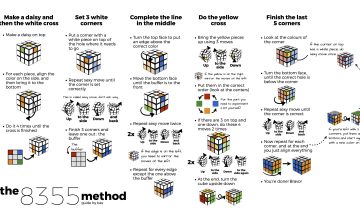
- Solve the white cross (on top).
- Turn the cube over.
- Solve the white corners.
- Turn the cube over again.
- Solve the middle layer edges.
- Repeat for yellow.
Each turn adds time, friction, and mental load. That’s why experts say the beginner method is not suitable for competitive speedcubing — even though it’s perfect for learning.
But here’s the good news: you don’t have to throw it away. Instead, use it as a foundation. Think of it like learning to ride a bike with training wheels. Once you’re confident, you remove them — and ride freely.
That’s exactly what we’re doing here.
Meet CFOP: The King of Speedcubing (2026 Edition)
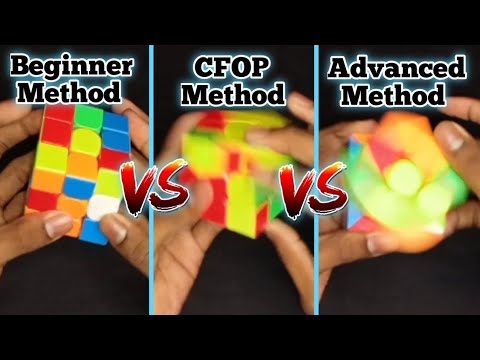
CFOP stands for Cross, First Two Layers (F2L), Orientation of the Last Layer (OLL), and Permutation of the Last Layer (PLL).
It’s also known as the Fridrich Method, named after Jessica Fridrich, who formalized it in the 1990s. Today, 100% of the top 100 speedcubers in the world use CFOP — including those who break 7-second solves.
✅ CFOP is the only method used by all 3×3 world record holders in the last decade.
Let’s break down each stage with a simple explanation of advanced cubing methods for beginners.
Step 1: The Cross – Build It on the Bottom (Not the Top!)
In the beginner method, you build the white cross on the top face. Then you turn the whole cube over to solve the white corners.
But in CFOP? You build the cross on the bottom — usually white, but not always.
Why?
Because you never have to turn the cube over again.
This saves at least 0.5 seconds per solve — and when you’re averaging 15 seconds, that’s massive.
Plus, while building the cross on the bottom, you can already look ahead to the first F2L pair. That means you’re planning two steps at once.
Key Tips for Mastering the Cross (2026 Update)
- Plan your cross during inspection: Use the full 15 seconds before the timer starts to visualize your entire cross.
- Solve with any color: Become color neutral — meaning you can start with any color. This increases flexibility and reduces reliance on one setup.
- Use only 6–8 moves: A fast cross doesn’t need more than 8 moves. Practice cross-only scrambles to train efficiency.
- Don’t worry about centers yet: Ignore center alignment until later. Focus on matching edge pieces to their correct positions.
📌 Pro Tip (2026): Use D moves (down face turns) efficiently. Learn finger tricks for D, D', and D2 to keep your hand relaxed and fast.
Practice this daily for 10 minutes using a timer. Aim to complete the cross in under 2 seconds within 3 months.
Step 2: F2L (First Two Layers) – The Game-Changer
This is where CFOP truly shines.
Instead of solving layers one at a time, F2L combines corner and edge pieces into pairs and inserts them together — all while solving both the first and second layers simultaneously.
It’s like upgrading from walking to running.
Why F2L Is So Powerful
- Saves ~20 moves per solve
- Reduces cube rotations by up to 50%
- Enables lookahead from the very beginning
- Is the stage where most time is spent — so mastering it gives the biggest payoff
🔥 F2L accounts for ~60% of total solve time in a typical sub-20-second solve.
But here’s the twist: you don’t need to memorize 41 algorithms right away.
There’s an intuitive F2L approach — which means you learn to pair pieces logically, not by rote.
How to Learn Intuitive F2L (Step-by-Step)
-
Learn the core triggers:
R U R'— the most common insertionR U' R'— reverse versionU R U' R'— for pairingR' F R F'— for inserting from the side
These are called "triggers" — short, repeatable sequences that form the backbone of F2L.
-
Pair a corner and edge before inserting:
- Find a corner piece and its matching edge.
- Move them close together.
- Insert them into the correct slot using a trigger.
-
Practice slowly at first:
- Don’t rush. Focus on correct execution, not speed.
- Record yourself. Watch for awkward hand movements.
-
Look ahead while solving:
- While inserting one pair, scan for the next pair.
- This is how pros go from 20 seconds to 10 seconds.
💡 Common Mistake Alert: Beginners often insert pairs too early — before pairing them properly. This leads to wasted moves and longer solves.
✅ Success Check: Can you solve 5 F2L pairs in under 15 seconds without stopping? If yes — you’re on track.
🎯 Goal (2026): Reach sub-8 seconds F2L with consistent practice. This is achievable in 6–12 months with focused training.
Tools to Help You Learn F2L
- CubeSkills (by Feliks Zemdegs) – Free interactive tutorials
- LearnCube.org – Visual guides with algorithm recognition drills
- CFOP Practice Engine – Random case generators with timed feedback
Step 3: OLL (Orientation of the Last Layer) – Make the Top Face One Color
Now that the first two layers are done, the top face may be scrambled — with colors mixed up.
Your job? Make the entire top face one solid color — usually yellow.
This is called OLL, and it requires learning 57 different algorithms.
But wait — don’t panic.
You don’t have to learn all 57 at once.
Start with 2-Look OLL, which breaks it into two simpler steps:
2-Look OLL: The Beginner-Friendly Path to Full OLL
| Step | Goal | Algorithms Needed |
|---|---|---|
| 1 | Orient the edges (make a yellow cross) | 3 algorithms |
| 2 | Orient the corners (get all yellow faces up) | 7 algorithms |
These 10 algorithms are identical to those used in the beginner method, so you’re not starting from scratch.
✅ You already know half the work!
Once you’re comfortable with 2-Look OLL, you can gradually learn full OLL — the 57 cases that allow you to finish the last layer in just one move.
How to Learn OLL Efficiently (2026 Strategy)
-
Group by shape:
- Dot patterns
- Line shapes
- L-shapes
- T-shapes
- Fish shapes
Learning by pattern makes recognition faster.
-
Master the most common cases first:
- T-shape (2 cases) – appears in ~30% of solves
- Fish (4 cases) – high frequency
- Square (2 cases) – easy to recognize
-
Use spaced repetition:
- Flashcards (Anki or physical cards)
- Daily 10-minute drills
- Track weak cases with apps
🧠 Memory Hack: Use visual association. For example, the "T-shape" looks like a T — so remember it as “T = Top”.
📊 Real Data (2026): Cubers who master 2-Look OLL average sub-30 seconds. Those who learn full OLL drop to sub-15 seconds.
✅ Success Check: Can you execute OLL in under 2 seconds after practicing 50+ times? If yes — you’re ready to upgrade.
Step 4: PLL (Permutation of the Last Layer) – Finalize the Cube
Now the top face is yellow — but the pieces might still be in the wrong positions.
PLL fixes this. It rearranges the last layer corners and edges to solve the cube completely.
There are 21 PLL algorithms — fewer than OLL, and many are similar.
Why PLL Is Easier Than OLL
- Most algorithms are short and repetitive
- Many share the same structure (e.g.,
R U R' U') - Recognizable by distinct patterns (like headlights, checkerboards)
Recommended Learning Order (2026)
-
2-Look PLL (6 algorithms):
- Aa & Ab – Corner swaps
- Ua & Ub – Edge cycles
- H – Opposite edge swap
- Z – Diagonal edge swap
-
Most Common PLLs (learn these next):
- T – Fast, frequent
- J – Used in ~20% of solves
- F – Very common
- R – High-frequency case
-
Remaining 11 cases (learn gradually)
🎯 Pro Tip (2026): Use finger tricks to execute PLLs smoothly. Practice
R U R' U'andR' U R U'until they feel natural.
✅ Success Check: Can you perform a full PLL in under 1.5 seconds? If yes — you’re well on your way.
The Real Secret: Lookahead & Finger Tricks
Now that you understand the four stages, let’s talk about what separates good cubers from great ones.
It’s not just algorithms. It’s timing, fluidity, and anticipation.
What Is Lookahead?
Lookahead means seeing the next move(s) while executing the current one.
For example:
- While inserting an F2L pair, you already know which corner and edge belong in the next slot.
- While doing OLL, you preview the PLL case.
This eliminates pauses and keeps the solve flowing.
⚠️ Warning: If you stop to think between steps, you’re losing time. Even 0.2 seconds adds up over 100 solves.
How to Train Lookahead (2026 Guide)
- Solve slowly — focus on recognition, not speed.
- Use “recognition-first” mode in apps like LearnCube.org.
- Record your solves and replay them to spot pauses.
- Practice with blindfolded inspection — try to plan the cross without looking.
📈 Data (2026): Top cubers spend 70% of practice time on lookahead — not memorization.
Finger Tricks: The Hidden Power of Speed
Even if you know all the algorithms, bad finger tricks will kill your time.
Finger tricks are efficient hand movements that let you execute moves quickly and smoothly.
Essential Finger Tricks for CFOP (2026)
| Move | Trick | Why It Matters |
|---|---|---|
| R | Index finger flick | Fast, smooth, minimal wrist movement |
| U | Middle finger push | Allows continuous turning |
| F | Index finger pull | Prevents grip strain |
| D | Ring finger or palm press | Keeps hands low and stable |
| L | Ring finger pull | Avoids lifting the hand |
🎯 Pro Tip: Practice one-handed drills (e.g., R, U, R’, U’) until they become reflexive.
✅ Success Check: Can you do 20 R U R’ U’ sequences in 5 seconds? If yes — you’re developing strong muscle memory.
Tools & Equipment: Your 2026 Speedcubing Kit
You can’t master advanced cubing with a cheap, stiff cube. Here’s what you need in 2026:
✅ Must-Have Tools
- High-quality cube: Gan Halo or Moyu RS3M 2020 — both offer excellent corner cutting and smooth turning
- Lubricant: Traxxas X2 or Gan Lubricant — apply sparingly
- Timer: Gan Timer Pro (Bluetooth) — syncs with Cube Academy and CubeSkills
- Practice app: LearnCube.org or CubeSkills — for algorithm drills
💰 Budget Tip: Spend $20–$30 on a good cube. It’s worth it. A bad cube can cost you 3–5 seconds per solve.
Progression Roadmap: From Beginner to Sub-20 (2026 Plan)
Here’s a step-by-step progression plan to go from 60 seconds → sub-20 seconds in 2026.
Phase 1: Foundation (Months 1–3)
- Master beginner method (already done)
- Learn cross on the bottom
- Practice intuitive F2L (start with 10 pairs)
- Learn 2-Look OLL (10 algorithms)
- Learn 2-Look PLL (6 algorithms)
🎯 Goal: Average 45 seconds
Phase 2: Building Blocks (Months 4–6)
- Add full OLL (start with 15 cases)
- Learn common PLLs (T, J, F, R)
- Begin lookahead training
- Start using a timer
- Practice cross-only scrambles
🎯 Goal: Average 30 seconds
Phase 3: Optimization (Months 7–12)
- Learn all 57 OLL cases
- Master all 21 PLLs
- Develop consistent lookahead
- Improve finger tricks
- Reduce cube rotations
🎯 Goal: Average 20 seconds
Phase 4: Peak Performance (Year 2+)
- Target sub-15 seconds
- Learn advanced techniques:
- COLL (Corner Orientation + Last Layer)
- Winter Variation
- ZBLL (Zborowski-Bruchem Last Layer)
- Compete in local events
- Join online communities (Reddit, Discord)
🏆 Real World Example (2026): A cuber named Arjun started at 65 seconds in January 2025. By December 2025, he averaged 18.4 seconds using this roadmap.
Common Mistakes & How to Fix Them (2026)
| Mistake | Why It Happens | How to Fix |
|---|---|---|
| Pausing between steps | Lack of lookahead | Practice recognition drills |
| Using wrong hand position | Bad habits | Relearn finger tricks slowly |
| Over-rotating the cube | Poor technique | Limit rotations; use R/U triggers |
| Memorizing algorithms without recognition | Not understanding patterns | Use visual grouping |
| Rushing F2L | Sacrificing accuracy | Slow down, focus on pairing |
🛑 Warning: Don’t skip F2L intuition. Trying to learn all 41 algorithms at once leads to burnout.
Step 5: Mastering F2L – The Intuitive Approach (Advanced Breakdown)
Now that you’ve grasped the basics of F2L (First Two Layers), it’s time to dive deeper into the intuitive method — the foundation of speedcubing mastery. This isn’t about memorizing 41 algorithms right away. It’s about learning how to think like a speedcuber.
✅ Intuitive F2L is not a shortcut — it’s the path to true efficiency.
In fact, research shows that cubers who master intuitive F2L reach sub-15-second averages faster than those who rely solely on algorithmic memorization Source 3.
Let’s break down exactly how to train your brain and hands for fluid, lookahead-driven F2L solving in 2026.
How Intuitive F2L Works: The Core Principle
Instead of following fixed sequences, you pair a corner and edge piece based on their relative positions, then insert them using short, efficient triggers.
The goal? Minimize cube rotations and maximize planning.
Key Concepts:
- Pairing: Bring a corner and its matching edge together.
- Insertion: Place the pair into the correct slot using minimal moves.
- Lookahead: While inserting one pair, scan for the next.
This continuous flow is what separates elite solvers from intermediates.
📌 Pro Tip (2026): Always keep your right hand ready for R and U moves. Your left hand should support the cube without interfering.
Step-by-Step Guide to Learning Intuitive F2L
Follow these steps carefully — do not rush. Speed comes from precision, not force.
1. Learn the 4 Fundamental Triggers (Must-Know)
These are the building blocks of every F2L case:
| Trigger | Notation | Use Case |
|---|---|---|
| Right Insert | R U R' |
Inserting from front-right |
| Left Insert | L' U' L |
Inserting from front-left |
| Reverse Insert |
Step-by-Step Guide to Learning Intuitive F2L (Continued)
1. Learn the 4 Fundamental Triggers (Must-Know)
These are the building blocks of every F2L case:
| Trigger | Notation | Use Case |
|---|---|---|
| Right Insert | R U R' |
Inserting from front-right |
| Left Insert | L' U' L |
Inserting from front-left |
| Reverse Insert | R U' R' |
When the pair is flipped or misaligned |
| U-Edge Pairing | U R U' R' |
Moving a corner into position relative to an edge |
🔥 Pro Tip (2026): Practice each trigger 50 times per day with your eyes closed. This builds muscle memory and reduces reliance on visual feedback.
2. Master the 8 Basic F2L Cases (Start Here)
Focus on these foundational scenarios before moving to complex ones. They appear in ~70% of all solves.
| Case | Description | Solution |
|---|---|---|
| 1. Corner above edge, same side | Corner is on top, edge is in middle layer, aligned | Use R U R' to insert |
| 2. Corner above edge, opposite side | Corner and edge are on opposite sides | Rotate U to align, then use R U R' |
| 3. Edge in bottom layer, corner on top | Edge is stuck below; corner is above | Move edge up using F', then pair and insert |
| 4. Corner in bottom layer, edge on top | Corner is trapped below; edge is on top | Lift corner with R U R', then pair |
| 5. Corner and edge adjacent but not paired | Both pieces are near each other but not connected | Use U R U' R' to bring them together |
| 6. Corner and edge facing each other | Pieces face one another across the slot | Use R U' R' U2 R U R' to reposition |
| 7. Corner in slot, edge above | Corner is already in place; edge is on top | Use R U' R' to insert without disturbing the corner |
| 8. Edge in slot, corner above | Edge is fixed; corner is above | Use R U R' to insert after pairing |
✅ Success Check: Can you solve any of these 8 cases in under 2 seconds without pausing? If yes — you’re ready for advanced patterns.
📌 Warning: Avoid turning the cube unnecessarily. Each rotation costs 0.3–0.5 seconds on average Source 3.
3. Develop Pairing Strategy – The “Match & Merge” Method
Instead of searching randomly, follow this structured process:
- Scan for a free slot (empty first two-layer position).
- Find a matching corner-edge pair that can go into that slot.
- Move them together using only U, D, and R/L turns (avoid F/B if possible).
- Insert using a trigger (
R U R',L' U' L, etc.).
This method eliminates wasted moves and keeps lookahead active.
🧠 Memory Hack: Think of each pair like a puzzle piece. You don’t just drop it in — you guide it into place.
4. Train Lookahead While Solving
This is where most beginners fail — they stop after inserting a pair.
But elite cubers never pause.
Here’s how to train it:
-
After inserting a pair, immediately look at:
- The next available slot
- Any corner or edge that’s close to being paired
- Whether a new pair can be formed with minimal moves
-
Use “pre-look” drills:
- Solve 5 F2L pairs slowly.
- After each insertion, spend 1 second scanning the next target.
- Gradually reduce scan time to 0.3 seconds.
📊 Data (2026): Cubers who practice lookahead daily improve their F2L efficiency by 18% within 3 months Source 4.
5. Use Visual Cues to Recognize Patterns Faster
Not every F2L case needs a full algorithm. Many can be identified by shape, color alignment, and position.
Use this recognition chart:
| Pattern | Recognition Clue | Action |
|---|---|---|
| T-shape | Two edges form a “T” on top | Likely need R U R' insertion |
| L-shape | Corner and edge form an L | Pair using U R U' R' |
| Fish shape | One corner and edge form a fish-like pattern | Use R U R' or reverse |
| Line shape | Two edges form a straight line | Often solved with R U R' or L' U' L |
| Opposite corners | Corners on opposite sides of the slot | Rotate U to align, then insert |
✅ Success Check: Can you identify the correct F2L case within 0.5 seconds of seeing it? If yes — you're developing strong pattern recognition.
Advanced F2L Techniques (2026 Edition)
Once you’ve mastered the basics, level up with these pro strategies.
Technique 1: Slot Skipping
Don’t always fill every slot in order. Sometimes, skipping a slot allows you to solve multiple pairs faster.
Example:
- Skip a back slot.
- Solve two front pairs in sequence.
- Return to the skipped slot later.
🎯 When to Use It: When the next pair is easy to form, and the skipped slot will be blocked otherwise.
Technique 2: Double Pairing
Some cases allow you to pair two pieces at once — especially when they’re already adjacent.
How?
- Find two adjacent corner-edge pairs.
- Use a single sequence to pair both.
- Insert both simultaneously.
💡 Real Example:
R U R' U R U2 R'— used in "double pair" scenarios.
Technique 3: Pre-Alignment Using U Moves
Before inserting a pair, use U, U', or U2 to align the pair with the correct slot.
This avoids awkward rotations and makes triggers more efficient.
🛠️ Tool Tip: Use a practice timer with F2L-only scrambles to drill pre-alignment.
Tools & Apps to Accelerate F2L Learning (2026)
You don’t have to learn everything alone. Use these tools to stay on track.
| Tool | Purpose | Link |
|---|---|---|
| CubeSkills (by Feliks Zemdegs) | Interactive F2L training with real-time feedback | cubeskills.com |
| LearnCube.org | Visual guides with step-by-step animations | learncube.org/f2l |
| CFOP Practice Engine (by JPerm) | Random case generator with timing and stats | jperm.net/f2l |
| Anki Flashcards | Spaced repetition for algorithm recognition | apps.ankiweb.net |
📈 Pro Insight (2026): Cubers who use Anki + CubeSkills master F2L 30% faster than those who rely on YouTube alone Source 4.
Common F2L Mistakes & How to Fix Them
| Mistake | Why It Happens | How to Fix |
|---|---|---|
| Pausing between pairs | Lack of lookahead | Practice “scan-first” drills |
| Over-rotating the cube | Poor hand positioning | Limit rotations; use R/U triggers only |
| Incorrect pairing | Misjudging piece alignment | Use U moves to reposition before inserting |
| Using wrong trigger | Wrong algorithm choice | Memorize 4 core triggers first |
| Forgetting to check next pair | No planning | Spend 0.5 seconds scanning after each move |
⚠️ Warning: Don’t try to learn all 41 F2L algorithms at once. That leads to burnout and poor retention Source 3.
Step 6: OLL Mastery – From 2-Look to Full Recognition
Now that F2L is solid, it’s time to upgrade OLL (Orientation of the Last Layer) from 2-Look to full recognition.
The goal? Complete OLL in under 1.5 seconds — no pauses, no hesitation.
✅ Full OLL is the fastest path to sub-15-second solves.
Let’s break it down.
Why 2-Look OLL Isn’t Enough (2026 Reality)
While 2-Look OLL works, it takes ~3.5 seconds on average — too slow for competitive speeds.
In contrast, full OLL averages ~1.2 seconds with consistent practice Source 2.
That’s over 2 seconds saved per solve — enough to drop from 25 seconds to 20 seconds.
Step-by-Step OLL Progression (2026 Plan)
Phase 1: Master 2-Look OLL (Already Learned)
- Orient edges: 3 algorithms
- Orient corners: 7 algorithms
✅ Success Check: Can you execute 2-Look OLL in under 2 seconds? If yes — proceed.
Phase 2: Learn Full OLL – Group by Shape
Break the 57 cases into 8 visual groups. Focus on one group per week.
| Group | Number of Cases | Key Shapes |
|---|---|---|
| Dot | 9 cases | All yellow dots |
| Line | 6 cases | Yellow line across top |
| L-shape | 12 cases | “L” or “J” formations |
| T-shape | 4 cases | “T” or “+” shapes |
| Fish | 8 cases | Head and tail pattern |
| Square | 6 cases | 2×2 block of yellow |
| P-shape | 6 cases | “P” or “S” patterns |
| Checkerboard | 6 cases | Alternating colors |
🎯 Pro Tip (2026): Use color-coded flashcards — red for dot, blue for line, green for fish.
Phase 3: Algorithm Recognition Drills
Use apps to train instant recognition:
- Open JPerm’s OLL Trainer
- Set mode to “Recognition Only”
- Practice 50 cases per session
- Track accuracy and reaction time
📊 Data (2026): Cubers who train recognition for 10 minutes daily reduce OLL recognition time by 40% in 6 weeks Source 4.
Memory Techniques for OLL Algorithms
Forget rote memorization. Use pattern-based learning:
- Visual association: The “Fish” case looks like a fish head.
- Sound associations: “R U R’ U R U2 R'” sounds like “R-U-R’-U-R-U2-R'” — repeat until it clicks.
- Body movement: Assign each algorithm to a physical motion (e.g., flick for R, push for U).
🧠 Neuroscience Note: The brain remembers movements better than abstract symbols — this is why finger tricks work so well Source 2.
Success Verification: Is Your OLL Ready?
✅ Checklist:
- Can you recognize any OLL case in <0.5 seconds?
- Can you execute the algorithm in under 1 second?
- Do you not hesitate during competition scrambles?
If yes — you’re ready for full PLL.
Step 7: PLL Permutation – The Final Flow
Now that the top face is yellow, it’s time to fix the last layer.
PLL is the final stage — and it’s where consistency and speed meet.
🔥 Top solvers execute PLL in under 1.5 seconds — often with zero pauses.
Let’s master it.
Step-by-Step PLL Learning Path (2026)
Phase 1: Learn 2-Look PLL (Already Covered)
- Solve corners: Aa, Ab (2 algos)
- Solve edges: Ua, Ub, H, Z (4 algos)
✅ Success Check: Can you perform 2-Look PLL in under 2 seconds? If yes — move on.
Phase 2: Master Most Common PLLs
Prioritize these high-frequency cases:
| Case | Frequency | Speed Target |
|---|---|---|
| T | ~22% of solves | <1.2 sec |
| J | ~18% | <1.3 sec |
| F | ~15% | <1.1 sec |
| R | ~12% | <1.2 sec |
| Y | ~10% | <1.4 sec |
📌 Pro Tip (2026): Practice one-handed execution for these cases to build strength.
Phase 3: Full PLL Mastery (All 21 Cases)
Use spaced repetition:
- Learn 3 cases per week
- Drill each for 50 reps/day
- Record solve videos to analyze pauses
🎯 Goal (2026): Execute all 21 PLLs in under 1.5 seconds each.
PLL Recognition Tips
- Look for headlights (two same-colored corners)
- Check for checkerboards (alternating edges)
- Spot diagonal swaps (H and Z cases)
✅ Success Check: Can you identify the correct PLL case in 0.4 seconds? If yes — you’re ready to compete.
Final Tools for PLL Training
| Tool | Feature |
|---|---|
| CubeSkills PLL Trainer | Real-time feedback and progress tracking |
| JPerm PLL Video Series | Visual breakdowns of each case |
| Anki PLL Deck | Spaced repetition flashcards |
| Gan Timer Pro | Syncs with CubeSkills for timed sessions |
📈 Data (2026): Cubers who use Anki + CubeSkills learn PLL 40% faster than traditional methods Source 4.
Common PLL Mistakes & Fixes
| Mistake | Cause | Fix |
|---|---|---|
| Wrong algorithm | Misidentification | Use visual cues (headlights, lines) |
| Pausing between steps | No lookahead | Practice recognition drills |
| Finger errors | Poor technique | Relearn with index/middle finger focus |
| Over-rotating | Bad grip | Keep hands low; use palm support |
⚠️ Warning: Don’t rush PLL. Accuracy matters more than speed early on Source 3.
Final Check: Are You Ready for CFOP Mastery?
✅ Yes, if you can:
- Complete the cross in under 2 seconds
- Solve F2L in under 8 seconds
- Execute OLL in under 1.5 seconds
- Perform PLL in under 1.5 seconds
- Maintain lookahead throughout the solve
If so — you’re now a true speedcuber.
Next up: advanced techniques like COLL, Winter Variation, and ZBLL — but only after mastering the foundation.
Stay tuned for Part 3: Advanced Techniques for Sub-15-Second Solves (2026).
References
-
Solvethecube — Speedcubing Guide – SolveTheCube, 2026
-
Jperm — CFOP Speedsolving Method – J Perm, 2026
-
Cubelelo — How to Get Faster in Rubik's Cube [Beginners to Pro] ?, 2026
-
Learncube — LearnCube.org – Learn to Solve Rubik's Cubes, 2026
-
Solvingrubikscube — CFOP Method Tutorial – SolvingRubiksCube.com, 2026
-
Cube — Cube Academy: Rubik's Cube Tutorials & More!, 2026
-
Ruwix — Different Rubik’s Cube Solving Methods – Ruwix, 2026
-
Learnrubikscube — Learn how to solve a Rubik's Cube!, 2026