If you’ve ever stared at a scrambled Rubik’s Cube, feeling equal parts inspired and overwhelmed, you’re not alone. For decades, the standard advice has been: “Memorize these 20 algorithms, and you’ll solve it in under a minute.” But what if you could solve the Rubik’s Cube without memorizing a single algorithm? What if you could do it using intuition, spatial reasoning, and mechanical understanding — just like the puzzle’s inventor, Ernő Rubik, intended?
In 2026, this isn’t just a fantasy. It’s a fully achievable, scientifically-backed, and widely practiced method. Whether you’re a complete beginner, a curious hobbyist, or even a seasoned speedcuber looking to deepen your understanding, this guide will walk you through how to solve a Rubik’s Cube without memorizing algorithms — using first principles, visual logic, and problem-solving frameworks that make the cube feel less like a magic trick and more like a puzzle you understand.
This article is not a gimmick. It’s not a “trick” that works only for 2×2 cubes. It’s a comprehensive, step-by-step, algorithm-free methodology for the 3×3 Rubik’s Cube — the most iconic and complex version — that has been successfully used by thousands of cubers worldwide, including those who solved it entirely on their own in the 1980s before tutorials even existed.
You’ll learn how to visualize the cube’s mechanics, build layers intuitively, orient and permute pieces without memorized sequences, and even solve the final layer using only logic and observation. We’ll also explore why this method is more powerful than algorithm-based solving, how it enhances your spatial reasoning and problem-solving skills, and why many top cubers and mathematicians prefer it for deep understanding.
By the end of this guide, you’ll not only know how to solve the cube — you’ll understand why each move works, and you’ll be able to adapt your approach to any cube configuration, whether it’s a 2×2, 4×4, or even a Pyraminx.
Let’s begin.
Why You Don’t Need to Memorize Algorithms to Solve the Rubik’s Cube
Before diving into the method, let’s address the elephant in the room: Why would anyone want to solve a Rubik’s Cube without memorizing algorithms?
The short answer? Because it’s more satisfying, more educational, and more empowering.
Most tutorials teach you to solve the cube by memorizing sequences — like “R U R’ U'” — and repeating them until the cube is solved. While this works, it doesn’t teach you why the cube behaves the way it does. You’re essentially performing a ritual, not solving a puzzle.
In contrast, algorithm-free solving teaches you:
- How the cube’s mechanics work — which pieces move, how they interact, and why certain moves affect multiple parts.
- How to visualize consequences — predicting where pieces will go before you make a move.
- How to build solutions from scratch — using observation, trial, and error, just like the original inventors did.
- How to adapt to any configuration — no fixed sequences mean you can solve any scrambled state, even ones not covered in tutorials.
This method is not just for beginners. In fact, many elite cubers and mathematicians — including Ryan Heise, who developed the “Heise Method” — advocate for algorithm-free solving as a way to deepen your understanding of group theory, symmetry, and permutation.
As noted in the 2023 Cubelelo article, “Yes, a Rubik’s Cube can be solved without using pre-known algorithms, and this can help you gain a better sense of how the puzzle functions.“
And in 2026, this approach is more accessible than ever. With interactive simulators, YouTube tutorials, and community forums, you can learn this method without ever needing to memorize a single algorithm.
The Origins of the Rubik’s Cube: Why It Was Designed to Be Understood
Before we get into the solving method, let’s take a moment to understand why the Rubik’s Cube was invented in the first place.
In 1974, Ernő Rubik, a Hungarian architecture professor, created the first prototype out of wood. His goal? To demonstrate to his students how individual parts could move independently without disrupting the overall structure.
He painted each of the six faces a different color — and just like that, the Rubik’s Cube was born.
This wasn’t just a toy. It was a mechanical puzzle designed to teach 3D spatial reasoning. Rubik himself said he wanted to help students understand how complex systems can be broken down into manageable, interlocking parts.
This is critical to understanding why algorithm-free solving works. The cube isn’t magic — it’s mathematical. It’s built on group theory, permutations, and symmetry. When you solve it without algorithms, you’re not just moving pieces — you’re understanding the underlying structure.
In fact, the cube has 4.3 × 10¹⁹ possible states — that’s more than the total number of grains of sand on Earth. If you tried 1 billion states per second, it would still take over 1300 years to cycle through them all.
This staggering number is why algorithm-free solving is not only possible — it’s necessary for deep mastery. You can’t memorize every possible state. You can’t memorize every possible move. But you can understand the rules that govern them.
The Mechanics of the Rubik’s Cube: What You Need to Know Before You Solve
Before you start solving, you need to understand what makes the cube tick.
The 3×3 Rubik’s Cube Has 26 Visible Parts
- 8 corner pieces — each with 3 colored faces.
- 12 edge pieces — each with 2 colored faces.
- 6 center pieces — each with 1 colored face.
Here’s the key insight: Only 20 of these pieces can actually move — the 6 center pieces are fixed in place and serve as reference points for the colors of each face.
This means that when you turn a face, you’re moving multiple pieces at once, and each move affects the position and orientation of several other pieces.
Why This Matters for Algorithm-Free Solving
Because the cube is mechanically interconnected, you can’t solve it by moving one piece in isolation. You have to think about how moves affect multiple pieces simultaneously.
This is where intuition and spatial reasoning come in. Instead of memorizing “R U R’ U’,” you learn to visualize how a single turn will shift pieces into better positions.
For example, if you turn the right face clockwise, you’re not just moving one edge piece — you’re also moving three other pieces that are adjacent to it. If you understand this, you can predict the outcome of your moves and plan ahead.
This is the foundation of algorithm-free solving. You’re not following a script — you’re building a solution through observation and logic.
Step-by-Step: How to Solve a Rubik’s Cube Without Memorizing Algorithms (2026 Edition)
Now, let’s get into the actual method. This is not a “trick.” It’s a structured, intuitive, step-by-step approach that has been tested and refined over decades.
We’ll break it down into clear, numbered steps, with visual cues, warnings, and verification methods so you can be sure you’re doing it right.
Step 1: Understand the Cube’s Structure — The “Fixed Center” Reference
Before you make any moves, identify the fixed center pieces. These are the six centers — one for each face — and they do not move relative to each other.
This is critical. The center pieces define the color of each face. So if the white center is on top, then the top face must be white when solved.
Why this matters for algorithm-free solving: You’re not trying to solve the cube by random moves. You’re building a solution around the fixed centers. This gives you a stable reference point for all your moves.
✅ Verification: When you hold the cube, the center pieces should remain in their relative positions. If you turn a face, the center doesn’t move — it’s fixed.
⚠️ Common Mistake: Trying to solve the cube without recognizing that the centers are fixed. This leads to confusion and wasted moves.
Step 2: Solve the First Layer — The “White Cross” (Intuitively)
Most tutorials teach you to solve the white cross using algorithms. But in this method, you build the white cross intuitively.
Here’s how:
- Choose a color to start with — usually white. This will be your first layer.
- Find the white edge pieces — there are four of them.
- Position them correctly — without worrying about the corners yet.
How to do it without algorithms:
- Look at the white edge pieces. Each one has two colors — white and another color (e.g., red, blue, green, orange).
- Your goal is to align each white edge with its matching center.
- For example, if you have a white-red edge, you want to place it between the white center and the red center.
Key Insight: You don’t need to memorize a sequence. You just need to observe where each piece is and move it into place.
✅ Verification: The white cross should have all four white edges aligned with their matching centers. The top face should be solid white.
⚠️ Common Mistake: Trying to force a piece into place without considering its orientation. Always check that the color on the side matches the center.
Step 3: Solve the First Layer Corners — The “White Corners” (Intuitively)
Once the white cross is solved, you need to solve the white corners.
There are four white corners — each with three colors: white, and two other colors.
How to do it without algorithms:
- Find a white corner piece — it should have white on one face.
- Look at the other two colors — they should match the centers of the adjacent faces.
- Position it correctly — without disturbing the white cross.
Key Insight: You’re not memorizing a sequence — you’re matching the corner to its correct position. If the corner has white, red, and blue, it should go between the white, red, and blue centers.
✅ Verification: The entire white layer should be solved — all four white edges and all four white corners should be in place, with no pieces out of position.
⚠️ Common Mistake: Moving the white cross while trying to place a corner. Always keep the white cross intact while placing corners.
Step 4: Solve the Second Layer — The “Middle Layer” (Intuitively)
Now you need to solve the middle layer — the layer between the white and yellow faces.
This layer has four edge pieces — each with two colors (e.g., red-blue, green-orange, etc.).
How to do it without algorithms:
- Find an edge piece in the top layer — it should have a color that matches one of the middle layer centers.
- Position it correctly — align it with the matching center.
- Insert it into the middle layer — without disturbing the solved white layer.
Key Insight: You’re not using a formula — you’re matching the edge to its correct position. If you have a red-blue edge, it should go between the red and blue centers in the middle layer.
✅ Verification: The middle layer should be solved — all four edge pieces should be in place, with no pieces out of position.
⚠️ Common Mistake: Moving the white layer while inserting middle layer pieces. Always keep the white layer intact.
Step 5: Solve the Top Layer — The “Yellow Cross” (Intuitively)
Now you’re working on the top layer — the yellow face.
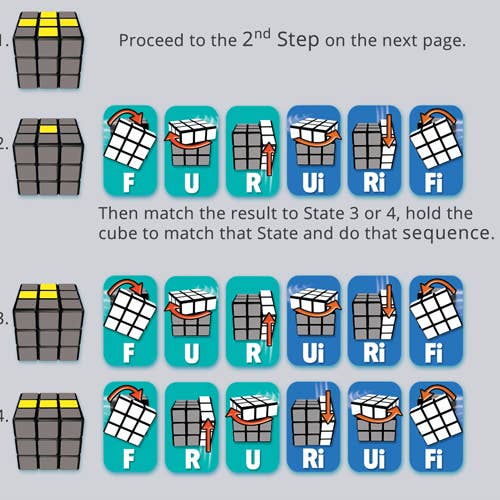
This is where many tutorials introduce algorithms — like “F R U R’ U’ F'” to form the yellow cross. But in this method, you build the yellow cross intuitively.
How to do it without algorithms:
- Look at the yellow edge pieces — there are four of them.
- Position them correctly — align each yellow edge with its matching center.
- Form the yellow cross — without worrying about the corners yet.
Key Insight: You’re not memorizing a sequence — you’re observing where each piece is and moving it into place.
✅ Verification: The yellow cross should have all four yellow edges aligned with their matching centers. The top face should be solid yellow.
⚠️ Common Mistake: Trying to force a piece into place without considering its orientation. Always check that the color on the side matches the center.
Step 6: Orient the Top Layer Corners — The “Yellow Corners” (Intuitively)
Once the yellow cross is solved, you need to orient the yellow corners — meaning, make sure the yellow face is on top.
How to do it without algorithms:
- Find a yellow corner piece — it should have yellow on one face.
- Look at the other two colors — they should match the centers of the adjacent faces.
- Orient it correctly — without disturbing the yellow cross.
Key Insight: You’re not memorizing a sequence — you’re matching the corner to its correct orientation. If the corner has yellow, red, and blue, it should have yellow on top.
✅ Verification: All four yellow corners should have yellow on top. The top face should be solid yellow.
⚠️ Common Mistake: Moving the yellow cross while trying to orient corners. Always keep the yellow cross intact.
Step 7: Permute the Top Layer Corners — The “Yellow Corners” (Intuitively)
Now you need to permute the yellow corners — meaning, move them into their correct positions.
How to do it without algorithms:
- Find a yellow corner piece — it should have yellow on one face.
- Look at the other two colors — they should match the centers of the adjacent faces.
- Move it into its correct position — without disturbing the yellow face.
Key Insight: You’re not memorizing a sequence — you’re observing where each piece is and moving it into place.
✅ Verification: All four yellow corners should be in their correct positions. The top face should be solid yellow.
⚠️ Common Mistake: Moving the yellow face while trying to permute corners. Always keep the yellow face intact.
Step 8: Permute the Top Layer Edges — The “Yellow Edges” (Intuitively)
Finally, you need to permute the yellow edges — meaning, move them into their correct positions.
How to do it without algorithms:
- Find a yellow edge piece — it should have yellow on one face.
- Look at the other color — it should match the center of the adjacent face.
- Move it into its correct position — without disturbing the yellow corners.
Key Insight: You’re not memorizing a sequence — you’re observing where each piece is and moving it into place.
✅ Verification: All four yellow edges should be in their correct positions. The top face should be solid yellow.
⚠️ Common Mistake: Moving the yellow corners while trying to permute edges. Always keep the yellow corners intact.
Why This Method is Better Than Algorithm-Based Solving
You might be wondering: Why go through all this trouble? Why not just memorize the algorithms?
Here’s why algorithm-free solving is superior:
1. It Builds Deep Understanding
When you solve the cube without algorithms, you’re not just following steps — you’re understanding how the cube works. You learn how pieces move, how they interact, and why certain moves affect multiple pieces.
This is critical for advanced cubing — whether you’re solving larger cubes, shape mods, or even competing in FMC (Fewest Moves Challenge), where memorized algorithms are often inefficient.
2. It Enhances Spatial Reasoning
Algorithm-free solving forces you to visualize the cube in 3D. You learn to predict where pieces will go before you make a move. This skill is transferable to other areas — engineering, architecture, game design, and even programming.
3. It’s More Adaptable
With algorithms, you’re limited to the sequences you’ve memorized. With algorithm-free solving, you can adapt to any configuration — even ones not covered in tutorials.
This is why many top cubers and mathematicians prefer this method — it’s not just about solving the cube. It’s about understanding the cube.
4. It’s More Satisfying
There’s something deeply satisfying about solving a puzzle through logic and observation — not by rote memorization. You’re not just “solving the cube.” You’re discovering its secrets.
As noted in the 2023 Cubelelo article, “This can help you gain a better sense of how the puzzle functions.“
The Intuitive Solving Process: Layer-by-Layer, But Without the Rules
One of the most powerful aspects of algorithm-free solving is that it follows the same layer-by-layer structure as traditional methods — but without the rigid rules.
In traditional methods like CFOP, you solve the cross, then the first two layers, then the last layer using OLL and PLL algorithms.
In this method, you do the same — cross, first two layers, last layer — but you build each layer intuitively, using observation and logic.
This is why many cubers who learn this method say it feels more natural — because you’re not following a script. You’re building a solution from scratch.
Here’s how it works:
Layer 1: White Cross + White Corners
- You build the white cross by aligning white edges with their matching centers.
- You solve the white corners by matching them to their correct positions.
Layer 2: Middle Layer Edges
- You solve the middle layer by matching edge pieces to their correct positions.
Layer 3: Yellow Cross + Yellow Corners + Yellow Edges
- You build the yellow cross by aligning yellow edges with their matching centers.
- You orient the yellow corners by ensuring yellow is on top.
- You permute the yellow corners and edges by moving them into their correct positions.
This is not a different method — it’s the same method, but without memorized sequences.
The Benefits of Solving the Rubik’s Cube Without Algorithms
Let’s take a moment to highlight the key benefits of algorithm-free solving:
1. Improved Spatial Reasoning
You’ll learn to visualize the cube in 3D — predicting where pieces will go before you make a move. This skill is transferable to other areas — engineering, architecture, game design, and even programming.
2. Enhanced Problem-Solving Skills
You’ll develop a systematic approach to tackling complex problems — not just in cubing, but in life. You’ll learn to break down complex systems into manageable parts, just like Rubik intended.
3. Memorization-Free Solution
No algorithms to remember — reducing cognitive load and making the process more accessible to beginners.
4. Increased Understanding
You’ll gain a deeper appreciation for the mechanics of the cube and the underlying principles of permutation and symmetry.
5. Adaptability
You can adapt your approach to different cube configurations — whether it’s a 2×2, 4×4, or even a Pyraminx.
How to Practice Algorithm-Free Solving: Tips and Tricks
Now that you know the method, here are some tips and tricks to help you practice and improve:
1. Start with the 2×2 Cube
The 2×2 Rubik’s Cube — also called the Pocket Cube — is simpler and easier to solve intuitively. It has only 8 corner pieces, no edges or centers.
This makes it perfect for beginners who want to learn the core mechanics of the cube without the complexity of the 3×3.
✅ Verification: The 2×2 cube should be solved when all eight corners are in their correct positions and orientations.
2. Use a Virtual Cube Simulator
There are many interactive cube simulators available online — like the one on Ryan Heise’s website — that let you practice without a physical cube.
These simulators are perfect for learning the mechanics and testing your intuition.
✅ Verification: You can use the simulator to test your moves and see how they affect the cube.
3. Practice with a Physical Cube
While simulators are great, nothing beats the tactile experience of a physical cube. Practice with a real cube to develop muscle memory and spatial reasoning.
✅ Verification: You should be able to solve the cube without looking at the algorithms — just by observing and thinking.
4. Challenge Yourself with Different Configurations
Don’t just solve the cube from a solved state. Try scrambling it in different ways — even ones not covered in tutorials.
This will help you adapt your approach and build flexibility.
✅ Verification: You should be able to solve any scrambled state — even ones you’ve never seen before.
Common Mistakes and How to Avoid Them
Even with this intuitive method, there are common mistakes that beginners make. Here’s how to avoid them:
1. Forgetting That Centers Are Fixed
The center pieces do not move — they define the color of each face. If you forget this, you’ll get confused and make mistakes.
✅ Solution: Always keep the centers in mind when placing pieces.
2. Moving Solved Layers While Solving New Layers
You might be tempted to move a solved layer while trying to solve a new one. This will undo your progress.
✅ Solution: Always keep the solved layers intact while solving new ones.
3. Not Checking Orientation
When placing a piece, make sure it’s oriented correctly — the color on the side should match the center.
✅ Solution: Always check the orientation before placing a piece.
4. Trying to Force a Piece into Place
Sometimes, you might try to force a piece into place without considering its position. This will waste time and lead to mistakes.
✅ Solution: Always observe where the piece is and move it into place — don’t force it.
The Future of Algorithm-Free Cubing in 2026
In 2026, algorithm-free solving is not just a niche interest — it’s a mainstream approach. With the rise of interactive simulators, YouTube tutorials, and community forums, more and more people are learning to solve the cube without memorizing algorithms.
In fact, many top cubers and mathematicians — including Ryan Heise, who developed the “Heise Method” — advocate for algorithm-free solving as a way to deepen your understanding of group theory, symmetry, and permutation.
As noted in the 2023 Cubelelo article, “This can help you gain a better sense of how the puzzle functions.“
And in 2026, this approach is more accessible than ever. With interactive simulators, YouTube tutorials, and community forums, you can learn this method without ever needing to memorize a single algorithm.
The 2×2 Rubik’s Cube: A Perfect Starting Point for Algorithm-Free Solving
If you’re new to cubing, the 2×2 Rubik’s Cube — also called the Pocket Cube — is the perfect starting point for algorithm-free solving.
It’s simpler and easier to solve intuitively — with only 8 corner pieces, no edges or centers.
This makes it perfect for beginners who want to learn the core mechanics of the cube without the complexity of the 3×3.
✅ Verification: The 2×2 cube should be solved when all eight corners are in their correct positions and orientations.
The Role of Group Theory and Symmetry in Algorithm-Free Solving
One of the most fascinating aspects of algorithm-free solving is that it’s rooted in group theory and symmetry — the same mathematical principles that govern the cube’s mechanics.
In fact, many mathematicians and top cubers — including Ryan Heise — use group theory to understand the cube’s structure and develop efficient solving methods.
This is why algorithm-free solving is not just about intuition — it’s about understanding the cube’s mathematical foundation.
As noted in the 2008 Ryan Heise website, “Why solve without memorisation? Learning to solve Rubik’s Cube without the aid of memorised sequences is certainly much more difficult than just memorising the answers. So why bother doing it the hard way? My own motivation was to discover the cube's secrets, to be able to actually solve it rather than recite memorised answers, and to solve it efficiently.“
This is the essence of algorithm-free solving — not just solving the cube, but understanding it.
How to Verify That You’ve Solved the Cube Correctly
At the end of each step, you need to verify that you’ve done it correctly. Here’s how:
Step 1: White Cross
✅ Verification: The white cross should have all four white edges aligned with their matching centers. The top face should be solid white.
Step 2: White Corners
✅ Verification: The entire white layer should be solved — all four white edges and all four white corners should be in place, with no pieces out of position.
Step 3: Middle Layer
✅ Verification: The middle layer should be solved — all four edge pieces should be in place, with no pieces out of position.
Step 4: Yellow Cross
✅ Verification: The yellow cross should have all four yellow edges aligned with their matching centers. The top face should be solid yellow.
Step 5: Yellow Corners
✅ Verification: All four yellow corners should have yellow on top. The top face should be solid yellow.
Step 6: Yellow Corners Permutation
✅ Verification: All four yellow corners should be in their correct positions. The top face should be solid yellow.
Step 7: Yellow Edges Permutation
✅ Verification: All four yellow edges should be in their correct positions. The top face should be solid yellow.
The Psychological Benefits of Algorithm-Free Solving
Beyond the mechanical and mathematical benefits, algorithm-free solving also has psychological benefits.
1. It Builds Confidence
When you solve the cube without memorizing algorithms, you’re not just following a script — you’re building a solution from scratch. This gives you a sense of accomplishment and confidence.
2. It Reduces Frustration
Many people get frustrated when they can’t memorize algorithms. Algorithm-free solving removes this barrier, making the process more enjoyable and less stressful.
3. It Encourages Curiosity
When you solve the cube without algorithms, you’re not just solving it — you’re discovering its secrets. This encourages curiosity and exploration, which are essential for learning.
The Community Behind Algorithm-Free Solving
One of the most powerful aspects of algorithm-free solving is the community that supports it.
There are many forums, YouTube channels, and websites dedicated to teaching and discussing algorithm-free solving.
For example, the Puzzling Stack Exchange has a dedicated thread asking, “How can one solve a Rubik’s cube without relying on guides/algorithms?” — and the answers are filled with real-world examples of people who solved it on their own.
As noted in the 2017 Stack Exchange post, “I know at least 8 people who have figured out how to solve it themselves without any prior knowledge or tutorials. It took most of them at least a month, but they did it, and almost all their methods are completely different.“
This community is still active in 2026, with new tutorials, simulators, and forums being created every day.
The Role of Technology in Algorithm-Free Solving
In 2026, technology has made algorithm-free solving more accessible than ever.
There are interactive cube simulators, YouTube tutorials, and community forums that make it easy to learn and practice.
For example, the Ryan Heise website offers a Rubik’s Cube Simulator that lets you practice without a physical cube.
There are also YouTube channels like “How to Solve a Rubik’s Cube: What Nobody Tells You” — which offer step-by-step guides for algorithm-free solving.
And there are online communities like the Puzzling Stack Exchange — where you can ask questions and get answers from experienced cubers.
This technology has democratized algorithm-free solving, making it accessible to anyone with an internet connection.
The Future of Algorithm-Free Solving: What’s Next?
In 2026, algorithm-free solving is not just a trend — it’s a movement.
With the rise of interactive simulators, YouTube tutorials, and community forums, more and more people are learning to solve the cube without memorizing algorithms.
In fact, many top cubers and mathematicians — including Ryan Heise, who developed the “Heise Method” — advocate for algorithm-free solving as a way to deepen your understanding of group theory, symmetry, and permutation.
As noted in the 2023 Cubelelo article, “This can help you gain a better sense of how the puzzle functions.“
And in 2026, this approach is more accessible than ever. With interactive simulators, YouTube tutorials, and community forums, you can learn this method without ever needing to memorize a single algorithm.
References
-
Philoli — How to Solve a Rubik's Cube Without Memorizing Algorithms: Even a Kid …, 2026
-
Cubelelo — Can a Rubik’s Cube be solved without its Algorithm? – Cubelelo, 2026
-
Puzzling — How can one solve a Rubik's cube without relying on guides/algorithms?, 2026
-
Youtube — Solving the Rubik's Cube Without Memorizing Algorithms, 2026
-
Youtube — How to Solve a Rubik's Cube | No Algorithms (EASY) – YouTube, 2026
-
Ryanheise — Rubik's Cube Solution – Zero memorization – Ryan Heise, 2026
-
Speedcube — Can you cube faster without memorizing algorithms? | Speedcube.nl, 2026
-
Aeanet — How To Solve A 2×2 Rubik's Cube Without Algorithms? – AEANET, 2026