Welcome to the definitive guide for F2L algorithms for beginners with intuitive examples in 2026. If you are holding a Rubik's Cube and feeling stuck after solving the cross, you are standing at the most critical junction of your speedcubing journey. The First Two Layers (F2L) is often the step that separates casual solvers from serious enthusiasts. It is the bridge between the beginner method and advanced speedcubing techniques like CFOP.
In this comprehensive article, we will dismantle the fear of memorization. We will explore how modern cubing communities, from local clubs in Chicago to online forums worldwide, have shifted their focus toward intuitive F2L. By understanding the logic behind piece movement, you can solve over 90% of cases without a single algorithm. However, for those moments when intuition hits a wall, having a robust library of optimized F2L algorithms is essential for breaking personal records.
Whether you are practicing in a quiet room in Tokyo or joining a meetup in Berlin, mastering these concepts will drastically reduce your solve times. Let's dive into the mechanics, strategies, and specific examples that will transform your cubing experience today.
Understanding the Core Philosophy of Intuitive F2L
Before diving into specific move sequences, it is vital to understand why "intuitive" solving has become the gold standard in 2026. Traditional beginner methods often teach layer-by-layer solving, which is slow and inefficient. In contrast, the CFOP method (Cross, F2L, OLL, PLL) focuses on pairing corner and edge pieces and inserting them together as a block.
The philosophy of intuitive F2L rests on five core concepts. These concepts allow you to look at any scrambled state and immediately visualize the solution path. You do not need to remember 41 distinct formulas; instead, you learn patterns of motion.
The Power of Pairing
The fundamental unit of F2L is the corner-edge pair. Imagine the corner and edge as dance partners. Your goal is to get them together in the top layer (U layer), align them correctly, and then slide them into their home slot simultaneously. When you master pairing, you stop thinking about individual stickers and start thinking about blocks. This shift in mindset is the first step toward sub-10-second solves.
Lookahead: The Secret Weapon
One of the biggest time-sinks for beginners is stopping to figure out what to do next. Advanced solvers utilize lookahead. This is the ability to solve the current pair while already planning the setup for the next pair. For example, while inserting the first pair, your eyes should already be scanning the cube for the second pair. This continuous flow eliminates pauses and keeps your hands moving.
Recognition Over Memorization
Many new cubers spend weeks memorizing algorithms before they even understand how the cube works. This approach is counterproductive. Instead, focus on pattern recognition. Can you spot when a corner is in the right place but the edge is flipped? Can you see when both pieces are separated in the top layer? Recognizing these states allows your brain to trigger the correct intuitive response instantly.
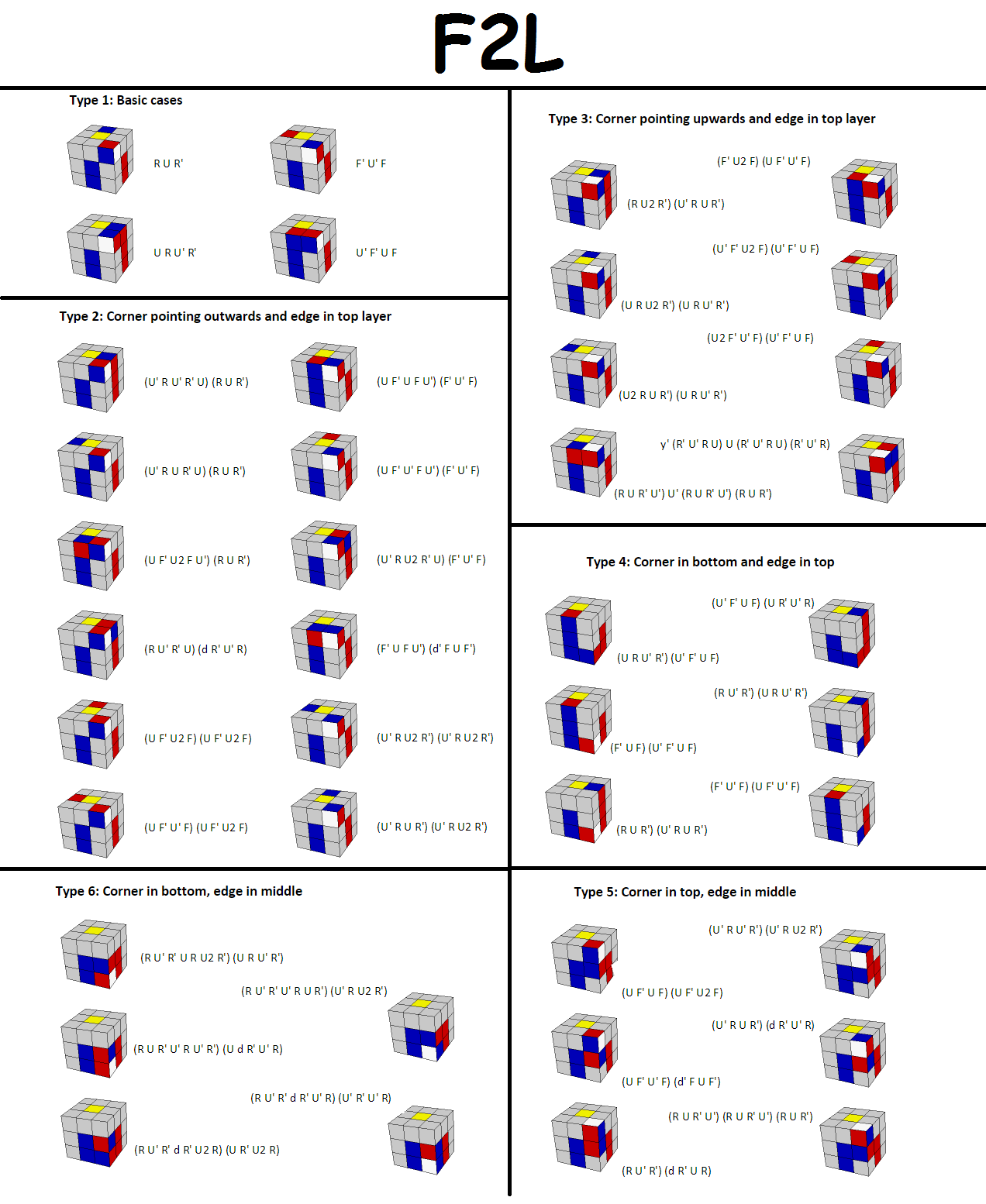
The Five Fundamental Scenarios Every Beginner Must Master
While there are officially 41 variations of F2L cases in the CFOP method, they all boil down to five fundamental scenarios. Once you master these five, you can solve any F2L case intuitively. Learning specific algorithms comes later, as a way to optimize these intuitive solutions.
1. Basic Insert: The Perfect Pair
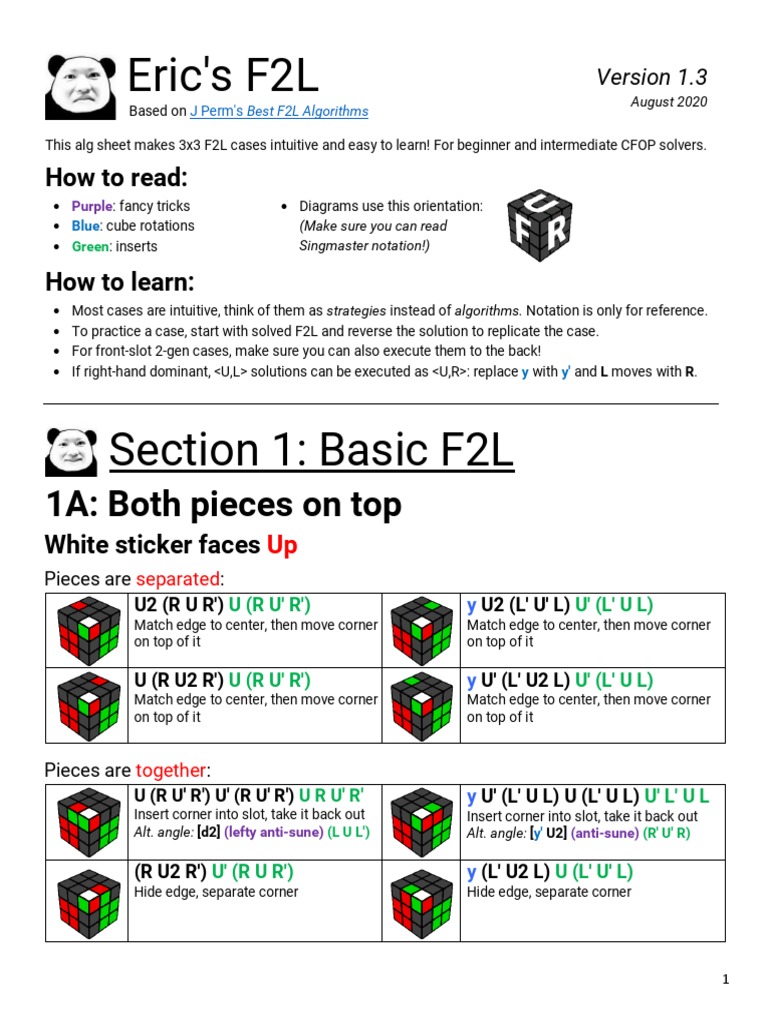
This is the most straightforward scenario. You have a corner and an edge that are already paired together in the top layer. Their colors match, and they are ready to go into the front-right or front-left slot.
- The Logic: Simply position the pair above the target slot and execute a simple insertion algorithm.
- The Algorithm: For the Front-Right slot, the sequence is usually R U R' U'. For the Front-Left, it is the mirror L' U' L U.
- Why it matters: This builds muscle memory for the basic "sexy move" rhythm. It teaches you how to insert a block without disrupting other parts of the cube.
2. Corner in Place: The Extraction Trick
In this scenario, the corner piece is already sitting in its correct slot, but the edge piece is elsewhere (usually in the top layer). You cannot simply insert because the corner is blocking the path or the edge isn't paired.
- The Logic: You must temporarily remove the corner to create space, bring the edge in to pair with it, and then re-insert the pair. Think of it as "Take out, pair up, put back."
- The Intuition: Use an F move to hide the corner, manipulate the edge into position, and then restore the corner to complete the pair.
- Common Mistake: Beginners often try to force the edge into the slot while the corner is still there, resulting in a mess. Always extract the corner first if the edge is not adjacent.
3. Edge in Place: The Mirror Scenario
This is the exact opposite of the previous case. The edge piece is already in its correct slot, but the corner is floating in the top layer.
- The Logic: Similar to the "Corner in Place" scenario, you must extract the edge temporarily. Bring the corner down to meet it, form the pair, and insert.
- The Intuition: Use F' moves or R moves to separate the edge, guide the corner, and reunite them.
- Optimization: Notice that this is often a mirror image of Case 2. Developing finger tricks that work for both mirrors simultaneously is crucial for speed.
4. Both Pieces Separate: The Top Layer Shuffle
Sometimes, neither the corner nor the edge is in the correct slot. Both are wandering around the top layer (U layer), perhaps even touching each other but misaligned.
- The Logic: You need to use the target slot as a tool to help them pair. Insert one piece into the slot, use the empty space to rotate the other piece into alignment, and then extract the newly formed pair.
- The Strategy: This requires good manipulation skills. You might use a sequence like R U R' U' to cycle pieces around until they form a valid pair above the slot.
- Lookahead Tip: While shuffling these two pieces, keep an eye on the rest of the cube. Are there other pairs waiting to be solved?
5. Split or Trapped Pairs: The Complex Reset
This is the most challenging intuitive scenario. The corner and edge are stuck in wrong slots, or they are trapped behind other pieces, making direct pairing impossible.
- The Logic: You must completely break the situation apart. Extract both pieces to the top layer, find a clear space to pair them there, and then insert the fresh pair into the correct slot.
- The Mindset: Do not try to fix them one by one in place. Accept that you are resetting the pair to a favorable state.
- Example: If a corner is in the back-right slot and an edge is in the front-left, you might need to cycle them both to the U layer before attempting to pair.
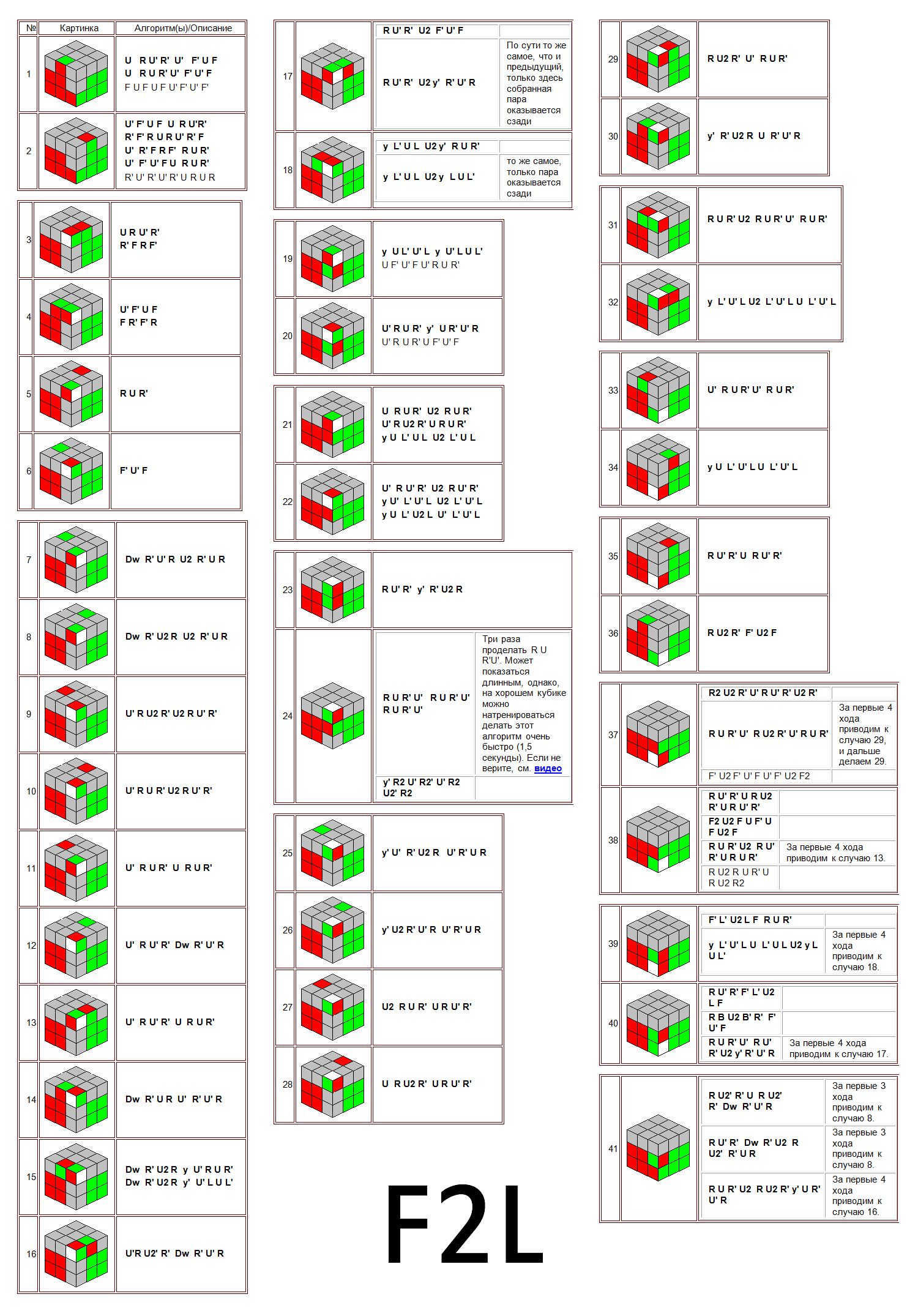
Deep Dive: Optimized Algorithms for Specific Cases
Once you have internalized the intuitive concepts, you will encounter situations where intuition alone isn't fast enough. This is where learning specific F2L algorithms becomes necessary. In 2026, the community favors algorithms that minimize rotations and maximize finger trick efficiency.
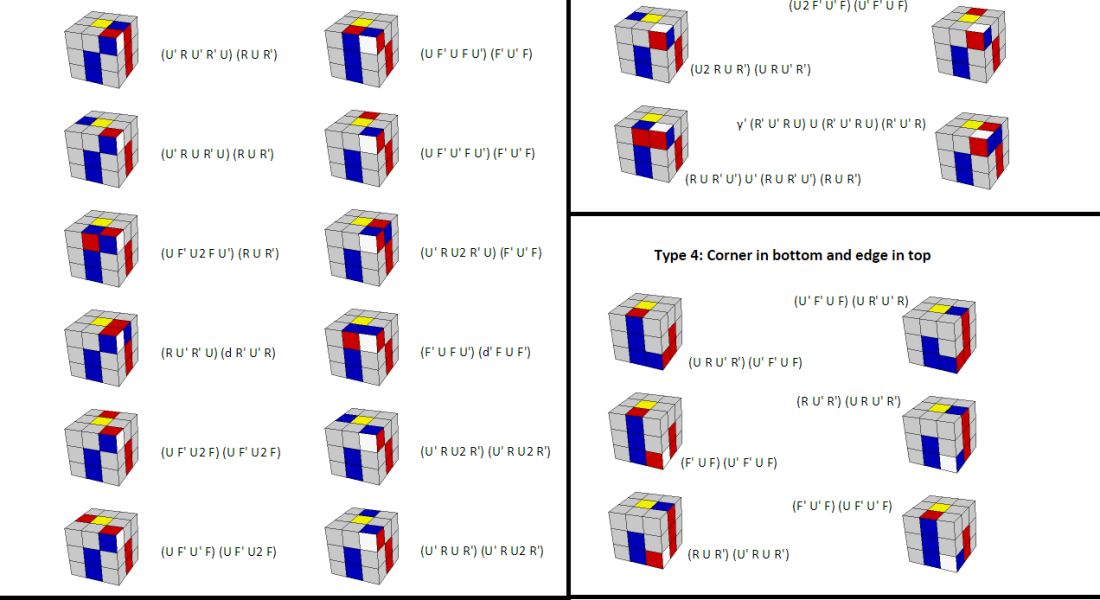
Below are detailed breakdowns of key algorithms categorized by their function. Note that these are designed to be used after you have set up the pair intuitively.
The "Sexy Move" Family
The sequence R U R' U' is known as the "Sexy Move." It is the backbone of almost every F2L algorithm. It rotates a corner-clockwise and an edge-counter-clockwise without disturbing the rest of the cube significantly.
- Application: Used extensively in Case 3 (Edge in Place) and Case 4 (Both Separate).
- Variation: The inverse U' R' U R is equally important for counter-clockwise adjustments.
- Pro Tip: Practice doing these moves rapidly with your right hand fingers (R, U, R', U') without looking at your hands. Muscle memory is key.
The Double Sexy Move
For more complex setups involving two layers of rotation, the double sexy move comes into play.
- Sequence: R U R' U' R U R' U'.
- Usage: This is often used when you need to cycle three edges or perform a more complex reorientation of a pair.
- Context: Found in advanced cases where a simple insertion would disrupt the cross or previously solved layers.
Mirror Algorithms for Left Hand
Speedcubing is not just about the right hand. Efficient solvers practice symmetric algorithms for the left side.
- Right Side: R U R' U'
- Left Side: L' U' L U
- Importance: Many cases appear on the left side of the cube. Knowing the mirror algorithm allows you to solve left-side pairs just as quickly as right-side pairs, maintaining your flow.
The Keyhole Technique
A powerful strategic concept introduced in recent years is the Keyhole. Sometimes, instead of forcing a difficult pair, you leave a small gap (a keyhole) in the first two layers and solve the remaining pairs freely, returning to fill the keyhole at the very end.
- When to use: When a specific pair is extremely difficult to set up intuitively.
- Benefit: It reduces anxiety and can sometimes lead to faster overall times by avoiding long, complex algorithms mid-solve.
Step-by-Step Training Drills for Rapid Improvement
Knowing the theory is one thing; executing it under pressure is another. To truly master F2L algorithms for beginners with intuitive examples, you must engage in deliberate practice. Here are three drills recommended by top coaches in 2026.
Drill 1: The Pause-and-Think Exercise
Solve the cross normally. Then, intentionally stop before grabbing the first pair. Take 3 seconds to analyze the cube. Ask yourself:
- Which pair should I solve first? (Prioritize pairs that are already partially formed).
- What is the intuitive setup for this pair?
- Where is the next pair located while I am solving the first?
Resume solving. Repeat this for every solve. This builds the neural pathways required for effective lookahead.
Drill 2: Algorithm Reduction Challenge
Take a scramble and attempt to solve the F2L stage using only intuitive methods. If you feel yourself reaching for a memorized algorithm, stop. Force your brain to find a new intuitive path. Only resort to algorithms after 3 failed intuitive attempts. This prevents "algorithm dependency" and keeps your solving fluid.
Drill 3: Single-Pair Timed Runs
Isolate just the F2L stage. Start with the cross already done. Set a timer for 30 seconds and try to solve as many pairs as possible. Focus purely on speed of execution and smooth transitions between pairs. This drill helps you refine your finger tricks and reduce the time spent pausing between moves.
Common Pitfalls and How to Avoid Them
Even with the best guides, beginners often fall into traps that hinder progress. Identifying these common mistakes early can save you months of frustration.
Mistake 1: Ignoring the Cross Orientation
One of the most frequent errors is solving the cross on the bottom but orienting it incorrectly relative to the rest of the cube. If your cross colors don't match the center pieces of the adjacent faces, your F2L pairs will be constantly misaligned.
- Solution: Ensure your cross is white-on-bottom (or whatever color you choose) and that the edge colors match the side centers before you start F2L.
Mistake 2: Poor Lookahead Habits
Beginners often solve a pair, then stop completely to look at the next one. This creates a "stop-start" rhythm that kills average speed.
- Solution: Train your eyes to scan the top layer continuously. As your thumb inserts the current pair, your eyes should already be locking onto the next target.
Mistake 3: Over-reliance on Memorization
Trying to memorize all 41 algorithms before understanding the basics leads to confusion. You will forget which algorithm goes where and lose confidence.
- Solution: Follow the hierarchy: Intuition > Basic Algorithms > Optimized Algorithms. Master the five fundamental scenarios first.
Mistake 4: Neglecting Finger Tricks
Using whole-hand rotations instead of finger flicks limits your potential speed. Modern cubing relies heavily on independent finger movements.
- Solution: Practice isolated finger exercises. Learn to roll the cube with your fingers rather than gripping and turning the entire layer. Resources like CubeSkills offer excellent tutorials on this.
The Role of Community and Local Cubing Scenes in 2026
Learning F2L is rarely a solitary endeavor. In 2026, the cubing community is more connected than ever, yet local scenes remain vital for motivation and skill exchange.
Joining Local Clubs
Cities like New York, London, Toronto, and Sydney host weekly cubing meetups. These events are not just for competitions; they are learning hubs. Watching experienced solvers demonstrate their lookahead techniques in real-time provides insights that videos cannot. You can observe how they handle "bad cases" and recover smoothly.
Online Forums and Discord Servers
Digital communities provide instant feedback. Platforms like Reddit's r/Cubing or specialized Discord servers allow you to upload your solve videos. Receving critique on your F2L flow can pinpoint exactly where your intuition is failing. Many of these groups share curated PDFs of intuitive F2L solutions tailored to different learning styles.
Competitions as Practice Grounds
Participating in local competitions, even casually, forces you to solve under pressure. The adrenaline can make you forget algorithms, pushing you back toward pure intuition. This is the ultimate test of your training. Whether you are competing in a school gym in Chicago or a community center in Berlin, the pressure refines your skills.
Building a Personal Algorithm Library
Once you have established a strong foundation in intuition, the next logical step is curating a personal library of algorithms. This does not mean memorizing every single variation found in speedcubing guides. Instead, it involves selecting specific sequences that fill gaps in your intuitive toolkit. For instance, if you find yourself struggling frequently with cases where the corner and edge are on opposite sides of the cube, you might choose to learn just one or two optimized algorithms for that specific geometry.
The beauty of a personalized library is its efficiency. You are not burdened by 41 complex formulas; you are armed with 5 to 10 high-impact tools that solve 95% of your difficult scenarios. When you encounter a case that feels "stuck," you consult your mental database. If an intuitive solution isn't coming quickly, you execute your pre-selected algorithm. This hybrid approach ensures that your solves remain fluid while still offering a safety net for the most challenging scrambles.
It is also important to consider the finger trick compatibility of any algorithm you add to your library. An algorithm that looks fast on paper might be slow to execute if it requires awkward hand rotations. Spend time analyzing the move sequences of potential additions. Do they flow naturally from the previous move? Can they be performed without rotating the entire cube? Prioritizing ergonomics over raw theoretical speed will yield better results in actual competition settings.
Advanced Concepts: From Intuition to Sub-10 Seconds
As you progress beyond the beginner stage, the line between "intuitive solving" and "algorithmic execution" begins to blur. The goal of sub-10-second solves is not merely about knowing more algorithms; it is about recognizing patterns so rapidly that the decision to use an algorithm becomes subconscious. This state is often referred to as "flow."
Case Splitting and Grouping
One advanced technique used by top-tier solvers is case splitting. Instead of treating a complex F2L scenario as a single unit, you break it down into smaller, manageable sub-problems. For example, rather than trying to insert a pair directly, you might first orient the corner correctly, then deal with the edge placement in a subsequent step. This reduces the cognitive load during high-pressure solves and allows for smoother transitions between different types of moves.
Global Lookahead vs. Local Lookahead
While we discussed lookahead earlier, advanced solvers take this to a global level. They don't just plan the next pair; they visualize the entire F2L stage three or four pairs ahead. This involves anticipating how the current insertion will affect the position of pieces needed later. It requires a deep understanding of cube mechanics and piece permutation. By mastering global lookahead, you eliminate almost all pauses, creating a seamless ribbon of movement that is both beautiful and incredibly fast.
The Role of ZBLL and Full OLL Integration
In the quest for speed, some solvers begin to integrate concepts from more advanced methods like ZBLL (Zborowski-Braun Memorial Last Layer) earlier in their training. While full ZBLL is too complex for beginners, understanding how last-layer algorithms interact with F2L can provide insights into efficient pair handling. Recognizing that certain F2L setups lead directly to favorable last-layer states can save precious milliseconds per solve. This holistic view of the cube helps you make decisions in the first two layers that benefit the final stages of the puzzle.
Equipment Matters: How Your Cube Influences Your Algorithms
In 2026, the hardware you use plays a significant role in how effectively you can execute F2L algorithms for beginners with intuitive examples. A high-quality speedcube is designed with specific tension, lubrication, and magnetic properties that facilitate faster finger tricks and smoother rotations.
Magnetic Alignment
Modern cubes feature magnets that help pieces snap into place. This magnetic assistance can reduce the need for precise alignment during algorithm execution. For beginners, this means that even if an algorithm isn't perfectly executed, the magnets may guide the pieces back into the correct orientation, reducing frustration and encouraging experimentation.
Tension and Turn Speed
The tension of a cube determines how easily layers turn. Looser tension allows for faster turns but may cause pieces to pop out during aggressive algorithms. Tighter tension offers stability but requires more force. Finding the right balance is crucial. As you refine your algorithms, you will likely adjust your cube's tension to match your personal style and speed preferences. A well-tuned cube makes the difference between a frustrating struggle and a fluid, rhythmic solve.
Lubrication and Maintenance
Proper maintenance ensures that your algorithms feel consistent. Dry or sticky cubes can disrupt the rhythm of finger tricks, making even simple sequences feel clunky. Regular cleaning and application of appropriate lubricants keep your cube responsive, allowing you to focus entirely on the logic and intuition of the solve rather than fighting mechanical resistance.
Mental Conditioning and Solving Under Pressure
Speedcubing is as much a mental game as it is a physical one. Developing the ability to stay calm and focused under pressure is essential for translating practice gains into competitive performance.
Managing Solve Anxiety
Many beginners experience anxiety when facing a difficult scramble, leading to rushed moves or forgotten algorithms. Techniques such as deep breathing before starting a solve, visualizing the solution path beforehand, and accepting that mistakes are part of the learning process can mitigate this anxiety. Remind yourself that every solver, regardless of skill level, encounters tough cases. The key is to maintain composure and trust your training.
Visualization Exercises
Beyond physical practice, mental visualization is a powerful tool. Close your eyes and imagine holding the cube. Visualize each algorithm being executed, feeling the finger movements and hearing the clicks of the pieces. This mental rehearsal strengthens neural pathways, making the physical execution feel more natural when you pick up the cube. Incorporate short visualization sessions into your daily routine to enhance your problem-solving capabilities.
Building Resilience Through Failure
Failure is inevitable in the journey to mastery. You will have days where your intuition fails, and you forget basic algorithms. Instead of viewing these moments as setbacks, see them as opportunities to learn. Analyze what went wrong, adjust your strategy, and try again. Resilience is built through repeated exposure to challenges and the determination to overcome them.
Frequently Asked Questions (FAQ)
Q: Do I really need to learn algorithms if I want to solve intuitively?
A: Not necessarily at the very beginning. Intuition is the primary driver for efficient F2L solving. However, having a small set of backup algorithms for stubborn cases provides a safety net. As you improve, the ratio of intuitive solves to algorithmic solves will shift heavily toward intuition, but knowing a few key algorithms can prevent plateaus in your progress.
Q: How long does it take to master intuitive F2L?
A: Mastery is a continuous process, but most dedicated beginners can develop solid intuitive skills within 2 to 4 weeks of consistent practice. Reaching an advanced level where lookahead is automatic and algorithm usage is minimal may take several months of focused training. Consistency is far more important than duration; practicing daily for 30 minutes yields better results than sporadic long sessions.
Q: What is the difference between CFOP and intuitive F2L?
A: CFOP (Cross, F2L, OLL, PLL) is a structured method that includes specific algorithms for every stage. Intuitive F2L is a philosophy within CFOP that prioritizes understanding piece movement over memorization. You can practice intuitive F2L while using the CFOP structure for the last layer. In fact, many world-class solvers use a blend of both, relying on intuition for F2L and algorithms only when necessary for optimization.
Q: Can I become fast without learning any algorithms?
A: You can become quite fast using purely intuitive methods, potentially reaching average times under 20 seconds. However, breaking into the sub-15 or sub-10 second range typically requires incorporating optimized algorithms for specific difficult cases. Algorithms allow you to bypass inefficient manual manipulations, providing the extra speed needed for elite competition.
Conclusion: Your Journey to Speedcubing Mastery
Mastering F2L algorithms for beginners with intuitive examples is a transformative journey that reshapes how you perceive the Rubik's Cube. It shifts your mindset from static sticker manipulation to dynamic block construction. By focusing on the five fundamental scenarios, practicing deliberate drills, and gradually integrating a selective library of algorithms, you unlock the true potential of your solving ability.
Remember that speedcubing is a marathon, not a sprint. The community surrounding us in 2026 is vast and supportive, offering resources, local meetups, and online forums to aid your growth. Whether you are solving in a quiet room in Tokyo or joining a meetup in Berlin, the principles of pairing, lookahead, and pattern recognition remain constant. Embrace the challenge, enjoy the process, and let your intuition guide you toward new personal bests.
As you continue to evolve, keep refining your technique and expanding your knowledge. The cube is a endless source of fascination, offering new puzzles and solutions with every scramble. Stay curious, stay persistent, and most importantly, have fun. The satisfaction of solving a complex configuration through pure understanding is unparalleled. Welcome to the world of serious cubing, where every move counts, and every solve is a victory.
With dedication and the right approach, your journey from a confused beginner to a confident speedcuber is well within reach. Start today, solve tomorrow, and watch your times plummet as your intuition sharpens. The cube awaits your next move.