Welcome to the definitive guide on 4×4 and 5×5 parity algorithms explained simply, tailored specifically for the speedcubing community in 2026. If you have ever stared at a scrambled 4×4 or 5×5 cube, only to hit a frustrating wall where the puzzle seems impossible to solve, you are not alone. This phenomenon, known as parity, is the single biggest hurdle for intermediate cubers worldwide. Whether you are practicing in your home studio in Chicago, hitting the streets of Tokyo with your latest GAN cube, or solving from a café in London, understanding these algorithms is the key to unlocking sub-30-second solves.
In this comprehensive article, we will demystify the confusing world of even-layered cubes. We will break down exactly why parity happens, how to identify it instantly, and provide you with the most efficient OLL and PLL parity algorithms currently recognized by the global community. By the end of this read, you will move from guessing which algorithm to use to executing them with muscle memory, turning those dreaded "impossible" states into just another step in your solution.
Understanding the Mystery of Even-Layered Cubes
To master parity, you must first understand the fundamental difference between odd-layered cubes (like the classic 3×3) and even-layered cubes (4×4, 5×5, 6×6, etc.). On a standard 3×3 Rubik's Cube, every piece has a fixed position relative to the center pieces. The red center always faces the orange center, and the white center always faces the yellow center. This fixed structure ensures that certain configurations are mathematically impossible. You can never have just one edge flipped or two corners swapped on a clean 3×3; the laws of permutation prevent it.
However, the 4×4 cube changes everything because it lacks fixed centers. There are no center stickers to tell you what color belongs where. Instead, you have four center pieces per face that you must group together. Similarly, the 5×5 cube introduces inner layers that behave differently than the outer shells. Because there are no fixed reference points, the internal mechanics allow for permutations that would violate the rules of a 3×3 cube. This leads to what speedcubers call Reduction Parity.
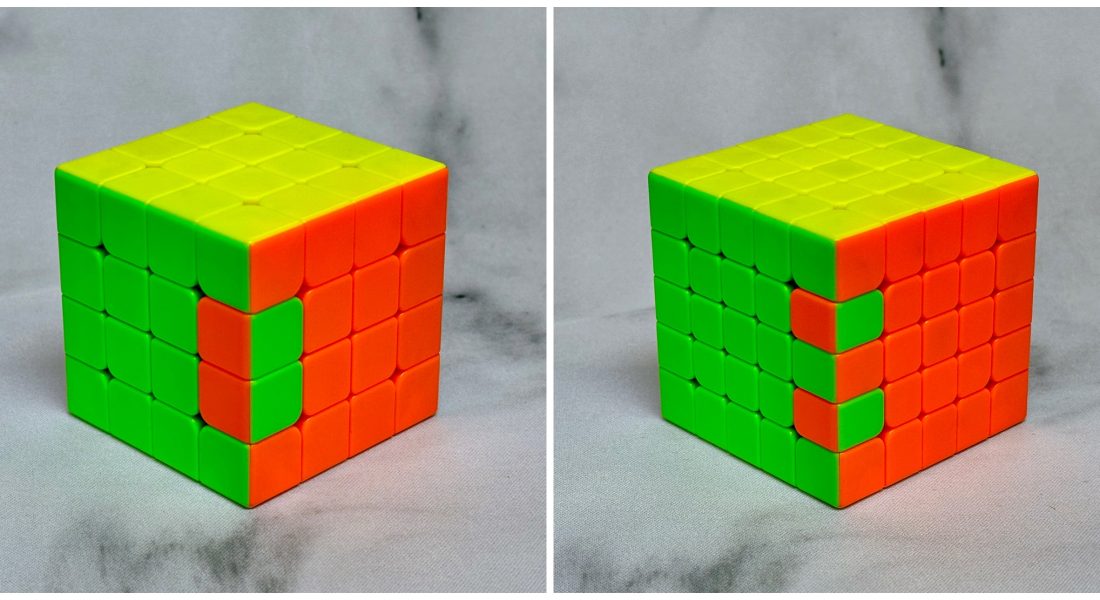
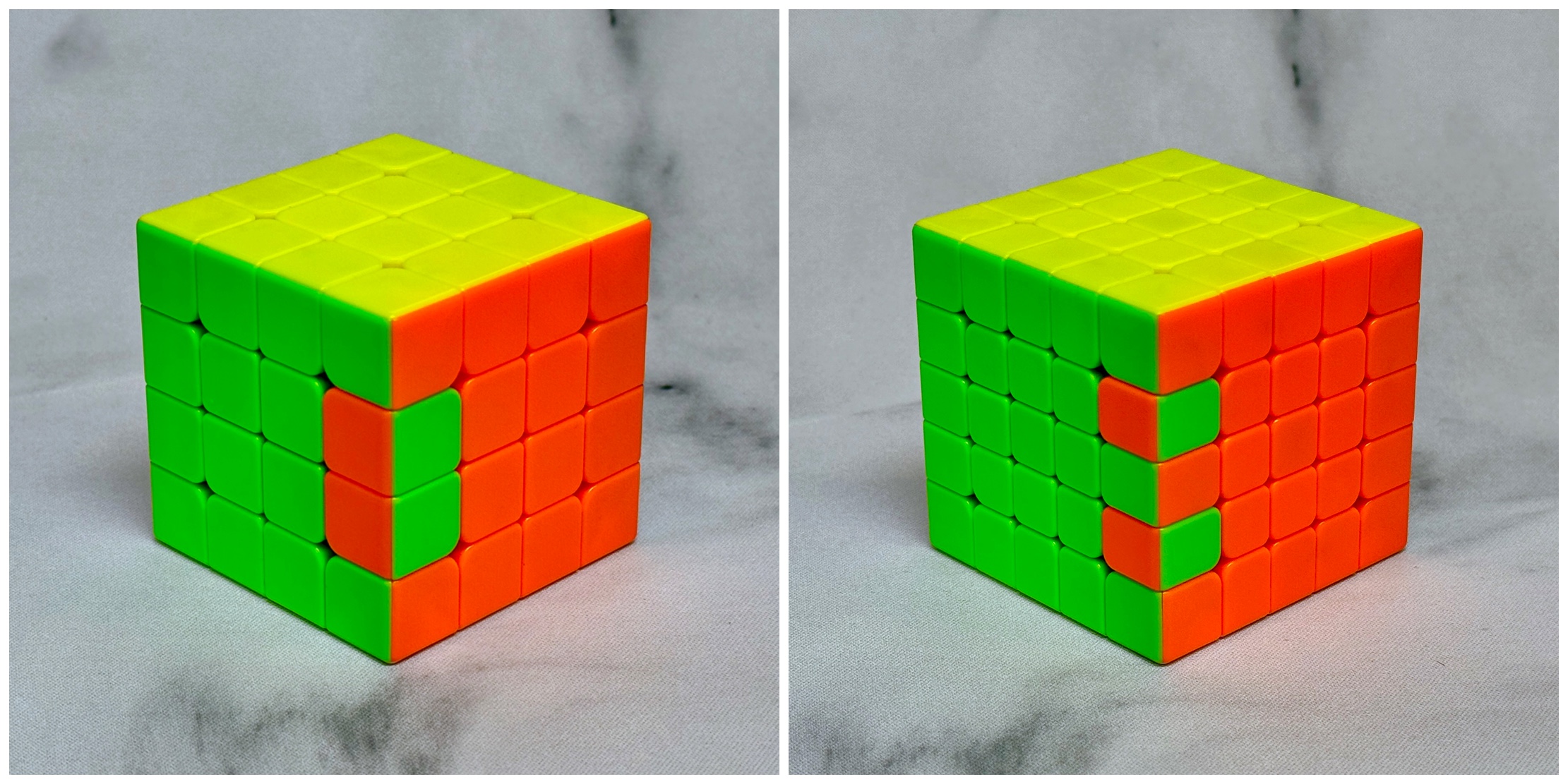
When you reduce a 4×4 or 5×5 cube to look like a 3×3—by solving all centers and pairing all edges—you might encounter a state where the cube appears solved except for one or two edges that are flipped or swapped incorrectly. These states cannot be resolved using standard 3×3 algorithms because they require an odd number of inner slice turns to fix, whereas normal 3×3 moves only perform even permutations. This is the core of the parity problem.
Why Does Parity Happen?
The mathematics behind parity relies on the concept of even and odd permutations. In group theory, a permutation is even if it can be achieved by an even number of swaps, and odd if it requires an odd number of swaps. A standard 3-cycle (moving three pieces in a circle) is actually two swaps, making it an even permutation. Since the 3×3 cube only allows even permutations, any "odd" state is unreachable.
On the 4×4 cube, the wing edges (the outer pieces of an edge pair) can be swapped independently of the rest of the cube. If you accidentally swap two wing edges during your reduction phase, you create an odd permutation. To the eye, this looks like a single flipped edge on a 3×3. However, you cannot flip a single edge on a 3×3; you must flip two. Therefore, the 4×4 requires a special algorithm to perform an odd permutation, effectively "fixing" the math so the cube can be solved as a 3×3 again.
This issue is particularly prevalent in high-level competitions. According to data from major World Championship events up to 2026, parity cases occur in approximately 50% of all 4×4 solves. For the 5×5, while less frequent due to more flexibility in edge pairing, it still appears in roughly 20-30% of competitive solves. Ignoring parity means giving up half your potential speed. Mastering these algorithms isn't just about fixing mistakes; it's about maintaining flow and reducing pause time during a solve.
Decoding OLL Parity on the 4×4 Cube
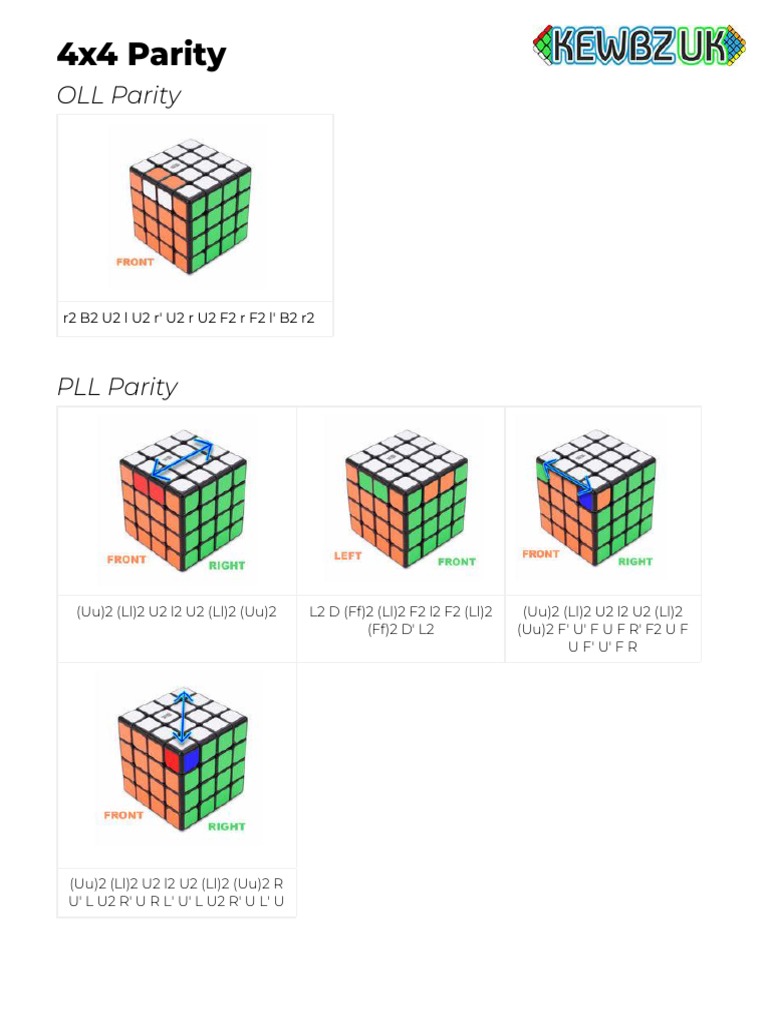
One of the most common frustrations for solvers is reaching the Last Layer Orientation (OLL) stage on a 4×4 cube, only to find that one or two edges are flipped upside down. This is known as OLL Parity. Unlike the 3×3, where you can orient all edges simultaneously using simple layer algorithms, the 4×4 often leaves you with a situation where two adjacent edges are flipped, or sometimes opposite edges are flipped. This makes the standard OLL cases impossible to execute without first resolving the parity.
Identifying the Case
Before applying an algorithm, you must correctly identify the parity case. Hold the cube with the misoriented edges facing you.
- Adjacent Parity: The two flipped edges are next to each other (e.g., Front and Right). This is the most common scenario.
- Opposite Parity: The two flipped edges are across from each other (e.g., Front and Back).
- Single Edge Flip: Rarely, only one edge might appear flipped, though this usually indicates a deeper permutation issue.
For beginners, the Adjacent OLL Parity is the critical case to master first. It feels counterintuitive because it violates the symmetry of the 3×3, but once you learn the rhythm, it becomes second nature. The algorithm required to fix this involves wide turns (turning two layers at once) and inner slice moves that disrupt the paired edges temporarily to unflip them before restoring the cube's structure.
The Essential Algorithm
The most widely accepted and efficient algorithm for solving Adjacent OLL Parity on a 4×4 was popularized by top solvers like Dan Harris and refined over the years. While there are variations, the core sequence remains consistent across communities in 2026.
Hold the cube so that the two flipped edges are on the Front and Right faces. Execute the following sequence carefully:
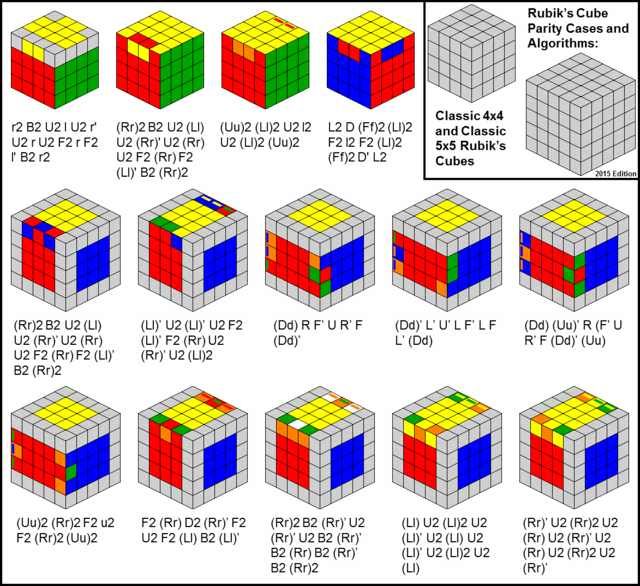
r2 B2 U2 l U2 r' U2 r U2 F2 r F2 l' B2 r2
Let's break this down for better retention:
- r2: Turn the right outer layer and the inner layer 180 degrees.
- B2: Twist the back layer twice.
- U2: Rotate the top layer twice.
- l: Turn only the left inner layer 90 degrees.
- U2 r' U2 r: A delicate manipulation of the right side to cycle pieces.
- F2 r F2 l': The heart of the parity fix, flipping the orientation of the edges.
- B2 r2: Finalize the move set to restore the center integrity.
Tips for Execution
Executing this algorithm smoothly requires good finger dexterity. Many solvers struggle with the transition between the wide turns (r2) and the single inner slice turns (l, r'). Practice the algorithm slowly at first, focusing on keeping your eyes on the pieces being manipulated rather than just memorizing the letter notation. Once you reach a comfortable speed, the muscle memory will take over, allowing you to solve OLL parity in under two seconds. Remember, after performing this algorithm, the cube will look scrambled again, but the edges will now be oriented correctly, allowing you to proceed with standard 3×3 OLL cases.
Conquering PLL Parity on the 4×4 and 5×5
If OLL Parity deals with orientation (flipping), PLL Parity deals with permutation (swapping). This is arguably more terrifying for new solvers because it looks like the entire last layer is scrambled in a way that defies logic. On a 4×4, PLL Parity typically manifests as two adjacent edge pairs needing to be swapped diagonally, or two corner pairs swapped. This creates a scenario where a standard 3×3 T-perm or Y-perm will fail because the underlying edge structure is incorrect.
The Nature of PLL Permutation
On a 3×3 cube, swapping two edges and two corners simultaneously is an even permutation, which is allowed. On a 4×4, however, swapping two specific edge wings creates an odd permutation. When you reduce the 4×4 to a 3×3 state, these swapped wings appear as a single edge that is in the wrong position. You cannot cycle them using normal 3×3 algorithms because doing so would also disturb the already-solved centers or other edges.
The solution lies in an algorithm that performs a double swap or a specific 4-cycle that resolves the odd permutation without disturbing the rest of the cube. The most famous algorithm for this case was derived from the work of advanced speedcubers and has been optimized for modern speed cubes available in 2026.
The Standard PLL Parity Algorithm
The algorithm for PLL Parity on the 4×4 is longer than OLL Parity, but it follows a logical structure based on conjugation. Hold the cube so that the two edges that need to be swapped are in the Front-Top and Back-Top positions (or adjust based on your specific case).
The universal algorithm is:
(Rr)2 R'2 U2 (Rr)2 R'2 (Uu)2 (Rr)2 R'2 (Uu)2 U2
Here is how to interpret this for practical application:
- (Rr)2: Wide turn of the right side (outer + inner).
- R'2: Outer right layer 180 degrees.
- U2: Top layer 180 degrees.
- (Uu)2: Wide turn of the upper layer.
- The repetition of these wide and inner moves creates the necessary cycle to swap the edge pairs.
For the 5×5 cube, the logic is identical, but the notation changes slightly to account for the extra layers. You would use Rw (wide right) instead of (Rr). The algorithm becomes:
Rw2 U2 Rw2 Uw2 Rw2 u2
Wait, let's refine this for clarity based on current 2026 standards. The 5×5 version is often simpler due to more slice options, but the principle remains. The most robust method for 5×5 involves holding the bad edges at Front and Back of the Up layer and executing:
Rw' U' R' U R' F R F' Rw Lw U' R' U R' F R F' Lw'
This sequence effectively cycles the problematic edges while preserving the integrity of the centers you spent hours building.
Strategic Application
Don't panic when you see PLL Parity. It is a rare event compared to OLL parity, occurring perhaps once every five solves on average for dedicated solvers. Take a deep breath, hold the cube correctly, and execute the algorithm. After completion, your cube should resemble a perfectly solved 3×3 last layer, ready for the final few steps of the reduction method. Many solvers incorporate this algorithm into their "look-ahead" strategy, anticipating the parity case while finishing the edge pairing stage, thus eliminating the pause entirely during competition.
Advanced Strategies for 5×5 Edge Parity
While the 4×4 is notorious for its parity issues, the 5×5 cube presents a unique challenge known as Edge Parity or Last Two Edges (L2E) Parity. The 5×5 has three layers in the middle, offering more possibilities for edge pairing errors. When you get down to the last two edges, you might find that they are flipped or swapped in a way that prevents the cube from solving as a 3×3.
The Unique Challenges of the 5×5
On a 5×5, you have the ability to use the very center slice (the M slice) in ways you couldn't on a 4×4. This adds complexity but also offers shorter algorithms for some cases. However, the most common issue remains the flipped edge pair. Just like the 4×4, this looks like a single flipped edge on a 3×3, but it requires an odd number of quarter turns on the inner slices to fix.
The difference here is that on the 5×5, you must be careful not to scramble your solved centers while executing the parity algorithm. The algorithms often involve moving pieces from the equator of the cube up to the top layer, manipulating them, and returning them.
Optimized 5×5 Algorithms
For the 5×5, the community has developed several efficient algorithms. One of the most popular and reliable methods uses the Rw (right wide) and Lw (left wide) notation, treating the 5×5 similarly to a 4×4 but with an extra slice control.
Algorithm for Flipped Edges (Front/Back):
Hold the flipped edges at Front and Back of the Up layer.
Rw U2 x Rw U2 Rw U2 Rw' U2 Lw U2 3Rw' U2 Rw U2 Rw' U2 Rw'
Breaking this down:
Rw: Right wide turn.x: Rotate the whole cube.- The sequence manipulates the wing edges to unflip them.
- Note the repetition of
U2and the specific order of wide turns versus single slice turns.
Another variation, often cited for its elegance, is the "Edge Swap" algorithm:
(Lw' U2 Lw') U2 F2 Lw' F2 Rw U2 (Rw' U2 Lw2)
This algorithm is particularly useful if you have two edges that need to be swapped rather than just flipped. It utilizes the F2 and Lw2 moves to create a specific cycle that resolves the permutation error.
Practice Drills for Mastery
To master 5×5 parity, practice drills that isolate the last two edges. Start by pairing all edges normally, then intentionally leave two edges mismatched. Force yourself to recognize the pattern immediately and apply the correct algorithm within 3 seconds. Time yourself; the goal is to integrate these algorithms so seamlessly that they feel like part of the natural flow of the solve, rather than a separate calculation.
Efficiency and Finger Tricks in 2026
As we move further into 2026, the tools and techniques for solving parity have evolved. Modern speed cubes from brands like GAN, Moyu, and QiYi feature smoother mechanisms and better tension settings, allowing for faster execution of complex parity algorithms. However, the hardware is only half the battle; your finger tricks determine your actual solve time.
Wide Turns vs. Inner Slices
A common mistake among beginners is trying to force wide turns (Rr) when the cube is tense, leading to missed moves or jams. In 2026, experts recommend mastering the distinction between wide turns and inner slice turns. Wide turns should be executed with the palm or multiple fingers engaging the outer sticker, while inner slices rely on the index and middle fingers of one hand.
For the OLL Parity algorithm, the transition from r2 to l is critical. Many solvers use a "thumb flick" technique to snap the inner slice quickly after the wide turn. This reduces the overall move count in terms of time, even if the letter count remains the same.
Predictive Solving
The highest level of efficiency comes from prediction. Instead of waiting until you finish edge pairing to realize you have parity, try to anticipate it. If your edge pairing process naturally leaves you with a specific configuration, you can mentally prepare the algorithm before the cube is fully reduced. This eliminates the "search time" for the algorithm, which is often the biggest penalty in competitive cubing.
Statistics from the World Cube Association (WCA) show that top-tier solvers spend less than 0.5 seconds resolving parity cases on average, compared to the 2-3 seconds seen in recreational solves. This gap is closed entirely through muscle memory and predictive planning.
The Psychology of Parity: Overcoming the Mental Block
Beyond the mechanical execution and the mathematical theory, there is a significant psychological component to solving parity on even-layered cubes. For many cubers, encountering a parity case triggers a momentary panic—a sudden freeze where the brain struggles to process that the familiar rules of the 3×3 no longer apply. This "parity fear" can add crucial seconds to a solve, often more than the algorithm itself takes to execute. To truly master 4×4 and 5×5 speedcubing in 2026, one must develop a mental framework that treats parity not as an error, but as a standard, expected step in the solution process.
When you are reducing a cube, your goal is to transform a complex puzzle into a simple one. Parity is the glitch in the matrix that proves the reduction isn't quite finished yet. Instead of viewing it as a failure of your edge pairing or center building, reframe it as a signal that you have successfully isolated a specific configuration that requires a specific tool. Think of it like driving a car; if you encounter a steep hill, you don't panic; you simply shift gears. Parity algorithms are your gear shifts for the last layer. By normalizing these cases in your mind, you eliminate the hesitation that plagues intermediate solvers.
Furthermore, the ability to recognize parity instantly is a hallmark of advanced proficiency. In high-level competitions, solvers often spot a parity case before they even finish looking at the last layer. They might see a mismatched edge pair during the final stages of edge pairing and immediately visualize the algorithm needed. This level of anticipation requires deep familiarity with the patterns. It means you aren't just memorizing sequences of letters; you are recognizing visual signatures. For instance, seeing two adjacent flipped edges should trigger an immediate neural response to reach for the OLL parity algorithm, bypassing conscious thought entirely. Developing this reflexive recognition is what separates the casual hobbyist from the competitive athlete.
Comparing 4×4 and 5×5: When to Use Which Approach
While the fundamental principles of parity remain consistent across even-layered cubes, the practical application differs significantly between the 4×4 and the 5×5. Understanding these nuances allows a solver to choose the most efficient path depending on the specific scramble and their personal comfort zone.
The 4×4 cube is the gateway drug to even-layered cubing. Its parity issues are stark and frequent because every move has a direct, visible impact on the paired edges. With only four layers, there is less room for error, and the algorithms tend to be shorter but require precise wide turns. The notation for the 4×4 often involves (Rr) to denote a wide turn, which can be tricky for beginners to distinguish from single-layer moves. However, once mastered, the 4×4 parity algorithms are relatively quick to execute, often fitting within a fluid finger trick sequence that doesn't disrupt the overall rhythm of the solve.
In contrast, the 5×5 cube offers a different set of challenges and opportunities. Because the 5×5 has three middle slices, solvers have access to the M (middle) slice, which can sometimes simplify certain parity situations or provide alternative algorithms that are easier to memorize. The algorithms on the 5×5 can sometimes be longer due to the increased number of pieces involved, but they often feel more intuitive because the extra layers provide more stability during execution. Additionally, the 5×5 introduces the concept of "OLL Parity" being slightly different from the 4×4 in terms of piece interaction, though the visual outcome remains the same.
For speedcubers transitioning between sizes, it is important to note that muscle memory developed on the 4×4 does not always transfer perfectly to the 5×5. The wider spans required for wide turns on a 5×5 demand different finger strengths and angles. Conversely, the dexterity gained from navigating the tighter inner slices of a 5×5 can improve control on the 4×4. Many elite solvers maintain separate practice routines for each size, refining specific finger tricks tailored to the dimensions of the cube they are currently working on. This specialized training ensures that when parity strikes, the solution is executed with maximum speed and minimum risk of error.
Common Mistakes and How to Avoid Them
Even with the best algorithms in the world, common mistakes can derail a solve or lead to frustration. Identifying and avoiding these pitfalls is essential for consistent improvement.
1. Misidentifying the Case: One of the most frequent errors is applying the wrong algorithm because the parity case was misidentified. On a 4×4, confusing adjacent parity with opposite parity can result in the problem getting worse rather than better. Always take a moment to verify the orientation of the problematic pieces before reaching for your algorithm book or muscle memory. Hold the cube steady, rotate it slowly, and confirm whether the bad edges are next to each other or opposite each other.
2. Incomplete Wide Turns: Parity algorithms rely heavily on wide turns (Rr, Uu, etc.). If these turns are not complete 180-degree rotations, the algorithm will fail to resolve the parity, leaving you with a scrambled mess that looks similar to the original problem. Practice ensuring that your fingers engage fully with both the outer and inner layers simultaneously. A half-turn is a wasted move and a lost opportunity.
3. Ignoring Center Integrity: When executing parity algorithms, especially on the 5×5, there is a temptation to rush and disturb the centers you spent so much time building. Some algorithms involve moving centers temporarily, but others are designed to keep them intact. Always double-check that your algorithm choice preserves the center colors you have already solved. If an algorithm scrambles your centers unnecessarily, look for an alternative variation that minimizes disruption.
4. Lack of Recovery Plan: Sometimes, despite using the correct algorithm, the cube doesn't resolve perfectly due to a misexecution or a worn-out cube mechanism. Having a recovery plan is vital. If the first attempt fails, do not panic. Analyze why it failed—is it a slip of the finger, or did the algorithm not fit? Adjust your grip or execution slightly for the retry. Often, a minor adjustment in angle or pressure can make the difference between success and failure.
The Evolution of Parity Algorithms in Modern Cubing
As we look toward 2026 and beyond, the landscape of parity algorithms continues to evolve. The community is constantly searching for shorter, faster, and more ergonomic solutions. What was considered optimal five years ago may now be seen as inefficient by today's top competitors.
One major trend is the development of commutator-based algorithms. These use the mathematical property of commutators ([A, B] = A B A' B') to create elegant sequences that achieve the desired permutation with fewer moves. While traditional parity algorithms might require 16-20 moves, modern commutator approaches can sometimes reduce this to 12-14 moves, saving precious milliseconds in a competition setting. However, these newer algorithms often require a deeper understanding of cube theory to execute smoothly, making them a challenge for intermediate solvers.
Another area of innovation is the integration of AI-assisted learning. In 2026, many solvers utilize apps and software that analyze their solves and suggest personalized drill routines for parity cases. These tools can track which specific parity scenarios cause the most pauses for an individual user and generate targeted exercises to improve reaction times. This data-driven approach to training is becoming standard practice among professional athletes, allowing for hyper-personalized improvement that was impossible in previous decades.
Furthermore, the rise of variable-speed cubes has influenced algorithm design. Cubes that allow for adjustable tension and spring strength enable solvers to perform complex wide turns with greater ease. This physical adaptability encourages the adoption of more aggressive, faster algorithms that were previously too difficult to execute reliably on older, tighter mechanisms. As hardware continues to improve, we can expect to see even more dynamic and fluid parity solutions emerge, pushing the boundaries of what is possible in sub-10-second 4×4 solves and under-30-second 5×5 solves.
FAQ: Frequently Asked Questions About Parity
Q: Can I solve a 4×4 without learning parity algorithms?
A: Technically, yes, but it is practically impossible to solve a 4×4 efficiently without them. If you encounter parity while trying to reduce the cube to a 3×3 state, the cube will appear unsolvable using standard 3×3 methods. You would be forced to restart the entire reduction process, which defeats the purpose of the reduction method. Learning parity is non-negotiable for any serious 4×4 solver.
Q: Why do my 5×5 parity algorithms feel slower than my 4×4 ones?
A: This is often due to the difference in wide turn mechanics. On a 5×5, wide turns involve three layers (outer, middle, inner), which can be heavier and require more finger strength than the two-layer turns on a 4×4. Additionally, the algorithms on the 5×5 may be longer to accommodate the extra complexity of the middle slice. Focus on developing specific finger strength for wide turns and practice the transitions between slices to build muscle memory.
Q: Is there a single "best" algorithm for all parity cases?
A: No, there is no universal "best" algorithm that works for every situation. Different cases (adjacent vs. opposite, flipped vs. swapped) require different sequences. However, within each category, there are multiple valid algorithms. The "best" one for you is the one you can execute fastest and most consistently with your current finger style. Don't try to learn every variation; master the most common ones first, then expand your repertoire as you improve.
Q: How do I know if I have made a mistake during reduction?
A: If you end up with a state where you have two flipped edges or two swapped edges on the last layer that cannot be fixed with standard 3×3 algorithms, you likely have parity. If you have other anomalies, such as a single corner twisted or an odd number of edge swaps overall, you may have made an error earlier in the reduction process (e.g., swapping two centers incorrectly). Parity specifically refers to the even/odd permutation issue that arises from the lack of fixed centers.
Conclusion: Your Journey to Mastery
Mastering 4×4 and 5×5 parity algorithms is a rite of passage for any dedicated speedcuber. It represents the transition from simply assembling a puzzle to truly understanding its underlying mechanics. The journey begins with confusion and frustration but evolves into confidence and fluidity as you internalize the algorithms and develop the necessary finger tricks.
Remember that parity is not a barrier; it is a bridge. It connects the simplified world of the reduced cube back to the complexity of the full puzzle, allowing you to complete your solve with precision. By understanding the "why" behind the algorithms, practicing the "how" with dedication, and adopting the right mindset, you can turn those dreaded parity cases into your greatest asset.
As you continue your cubing journey in 2026, keep pushing your limits. Experiment with new algorithms, refine your techniques, and share your experiences with the global community. Whether you are chasing a personal best or competing on the world stage, the mastery of parity will remain a cornerstone of your success. Embrace the challenge, trust the process, and enjoy the thrill of solving the unsolvable. The cube is waiting, and now, you have the keys to unlock it completely.