Welcome to the most critical juncture in your speedcubing journey. If you are reading this in 2026, you likely know exactly what it feels like to stare at a scrambled cube, solve it using the basic Layer-by-Layer method, and hit a frustrating wall around the 60-second mark. You have mastered the first layer, the middle edges, and perhaps even the last layer orientation, but your solves feel choppy, disjointed, and exhausting. This is the universal experience of every cuber before they break through.
Transitioning from beginner to intermediate is not just about learning more algorithms; it is about fundamentally changing how you interact with the puzzle. It is the shift from "solving" the cube to "flowing" through it. In today's hyper-connected cubing community, where average times for enthusiasts in cities like Austin, Seattle, London, and Tokyo consistently dip below 15 seconds, the gap between a casual solver and an intermediate competitor is defined by efficiency, lookahead, and finger trick mastery.
This comprehensive guide, updated for the 2026 landscape, will walk you through the exact steps to shed your beginner habits. We will dive deep into the CFOP method (Fridrich), the industry standard for speed, while also touching upon alternative methods like Roux for those who prefer a different mechanical approach. Whether you are aiming for your first sub-40 solve or preparing for local competitions in your neighborhood, this roadmap is designed to get you there faster.
Defining the Gap: What Actually Separates Beginners from Intermediates?
Before we can build a bridge, we must understand the terrain on both sides. The terms "beginner" and "intermediate" are often used loosely, but in the context of competitive cubing, they represent distinct skill sets with measurable differences. As noted by leading resources like SpeedCubeReview and CubeSkills, a true beginner is typically defined as someone who solves the cube using the Layer-by-Layer (LBL) method and clocks in anywhere from 25 seconds to over 60 seconds.
The transition phase is characterized by a temporary slowdown. Many aspiring intermediates panic when their times initially increase after starting to learn advanced techniques. This is normal. The cognitive load of learning new patterns while trying to execute them physically is immense. However, the goal is to move past this plateau. An intermediate cuber in 2026 is generally someone who has adopted a full method like CFOP and aims for an average time between 15 and 20 seconds.
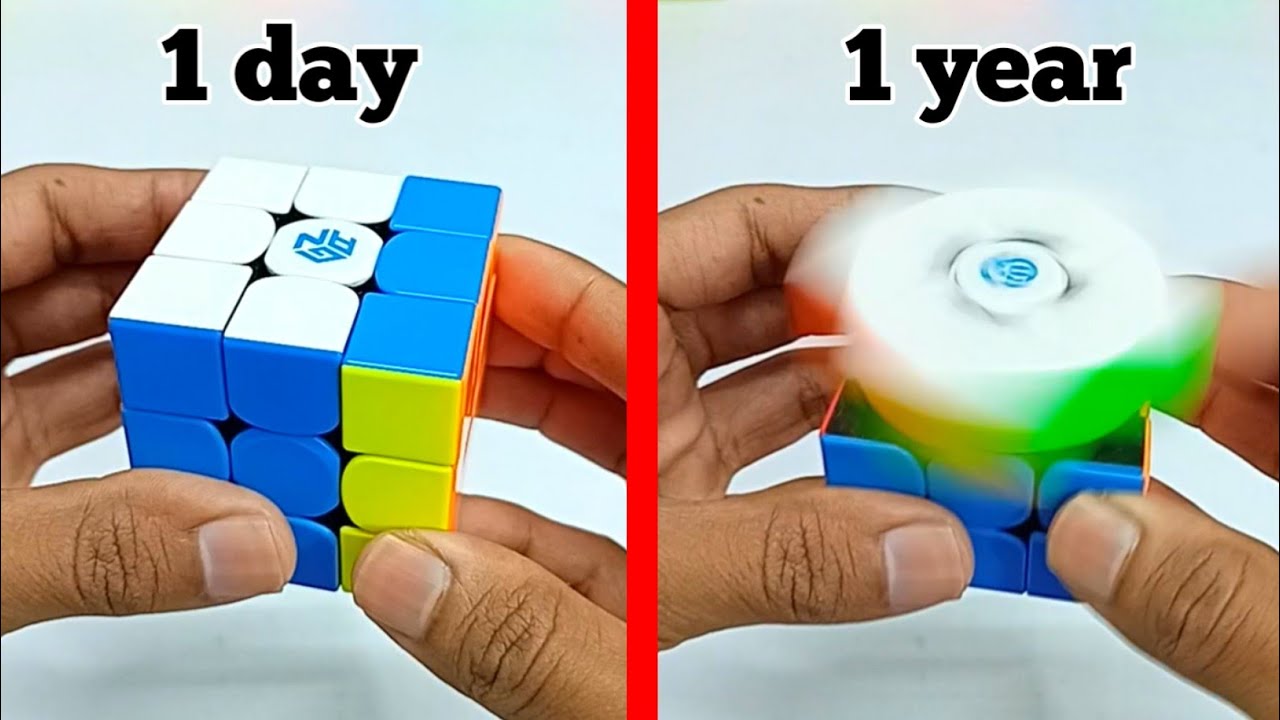
The primary distinction lies in efficiency of movement and cognitive planning. Beginners often solve one piece at a time, pausing between layers to find the next piece. They rely heavily on memorized sequences without understanding the underlying mechanics. Intermediate cubers, conversely, solve groups of pieces simultaneously, plan their moves several steps ahead, and maintain a continuous flow that eliminates unnecessary rotations and pauses.
To make this transition successfully, you must accept that your current method, while functional, is inefficient for speed. The Layer-by-Layer method requires approximately 60 moves per solve on average. By adopting intermediate techniques, you can reduce this to roughly 40 moves or fewer, creating the necessary space for speed. This reduction in move count is the mathematical foundation of breaking the one-minute barrier and eventually hitting the sub-20 second range that defines the modern intermediate era.
Mastering the Cross: The Foundation of Speed Solving
The cross is the starting point of every serious speedsolve, yet it is often the weakest link for beginners transitioning to intermediate status. In the beginner method, the cross is usually solved on the top face, requiring a final rotation of the entire cube to begin the second layer. This extra step costs valuable time and breaks the rhythm of the solve.
Solving the Cross on the Bottom
The single most impactful change you can make immediately is to switch to solving the cross on the bottom layer. While this seems counterintuitive if you are used to seeing white on top, it offers two massive advantages:
- Immediate Access: Once the bottom cross is solved, you can immediately start working on the First Two Layers (F2L) without rotating the whole cube.
- Lookahead Potential: Solving the cross on the bottom allows you to look ahead at the F2L pairs while you are still executing cross moves, a concept known as pre-planning.
According to tutorials from Classy Cubing and CubeSkills, mastering the bottom cross takes practice, but it is non-negotiable for intermediate progression. Your goal should be to solve the cross in under 3 seconds without looking at the cube for more than a split second during inspection. This involves developing color neutrality, where you can start the cross on any color combination, rather than being tethered to White or Yellow.
Optimization Techniques for 2026
In 2026, tools and community knowledge have made cross optimization easier than ever. You should focus on:
- Pattern Recognition: Instead of calculating moves for each edge, train your eyes to recognize common cross patterns instantly.
- Edge Orientation: Learn to orient edges as you place them (often called "EO" or Edge Orientation) so that all four edges are oriented correctly before you even finish placing them. This saves significant time later.
- Efficient Algorithms: Use specific algorithms to flip edges without disrupting already placed pieces. Avoid generic "move the edge here" approaches; use dedicated cross-flip algorithms that minimize cube rotations.
By perfecting your cross, you eliminate the largest source of inefficiency in the beginner method. It sets the stage for the rest of the solve to flow smoothly. If your cross takes more than 5 seconds, you are not yet ready to tackle complex F2L cases efficiently.
Decoding F2L: From Disjointed Pairs to Fluid Intuition
If the cross is the foundation, the First Two Layers (F2L) is the engine of the CFOP method. This is the stage where the majority of beginner-to-intermediate transitions happen, and where most solvers either succeed or quit. For beginners, F2L is often a tedious process of inserting a corner, then finding an edge, inserting the edge, and repeating. This disjointed approach kills momentum.
The Philosophy of Pairing
Intermediate cubing introduces the concept of the Pair. Instead of treating the corner and edge as separate entities, you identify them in the Top Layer (TL), bring them together to form a pair, and insert them into their slot simultaneously. This reduces the number of operations required to solve the first two layers from roughly 20 moves to just 8-10 moves per pair.
As explained in detailed guides from SolvingRubiksCube.com, there are three basic scenarios you will encounter:
- The Joined Pair: The corner and edge are already connected correctly. You simply rotate the top layer to align the pair with its slot and insert.
- The Separated Pair: The corner and edge are in the top layer but not connected. You must perform a short sequence to join them before insertion.
- The Incorrectly Joined Pair: The pieces are connected but facing the wrong way. You must separate them, reorient, and rejoin correctly.
While there are 41 possible F2L cases, you do not need to memorize all of them immediately. The hallmark of an intermediate cuber is intuitive solving. You should aim to understand the logic behind the movements so well that you rarely need to recall a specific algorithm. Only resort to algorithms when intuition fails or for highly specific, difficult cases.
Developing Lookahead
The difference between a 30-second solver and a 15-second solver is almost entirely lookahead. Lookahead is the ability to see the next F2L pair while you are currently inserting the previous one.
- Beginner Habits: Finish inserting Pair A -> Stop -> Scan Cube -> Find Pair B -> Start moving.
- Intermediate Habits: Insert Pair A -> While turning, your eyes are already scanning for Pair B -> Start moving Pair B before Pair A is fully inserted.
To develop this skill, practice solving slowly with the intention of spotting the next pair early. Use resources from CubeSkills which emphasize drilling F2L cases until they become muscle memory. In 2026, many solvers use simulators and replay software to analyze their solves frame-by-frame, identifying exactly where their lookahead broke down.
Finger Tricks and Efficiency
Even with perfect lookahead, poor finger dexterity will hold you back. Intermediate cubers utilize specific finger tricks—using individual fingers (index, middle, ring) to rotate layers rapidly without moving the whole hand.
- Practice rotating the U (Up) layer with just your index finger.
- Learn to flick the R (Right) and L (Left) faces using thumb and pinky/index combinations.
- Avoid excessive cube rotations (x, y, z). Every rotation is a pause. Train yourself to manipulate the cube in space rather than turning the whole object.
Last Layer Mastery: OLL and PLL Algorithms
Once the first two layers are complete, you are left with the Last Layer (LL). In the beginner method, this involves multiple stages: orienting all yellow stickers, then permuting the corners, then the edges. This fragmented approach leads to long pauses. The CFOP method condenses this into two efficient steps: OLL (Orientation of the Last Layer) and PLL (Permutation of the Last Layer).
Orientation of the Last Layer (OLL)
OLL involves flipping all the pieces on the top layer so that the top face is a solid color (usually yellow). There are 57 algorithms in the full OLL set. For an intermediate cuber aiming for sub-20 times, learning the 2-Look OLL is the essential first milestone.
- Step 1: Solve the Yellow Cross.
- Step 2: Orient all Yellow Corners.
- Step 3: Permute the Last Layer (PLL).
Many intermediate cubers stop at 2-Look OLL because it covers about 90% of cases with only 2 algorithms (the Sune and Anti-Sune variants) plus the cross cases. This allows for a massive speed jump without the overwhelming burden of memorizing all 57 cases immediately. However, as you progress toward advanced levels in 2026, transitioning to Full OLL becomes necessary to shave off those final seconds.
Permutation of the Last Layer (PLL)
PLL is purely about moving the pieces to their correct final positions without worrying about their orientation (since OLL already fixed that). There are 21 PLL algorithms. Like OLL, you do not need to learn these all at once.
- Start with the basics: T-Perm, J-Perm, and U-Perm. These handle the majority of scrambles.
- Progress to edge swaps and corner swaps as your comfort level increases.
The key to mastering LL is recognition speed. You must be able to look at the scrambled top layer and instantly know which algorithm to apply. This is similar to reading words in a sentence rather than sounding out individual letters. Practice drills where you scramble the cube, look at it for 5 seconds, and call out the algorithm name before solving.
Essential Skills Beyond Algorithms: Inspection, Lubrication, and Ergonomics
Algorithms are only half the battle. In the competitive cubing scene of 2026, physical setup and mental preparation are just as critical as knowing your math. A world-class solver with poor ergonomics will never beat a moderately skilled solver with perfect technique.
The Inspection Phase
The inspection period (the 15 seconds before you touch the cube) is where champions are made. Beginners often waste this time staring blankly or planning only the first few moves. Intermediate cubers use this time to plan the entire solve.
- Plan the Cross: Decide which colors to start with and where the edges will go.
- Plan F2L Slots: Identify potential F2L pairs in the scramble.
- Plan Last Layer: Anticipate which OLL and PLL cases you will face.
Resources from TheCubicle and CubeSkills emphasize that a good inspection plan can save 3-5 seconds on every solve. Practice solving blindfolded or with your eyes closed for short periods to force yourself to visualize the cube state deeply.
Equipment Matters: Lubrication and Tuning
Your gear plays a pivotal role in your transition. In 2026, the market offers high-performance cubes with superior bearing systems and magnetic stabilization. However, even the best cube needs maintenance.
- Lubrication: Apply high-quality lubricants (like Google Grease or Cosmoss) to the internal mechanisms. A dry cube creates friction, slowing down turns and causing jitter.
- Tension Adjustment: Tune your cube so that the layers turn smoothly but stay together firmly. Too loose, and pieces pop; too tight, and you struggle to rotate.
- Stickers vs. Skinless: Consider going skinless (removing stickers) for better tactile feedback, though this is a personal preference.
Local cubing communities often organize group lube sessions or equipment swaps. If you are in a city with a strong cubing scene, attending a local meetup can provide access to premium gear that accelerates your learning curve.
Ergonomics and Hand Placement
How you hold the cube affects your speed immensely. Beginners often grip the cube too tightly or use awkward hand positions that limit finger independence.
- Neutral Grip: Adopt a relaxed grip where your thumbs rest on the front faces and your fingers support the back.
- Finger Independence: Ensure your pinky, ring, and middle fingers can move independently to execute rapid layer rotations.
- Posture: Sit comfortably with your elbows supported if possible, allowing your wrists to float freely above the table.
Alternative Methods: Exploring Roux and Other Paths
While CFOP is the most popular method globally, it is not the only path to intermediate status. Some cubers find the heavy algorithmic load of CFOP daunting and prefer methods that rely more on intuition and fewer moves.
The Roux Method
The Roux method focuses on solving the first two layers by building two 1x2x3 blocks instead of pairing corners and edges. This method typically uses fewer moves than CFOP (around 50-55 moves vs. 60+), which can lead to faster times for solvers who struggle with memorization.
- Pros: Excellent for lookahead, fewer algorithms to learn initially, intuitive block-building.
- Cons: The Last Layer can be more complex (requiring M-layer moves and specialized CLL/EG algorithms).
- Best For: Solvers who want to break the 30-second barrier quickly without learning 57 OLL cases.
One-Handed and Blindfolded
For cubers looking to push their limits further, exploring One-Handed (OH) or Blindfolded (BLD) solving can provide a fresh perspective on cube mechanics. These disciplines force you to rely entirely on muscle memory and spatial awareness, often accelerating the transition to intermediate status in standard CFOP as well.
Building a Sustainable Practice Routine
Transitioning from beginner to intermediate requires consistency. Sporadic practice yields sporadic results. To ensure steady progress, adopt a structured practice routine tailored to your current goals.
The 30-Minute Drill Structure
Divide your practice session into focused segments:
- Warm-up (5 mins): Solve 5-10 easy crosses or simple F2L cases to get your fingers moving.
- Focused Drilling (15 mins): Pick one specific area to improve (e.g., "Today I am drilling my T-Perm recognition" or "I am practicing bottom-cross on white"). Repeat solves specifically targeting this weakness.
- Random Solves (10 mins): Solve normally without stopping, focusing on applying your new skills in a real-time environment. Record your times.
Tracking Progress
Use a timer app or a WCA (World Cube Association) account to track your averages. Aim for incremental improvements rather than overnight miracles. If your current average is 50 seconds, aim for 45, then 40. Celebrate small wins to stay motivated. Join online forums like Reddit/r/Cubers or SpeedSolving.com to share your progress and get feedback from the community.
Overcoming Plateaus
Every cuber hits a plateau. You might stay at 25 seconds for weeks despite practicing hard. When this happens:
- Change your focus: If you've been drilling F2L, switch to OLL for a week.
- Rest: Take a few days off to let your brain consolidate the new motor skills.
- Analyze: Record a solve and watch it back. Identify exactly where you are hesitating.
The Mental Game: Cultivating Focus and Resilience
Beyond the physical mechanics and algorithmic knowledge lies the most overlooked yet critical component of speedcubing: the mental game. Transitioning from beginner to intermediate is as much a psychological shift as it is a technical one. Beginners often view a slow solve or a mistake as a failure, leading to frustration that compounds with every subsequent attempt. Intermediate cubers, however, understand that mistakes are data points, not definitions of their ability. They possess a resilience that allows them to reset instantly after a bad scramble, maintaining a neutral emotional state that keeps their cognitive processing clear.
In the high-pressure environment of competition, this mental fortitude becomes even more pronounced. The "yips," those involuntary spasms of the fingers that cause a solver to freeze mid-turn, are often symptoms of performance anxiety rather than a lack of skill. To combat this, you must cultivate a mindset of flow. Flow states occur when you are fully immersed in the activity, losing track of time and self-consciousness. Achieving this requires deep practice under simulated pressure. Do not just solve at home; solve while recording yourself, solve with music playing, or solve with a timer ticking loudly in the background. These stressors train your brain to maintain focus despite external distractions, mirroring the chaotic energy of a real competition hall.
Furthermore, visualization techniques play a pivotal role in lookahead development. Before you even pick up the cube during inspection, spend a few seconds mentally rotating the scrambled image. Visualize the path of each piece, the algorithms you will use, and the final solved state. This mental rehearsal primes your neural pathways, making the physical execution feel smoother and more intuitive. Many top-tier solvers in 2026 attribute their consistency not to better reflexes, but to superior visualization skills that allow them to execute complex sequences without conscious thought.
Navigating the Competitive Landscape: Competitions and Community
Once you have solidified your technique and built your mental resilience, the next logical step is to enter the competitive arena. While competitions are optional for hobbyists, they serve as an invaluable benchmark for your progress. In 2026, the competitive scene has become more accessible than ever, with local events popping up in cities large and small, facilitated by digital registration platforms and virtual qualifiers.
Understanding the WCA Framework
The World Cube Association (WCA) remains the governing body for official speedcubing records. Participating in WCA-sanctioned events provides structure and legitimacy to your journey. You will compete in various disciplines, including Single Solve (the fastest of five random scrambles), Average of Five (excluding best and worst), and Average of Three. For an intermediate cuber, targeting the "Average of Five" is often the most practical goal, as it rewards consistency over a single lucky moment.
Before your first competition, familiarize yourself with the rules. Know how to start and stop the timer correctly, how to handle disallowed moves, and what constitutes a valid solve. A common pitfall for new competitors is the "mis-timing" penalty, where starting too early or stopping too late results in a DNF (Did Not Finish) or a significant time addition. Practicing these procedural elements during your warm-up solves at home can prevent costly errors on competition day.
Building a Support Network
Cubing is inherently social, and surrounding yourself with a supportive community accelerates growth. Join local clubs, online Discord servers, or subreddits dedicated to your region. These communities offer more than just friendship; they provide access to shared resources, equipment swaps, and mentorship opportunities. Experienced intermediates can offer tailored advice on your specific weaknesses, whether it's refining your cross technique or choosing the right lubricant for your current cube.
Attending meetups also exposes you to different solving styles and methods. Watching others solve can spark new ideas for your own approach. You might see someone using a unique finger trick or a variation of an algorithm that clicks for you, prompting you to experiment and adapt. The collective knowledge of the community acts as a force multiplier, allowing you to leapfrog obstacles that would take years to overcome in isolation.
Future-Proofing Your Skills: Trends in 2026 and Beyond
As we look toward the horizon of 2026 and beyond, the landscape of speedcubing continues to evolve rapidly. Technological advancements, new algorithm discoveries, and shifting community trends all influence how we approach the puzzle. Staying adaptable is key to long-term success.
The Rise of AI and Solving Analysis
Artificial Intelligence has begun to permeate the cubing world in profound ways. Advanced solvers now utilize AI-driven analysis tools to break down their solves with unprecedented precision. These tools can identify micro-hesitations, suboptimal move counts, and lookahead failures that the human eye might miss. By integrating AI feedback into your practice routine, you can refine your technique with surgical accuracy. Imagine having a personal coach that analyzes every frame of your solve and suggests specific drills to address your bottlenecks. Embracing these technologies early will give you a significant edge over those who rely solely on traditional trial-and-error methods.
Evolving Methods and Meta-Game Shifts
While CFOP remains dominant, the "meta" of speedcubing is constantly shifting. New variations of existing methods emerge, blending elements of Roux, Petrus, and ZZ to create hybrid approaches optimized for modern high-speed cubes. Additionally, the introduction of new cube designs with improved bearing systems and magnetic stabilization forces solvers to adapt their finger tricks and turning speeds continuously. What works today might be slightly inefficient tomorrow as hardware improves. Remaining open to experimenting with different methods and gear ensures that your skills remain sharp and relevant.
Sustainability and Accessibility
Another trend shaping the future of cubing is a greater emphasis on sustainability and accessibility. There is a growing movement towards eco-friendly materials in cube manufacturing and initiatives to make cubing more inclusive for diverse demographics. As the community grows, there will be more resources available for beginners transitioning to intermediate levels, tailored to various learning styles and physical abilities. Keeping an eye on these developments can help you find the most supportive and effective resources for your personal journey.
Frequently Asked Questions
Q: How long does it typically take to transition from beginner to intermediate?
A: The timeline varies significantly based on individual dedication, natural aptitude, and practice frequency. For a dedicated cuber practicing 1-2 hours daily, the transition often takes between 3 to 6 months. However, some may break through sooner, while others might take a year or more. The key is consistency rather than speed; rushing the process often leads to bad habits that are harder to unlearn later.
Q: Do I need to learn all 57 OLL algorithms to be considered intermediate?
A: No. Learning all 57 OLL cases is the goal for advanced solvers aiming for sub-15 times. For a solid intermediate status (averaging 15-20 seconds), mastering 2-Look OLL (approximately 2-4 core algorithms) combined with efficient cross and F2L is sufficient. You can always add more OLL cases gradually as you progress, but it is not a prerequisite for breaking the 30-second barrier or entering local competitions.
Q: Is it better to stick with one method or switch to try others?
A: For the transition from beginner to intermediate, sticking with one primary method like CFOP is usually best to build a strong foundation. Once you are comfortable with the basics, exploring alternatives like Roux can provide fresh perspectives and help solve specific plateaus. Many successful cubers eventually adopt a hybrid approach, borrowing techniques from multiple methods to suit their unique strengths.
Q: How important is equipment compared to skill?
A: Equipment matters, but skill is paramount. A $10 cube tuned perfectly can yield faster times than a $100 cube used with poor technique. However, once you reach a certain level of proficiency, high-quality equipment becomes the differentiator that allows you to unlock your remaining potential. Think of equipment as the vehicle and your skills as the driver; you need both to reach high speeds safely and efficiently.
Conclusion: Your Journey Continues
Transitioning from a beginner to an intermediate cuber is a transformative journey that reshapes not only how you interact with a Rubik's Cube but also how you approach challenges in life. It teaches patience, pattern recognition, strategic planning, and the value of persistent practice. The road ahead is paved with thousands of solves, moments of frustration, and eventual breakthroughs that feel like magic.
Remember that every world record holder started exactly where you are now: staring at a scrambled cube, unsure of where to begin. The difference between them and you is simply the willingness to keep turning, keep learning, and keep improving. In 2026, the tools and knowledge at your disposal are more powerful than ever before. Whether you aim for a personal best of 25 seconds or dream of competing on the global stage, the path is clear if you walk it with dedication.
Embrace the process. Celebrate the small victories, from solving your first bottom cross in under three seconds to executing a flawless F2L sequence without looking. Let the community support you, leverage the technology available, and never stop curiosity about the infinite possibilities of the puzzle. Your intermediate era is waiting to happen; all it takes is one more turn, one more algorithm learned, and one more solve completed with confidence. Keep cubing, keep growing, and enjoy the ride.