The world of twisty puzzles has evolved dramatically since Hungarian professor Erno Rubik invented the original "Magic Cube" in 1974. What began as a geometric teaching tool has spawned an entire universe of mind-bending variations that challenge even the most seasoned speedcubers. In 2026, the question isn't just "how do you solve a Rubik's Cube?" but rather "which of these impossible-seeming variants will you conquer first?"
Many puzzlers mistakenly believe that bigger equals harder. A 17×17 cube, for instance, follows the exact same fundamental solving principles as a 5×5—just with more repetitive steps. True difficulty emerges from shape-shifting mechanics, jumbling (where moves become blocked mid-turn), parity issues (apparently unsolvable states), and constraint-based designs that force you to abandon familiar algorithms entirely.
This comprehensive 2026 guide ranks the hardest Rubik's cube variants by difficulty level, providing you with a clear roadmap from beginner-friendly shape mods to truly mind-breaking mechanical beasts. Whether you're a casual solver looking for your next challenge or a competitive cuber aiming to expand your skill set, this tiered approach will help you progress systematically through the most demanding puzzles ever created.
What Makes a Rubik's Cube Variant "Hard"?
Before diving into specific puzzles, it's crucial to understand the factors that genuinely increase difficulty in twisty puzzles. The community has developed a fairly standardized difficulty rating system:
- 2.0-2.9 (Simple): Few algorithms required, shorter sequences, intuitive solving possible
- 3.0-3.9 (Average): Multiple algorithms needed, average length, tutorial likely necessary
- 4.0-4.9 (Difficult): Confusing mechanics, many algorithms, parity cases common
- 5.0 (Impossible): Extremely rare—puzzles that push human cognitive limits
What actually makes a twisty puzzle difficult isn't the number of pieces or turns required. Instead, these are the real difficulty multipliers:
Shape-shifting: The puzzle's physical form changes during solving, destroying your sense of orientation and reference points. The Ghost Cube and Mastermorphix are prime examples.
Jumbling: Moves become blocked at angles other than 90 degrees, creating a chaotic state where standard algorithms fail. The Helicopter Cube (Curvy Copter) excels at this.
Parity: The puzzle enters states that appear unsolvable with standard methods, requiring specialized algorithms to fix. Common in even-layered cubes like the 4×4 and complex shapes.
Constraints: Physical or logical limitations restrict which moves you can make, forcing entirely new problem-solving approaches. The Constrained Cube Ultimate perfectly demonstrates this.
Hidden reference frames: When colors or obvious solved states are removed, you must track piece relationships mentally. The Mirror Cube and Ghost Cube rely heavily on this.
Understanding these factors will help you prepare mentally for the variants ranked below. Now, let's explore the hardest Rubik's cube variants in ascending order of difficulty, starting with accessible challenges and building toward true nightmares.
Tier 1: Accessible Challenges for Beginner-to-Intermediate Solvers
2x2x2 Pocket Cube: The Deceptive Simpleton
Don't let the Pocket Cube's size fool you. While it has only 8 corner pieces and no edges or centers, the lack of reference points makes it surprisingly tricky for new solvers. There are 3,674,160 possible combinations—far fewer than the 3×3's 43 quintillion, but still plenty to keep you busy.
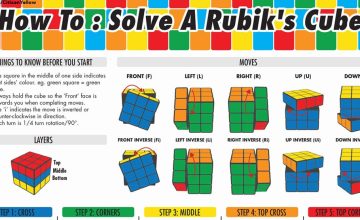
Solving approach: Most people learn a simplified version of the 3×3 method. You'll typically solve the first layer, orient the last layer corners, then permute them into place. Algorithms are minimal, but spatial reasoning is key since you can't rely on center pieces for orientation.
Difficulty rating: 2.1/5.0
Why it's ranked here: It's genuinely easier than a 3×3 for algorithmic complexity, but the absence of fixed centers creates a cognitive challenge that catches beginners off guard.
3x3x3 Standard Rubik's Cube: The Classic Benchmark
Ironically, the original cube ranks as one of the hardest for absolute beginners despite being the foundation for all other variants. With over 43 quintillion possible combinations, it requires learning multiple algorithms, understanding layer-by-layer or corner-first methods, and developing muscle memory.
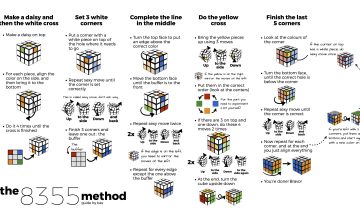
Solving approach: The beginner's method (layer-by-layer) uses about 5-7 algorithms. Advanced methods like CFOP (Fridrich), Roux, or ZZ require 50-100+ algorithms but dramatically reduce solve times.
Difficulty rating: 2.8/5.0 for learning to solve; 4.5/5.0 for speedcubing under 15 seconds
Why it's ranked here: While mechanically simple, the 3×3 remains the ultimate test of algorithmic learning and pattern recognition. Many never solve it without guidance.
4x4x4 Rubik's Revenge: The Parity Introducer
The 4×4 introduces two major complications: no fixed center pieces and parity cases that don't exist on the 3×3. You'll need to build centers first, then pair edges before reducing it to a 3×3-like state. But then the nightmare begins—occasionally you'll encounter situations where two edges or two corners are swapped in ways impossible on a 3×3.
Solving approach: Reduction method (solve centers, pair edges, solve as 3×3) plus specialized parity algorithms. OLL (Orientation of Last Layer) and PLL (Permutation of Last Layer) parity require unique sequences.
Difficulty rating: 3.4/5.0
Why it's ranked here: The 4×4 forces you to think in multiple stages and deal with seemingly unsolvable states. It's a gateway to understanding larger cubes and parity concepts.
5x5x5 Professor's Cube: The Odd-Layered Relief
Surprisingly, the 5×5 is easier than the 4×4 in terms of parity. Because it has fixed center pieces (the middle piece of each face), you always have orientation references. The solving process is similar: solve centers, pair edges, reduce to 3×3. The only extra complexity is more pieces to manage.
Solving approach: Same reduction method as 4×4, but with more intuitive center building. No parity cases to worry about once reduced.
Difficulty rating: 3.2/5.0
Why it's ranked here: More time-consuming but conceptually simpler than the 4×4. A good confidence builder after mastering the 4×4.
Pyraminx: The Tetrahedral Introduction
This triangular pyramid puzzle is often the first "non-cube" twisty puzzle solvers encounter. With only 4 corners, 4 middle edges, and 4 axial pieces, it's mechanically straightforward. The tips (corner extensions) are essentially free solves that just need twisting into place.
Solving approach: Solve the tips first (trivial), then use basic 3×3 corner and edge algorithms adapted for the tetrahedron shape.
Difficulty rating: 2.0/5.0
Why it's ranked here: It's genuinely one of the easiest puzzles, but introduces you to non-cubic geometry and builds spatial reasoning for more complex shapes.
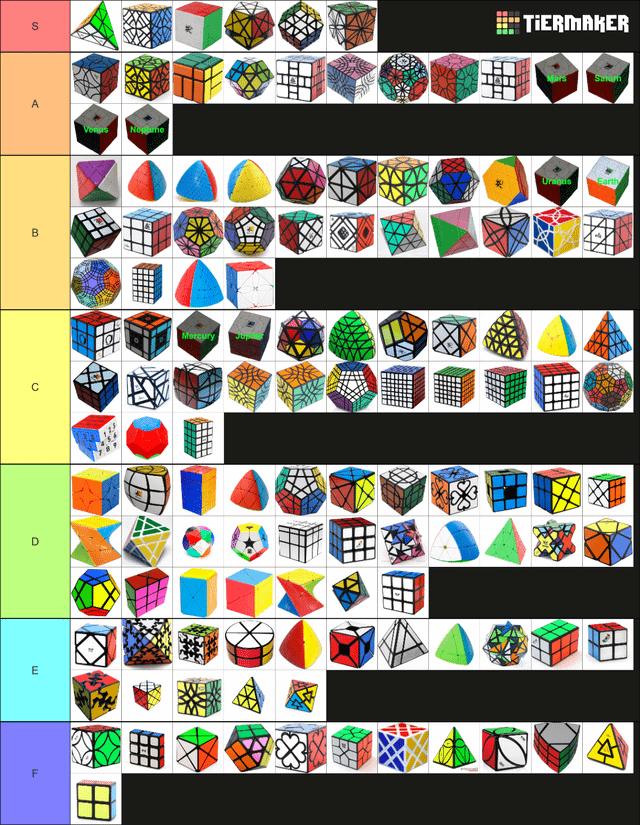
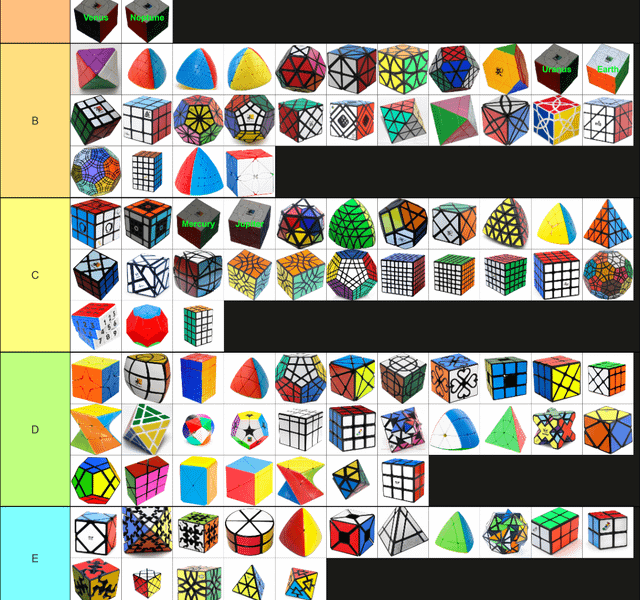
Community tier lists show how experienced cubers categorize these foundational puzzles as "entry-level" compared to the shape-shifting monsters above.
Tier 2: Intermediate Complexity with New Challenges
6x6x6 and 7x7x7 Cubes: Scaling Up the Method
Larger cubes (6×6 and beyond) follow the same reduction principle as the 4×4 and 5×5. The 6×6 reintroduces parity issues (since it's even-layered), while the 7×7 has fixed centers like the 5×5. The real challenge isn't the algorithms—it's patience and managing the increased piece count without losing track of your progress.
Solving approach: Extended reduction method. For 6×6: solve centers, pair edges (more complex than 4×4), reduce to 4x3x3 state, handle parity. For 7×7: solve centers (larger 5×5 grids), pair edges, reduce to 3×3.
Difficulty rating: 6×6: 3.5/5.0, 7×7: 3.3/5.0
Why ranked here: More tedious than difficult. A 12×12 or even 17×17 is solved the same way—just with more repetition.
Skewb: The Diagonal Challenger
The Skewb twists around corners instead of faces, creating a different type of spatial puzzle. It has 8 corner pieces that are also the "centers" and 6 edge pieces. The moves affect three faces at once, which throws off people used to face-turning cubes.
Solving approach: Often solved intuitively in 10-15 moves. Learn basic corner placement and edge insertion algorithms.
Difficulty rating: 2.3/5.0
Why ranked here: Mechanically simple but conceptually different. Great for training flexible spatial thinking.
Megaminx: The Dodecahedral Beast
This 12-sided puzzle looks terrifying but is essentially a 3×3 with more faces. The solving method is nearly identical to a 3×3: solve one face, then cycles of edges and corners around the equator, then the last layer. The only real difference is more pieces to track and slightly more complex algorithms for the last few pieces.
Solving approach: Standard 3×3 layer-by-layer, repeated across 12 faces instead of 6. Last layer may require more algorithms or intuitive solving.
Difficulty rating: 3.0/5.0
Why ranked here: The sheer number of pieces (50 movable pieces) intimidates beginners, but the method is straightforward once you accept it's just a "longer" 3×3.
Square-1: The Shape-Shifting Gateway
The Square-1 combines layers of triangles and squares, allowing it to change shape completely during solving. It's the first puzzle on most lists that requires you to think about restoring the cube shape before solving colors. Jumbling is minimal, but the piece asymmetry is disorienting.
Solving approach: Three phases: 1) Slice the puzzle (even number of triangles on top layer), 2) Restore cube shape, 3) Solve like a 3×3 using adapted algorithms.
Difficulty rating: 3.7/5.0
Why ranked here: Introduces shape-shifting without the chaos of full jumbling. A critical stepping stone to harder puzzles.
Mirror Cube: The Colorless Challenge
Also called the Mirror Blocks, this puzzle removes color entirely. All stickers are the same color (usually silver), and you solve by matching piece heights and shapes to restore the cube form. It's mechanically identical to a 3×3, but the lack of color forces you to track piece relationships visually.
Solving approach: Standard 3×3 method, but you must learn to identify center, edge, and corner pieces by their 3D shape rather than color. Centers are the flattest pieces, edges are longer, corners are the bulkiest.
Difficulty rating: 2.9/5.0
Why ranked here: It's just a 3×3 in disguise, but the cognitive load of tracking shapes instead of colors makes it feel harder. Excellent for improving spatial awareness.
Fisher Cube: The Rotated 3×3
The Fisher Cube is a shape mod of the 3×3 where the cut planes are rotated 45 degrees relative to the centers. This causes the puzzle to change shape when scrambled, but unlike the Square-1, it doesn't jumble. You still solve it using 3×3 algorithms, but you have to mentally map the distorted pieces back to their 3×3 equivalents.
Solving approach: Recognize that it's a 3×3 with shifted slice layers. Solve centers first (they're the pieces that don't move relative to each other), then edges and corners using standard 3×3 algorithms with adjusted grip.
Difficulty rating: 3.1/5.0
Why ranked here: Introduces the concept of "shape mods" without full jumbling. A good test of whether you understand cube mechanics rather than just memorizing algorithms.
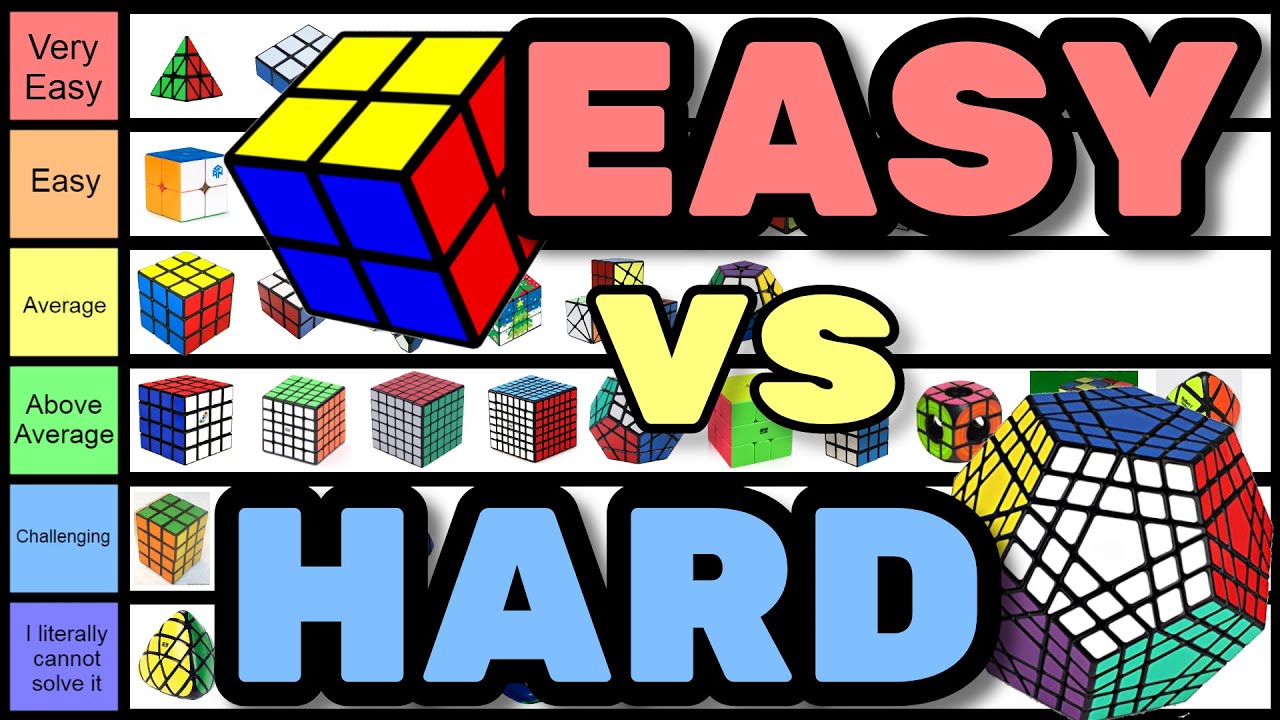
This tier represents the "bridge" puzzles where solvers transition from pure algorithm execution to true spatial reasoning and puzzle comprehension.
Tier 3: Advanced Shape-Shifting and Jumbling Begins
Mastermorphix: The Tetrahedral Shape-Shifter
The Mastermorphix looks like a friendly tetrahedron, but once scrambled it loses all sense of orientation. It's a shape mod of the Pyraminx, but with deeper cuts that allow full shape-shifting. The key realization is that it's structurally identical to a 3×3 cube—just transformed into a tetrahedron.
Solving approach: The breakthrough is mentally mapping each piece back to its 3×3 role. What looks like a curved triangle is actually a 3×3 corner. The awkward double-width piece is an edge. Once you overlay 3×3 logic, you can use standard algorithms with careful piece tracking.
Difficulty rating: 3.8/5.0
Why ranked here: It destroys your orientation and forces you to solve without a fixed "top" or "bottom." Memorizing more algorithms doesn't help—you must understand the underlying structure.
Axis Cube: The Asymmetric Nightmare
The Axis Cube has cuts that are not aligned with the faces, creating an asymmetric shape that changes with every turn. It's a shape mod of the 3×3 with cuts along the cube's face diagonals. The result is a puzzle where no two pieces look the same, and the solved state isn't a cube at all—it's a distorted octahedron-like shape.
Solving approach: Like the Mastermorphix, you must mentally map pieces to 3×3 roles. The centers are the pieces that stay in place relative to each other (forming a core axis). Edges and corners are identified by shape and position relative to those centers. Algorithms must be applied with constant awareness of the current shape.
Difficulty rating: 4.0/5.0
Why ranked here: The asymmetric cuts mean you can't rely on any symmetry or pattern recognition. Every solve requires intense spatial tracking.
Helicopter Cube (Curvy Copter): The Jumbling Icon
This puzzle is famous for its curved cuts that cause jumbling—moves become blocked at arbitrary angles, creating a chaotic state that looks unsolvable. It has 8 corner pieces and 6 face pieces, all with curved shapes. The solved state is a sphere-like shape, but scrambling can produce wildly asymmetric forms.
Solving approach: There is no single algorithmic method. You must learn to recognize solvable vs. jumbled states and use intuition to restore symmetry. Many solvers use a "bandaging" technique: making moves that are legal and slowly reducing the puzzle to a solvable state.
Difficulty rating: 4.2/5.0
Why ranked here: Jumbling breaks all algorithmic thinking. You're essentially doing a 3D jigsaw puzzle with moving parts.
Redi Cube Mods: The Constrained Chaos
The Redi Cube is a 3×3 with internal constraints that limit how far each face can turn. Some versions have faces that only turn 90 degrees, others have faces that are blocked at certain angles. The Constrained Cube Ultimate takes this further: one face is completely locked, and other faces have partial restrictions. This means many standard 3×3 algorithms are impossible to execute.
Solving approach: You must invent new algorithms that work within the movement constraints. Often this means breaking down standard algorithms into smaller, legal moves or finding completely different approaches.
Difficulty rating: 3.9/5.0 (basic Redi), 4.1/5.0 (Constrained Cube Ultimate)
Why ranked here: Constraints force you to think creatively rather than rely on memorization. It's a test of true problem-solving.
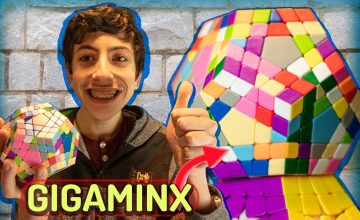
Gigaminx, Teraminx, and Larger: The Size Monsters
The Gigaminx is a 12-sided puzzle like the Megaminx but with 5 layers per face (like a 5×5). The Teraminx is a 3-layer Pyraminx. These puzzles are time-consuming but not mechanically harder than their smaller counterparts. A Gigaminx is just a Megaminx with more pieces to pair; a Teraminx is just a larger Pyraminx.
Solving approach: Same methods as smaller versions, scaled up. More centers to solve, more edges to pair.
Difficulty rating: Gigaminx: 3.4/5.0, Teraminx: 2.5/5.0
Why ranked here: They test patience and consistency, not new skills. A 11×11 Megaminx exists and is solved the same way.
Windmill Cube: The Rotational Shape-Shifter
The Windmill Cube is a shape mod of the 3×3 with cuts that follow a windmill pattern. It changes shape as you turn, and the pieces have irregular forms. Like the Fisher Cube, it doesn't jumble, but the shape-shifting is more pronounced.
Solving approach: Recognize it as a 3×3 with rotated cuts. Solve centers first, then use 3×3 algorithms with adjusted piece tracking.
Difficulty rating: 3.3/5.0
Why ranked here: Another stepping stone between basic shape mods and full jumbling puzzles.
Over-the-Top Cube: The Extreme Shape Mod
The Over-the-Top Cube is a **heav
y distorted shape mod of the 3×3 where the center pieces are pushed outward, creating a puzzle that looks like a cube with bulging faces. The cuts are offset from the standard 3×3 grid, causing the puzzle to shift into bizarre asymmetric forms when scrambled. Unlike the Fisher Cube, the Over-the-Top has more extreme distortion, making it harder to recognize which pieces correspond to standard 3×3 roles.
Solving approach: Treat it as a 3×3 with warped geometry. The first step is always to identify the core axis—the set of pieces that form the true centers despite their outward bulge. Once you lock those in place, you can map edges and corners by their relative positions and apply 3×3 algorithms, but with constant visual adjustments for the warped shape.
Difficulty rating: 3.6/5.0
Why ranked here: It pushes shape mod comprehension further than the Fisher Cube, requiring you to solve without clear right angles or flat faces. A good test of whether you truly understand cube mechanics versus just memorizing patterns.
Tier 4: Expert-Level Jumbling and Parity Nightmares
Ghost Cube: The No-Reference Nightmare
The Ghost Cube is arguably the hardest pure shape mod ever created. It has no colors, no flat faces, and no obvious solved state. When scrambled, it looks like a chaotic cluster of irregular polyhedra. The breakthrough is realizing it's structurally a 3×3 cube with all cuts rotated and distorted. Every piece must be identified by shape alone, and there's no fixed orientation to guide you.
Prerequisites:
- Mastery of 3×3 algorithms (CFOP or Roux)
- Strong spatial visualization skills
- Patience for trial-and-error piece identification
- A solved Ghost Cube to study (or a simulator)
Step-by-step solving method:
-
Examine the solved state: Before scrambling, spend time rotating the solved Ghost Cube. Notice how the pieces interlock. The centers are the three pieces that share a vertex on each face—these form the core axis and don't move relative to each other.
-
Identify the centers first: When scrambled, look for the three pieces that can still form a stable vertex. These are your reference points. They may not look like "centers" but they're the only pieces with three mutual neighbors.
-
Map edges and corners: Edges connect two centers; corners connect three centers. Use shape matching—edges are typically longer and thinner, corners are bulkier with three distinct faces.
-
Apply 3×3 algorithms with extreme caution: Once you've identified piece roles, use standard 3×3 algorithms, but after every move, check if the puzzle has shifted into a jumbled state. If a move blocks, you've misidentified a piece.
-
Iterate and correct: Ghost Cube solving is often backtracking. If you get stuck, undo moves and re-identify pieces. There's no algorithm for misidentified pieces—you must use logic.
⚠️ WARNING: Many solvers give up because they assume their piece identification is correct. The Ghost Cube's cruelty is that one misidentified piece can make the entire puzzle appear unsolvable. Double-check every piece's role before proceeding.
Verification: After solving, the Ghost Cube should return to its original symmetric solved shape—a distorted cube with all pieces aligned. If it looks even slightly off, you likely have a piece misoriented.
Difficulty rating: 4.7/5.0
Why ranked here: It removes every visual cue and forces pure spatial reasoning. Even experienced cubers struggle for weeks.
Curvy Coaster: The Jumbling Evolution
The Curvy Coaster is an advanced version of the Helicopter Cube with deeper cuts and more jumbling potential. It can enter states where no moves are possible except the reverse of the last move—called a "dead end." Solving requires reducing jumbling step-by-step rather than applying algorithms.
Solving approach: Use a "bandaging" method: make moves that create symmetry, then solve symmetric layers first. There's no standard algorithm set—each solve is unique.
Difficulty rating: 4.4/5.0
Why ranked here: Jumbling is taken to the extreme. You're essentially solving a 3D puzzle with no guaranteed moves.
11×11 and Larger Even-Layered Cubes: Parity on Steroids
While larger cubes follow the same reduction method, even-layered cubes (12×12, 14×14) introduce multiple parity cases that can occur in any layer. The 11×11 (odd-layered) has fixed centers, so it's easier than the 12×12. However, the sheer number of pieces means parity can appear in multiple places simultaneously, requiring complex multi-step algorithms.
Solving approach: Standard reduction (solve centers, pair edges), but you must be prepared for edge parity, corner parity, and even center parity in larger even-layered cubes. Learn parity algorithms for each case type.
Difficulty rating: 12×12: 3.8/5.0, 14×14: 3.9/5.0
Why ranked here: The mechanical difficulty is low, but the cognitive load of managing multiple parity cases pushes it into expert territory.
Square-2 and Square-3: The Square-1 Family
The Square-2 is a 2-layer version of the Square-1, and the Square-3 is a 3-layer version with more piece types. Both change shape and require restoration to a cube form before solving colors. The Square-3 is particularly nasty because it has multiple slice layers that can jumble independently.
Solving approach: Similar to Square-1: slice, restore shape, solve. But with more layers, you must manage interdependent slices and avoid creating jumbles in one layer while fixing another.
Difficulty rating: Square-2: 3.5/5.0, Square-3: 4.0/5.0
Why ranked here: The Square-3's independent slices create a multi-dimensional jumbling challenge.
Tier 5: The Impossible Tier—Puzzles That Break the Mind
Constrained Cube Ultimate: The Locked Beast
The Constrained Cube Ultimate is a 3×3 with one face completely locked (cannot turn) and other faces having partial restrictions (e.g., only 90-degree turns). This means standard 3×3 algorithms are often impossible, and you must invent new sequences that work within the constraints.
Prerequisites:
- Deep understanding of 3×3 commutators and conjugates
- Ability to write custom algorithms
- High frustration tolerance
Step-by-step solving method:
-
Analyze the constraints: Determine which faces can turn and by how much. For example, if the U (up) face is locked, you cannot use any algorithm that requires a U move.
-
Solve using only legal moves: Start with the bottom layer (D face) if it's free. Use only D, R, L, F, B moves as allowed. You'll need to adapt standard algorithms—e.g., replace U moves with sequences like (R U' R') if U is locked but R and U' are legal.
-
Use commutators for fine adjustments: When you can't execute a full algorithm, use commutators (A B A' B') to swap or orient specific pieces without disturbing solved parts.
-
Parity handling: The constraints can create parity-like states. You may need to develop custom parity algorithms that only use legal moves.
-
Iterative testing: Many solves require trial-and-error. Write down your custom algorithms and test them on a simulator before applying to the physical puzzle.
⚠️ CAUTION: Do not force moves beyond the constraints—you will break the puzzle. The Constrained Cube Ultimate is precision-engineered; forcing it will damage internal mechanisms.
Verification: After solving, the locked face should be in its solved orientation without having been turned. If you had to turn it at any point, you violated the constraint.
Difficulty rating: 4.8/5.0
Why ranked here: It's a 3×3 with artificial limitations that turn it into a custom algorithmic challenge. Every solve is a unique programming problem.
Rubik's Snake: The Freeform Jigsaw
The Rubik's Snake is a completely different beast: a twisty puzzle with no fixed solved state. It consists of 13 triangular prisms that can be twisted into any shape. The "solve" is replicating a specific target shape (e.g., a sphere, dog, or star). Because there's no single solution, it tests creative spatial construction rather than algorithmic solving.
Solving approach: For a given target shape, you must plan a sequence of twists that builds the shape layer by layer. There's no standard method—each shape requires its own strategy.
Difficulty rating: 4.5/5.0 (for complex shapes)
Why ranked here: It removes the concept of a "solved state" entirely, forcing you to think in terms of construction rather than restoration.
Void Cube: The Missing Center Mystery
The Void Cube is a 4×4 with the center 2×2 of each face removed, leaving a hollow core. This means no fixed centers at all—even more disorienting than the 4×4. You must solve it by matching edge colors to infer center positions, but because there are no centers, you can end up with the puzzle solved but rotated 90 degrees on an axis (a parity-like state that looks solved but isn't).
Solving approach: Treat it as a 4×4, but use edge colors to define the centers mentally. After reduction, you may need to perform a whole-cube rotation algorithm to fix the orientation parity.
Difficulty rating: 3.9/5.0
Why ranked here: The absence of centers creates a subtle but maddening orientation problem that catches even experienced 4×4 solvers.
Professor's Puzzle: The 6x6x6 with a Twist
The Professor's Puzzle is a shape mod of the 6×6 where the cuts are offset, causing shape-shifting. It's like combining the 6×6's parity challenges with the Fisher Cube's distortion. The puzzle can jumble slightly, making edge pairing more complex.
Solving approach: Use 6×6 reduction, but be prepared for pieces that don't pair cleanly due to shape distortion. You may need to use intuitive pairing rather than standard algorithms.
Difficulty rating: 4.1/5.0
Why ranked here: It merges two difficulty multipliers: parity and shape-shifting.
Square-4 and Higher: The Multi-Layer Square-1 Family
The Square-4 is a 4-layer version of the Square-1 with even more piece types and slice interactions. Each additional layer increases the combinatorial complexity of jumbling exponentially. The Square-4 can enter states where multiple slices are jumbled independently, requiring careful layer-by-layer restoration.
Solving approach: Extend the Square-1 method: slice, restore shape, solve. But with 4 layers, you must restore shape in a specific order (e.g., outer layers first, then inner) to avoid creating new jumbles.
Difficulty rating: 4.3/5.0
Why ranked here: The Square-4 is the point where the Square-1 family becomes truly combinatorial. Each solve is a unique puzzle.
How to Approach These Hardest Variants: A Strategic Roadmap
Tackling the hardest Rubik's cube variants isn't about brute force—it's about strategic skill-building. Here's a step-by-step roadmap to conquer the top difficulty tiers:
Phase 1: Master the Foundations (Tier 1-2)
- Solve a 3×3 under 2 minutes using the beginner's method.
- Learn CFOP or Roux to reduce solve time to under 1 minute. This builds algorithm fluency.
- Solve a 4×4 and 5×5 to understand parity and reduction methods.
- Solve a Square-1 to get comfortable with shape-shifting and restoration.
Phase 2: Introduce Shape Mods (Tier 2-3)
5. Solve a Mirror Cube to train shape-based recognition.
6. Solve a Fisher Cube to understand rotated cuts.
7. Solve a Mastermorphix to practice solving without fixed orientation.
8. Solve an Axis Cube to handle asymmetric pieces.
Phase 3: Conquer Jumbling (Tier 3-4)
9. Solve a Helicopter Cube using intuitive bandaging.
10. Solve a Curvy Copter to handle deeper jumbling.
11. Solve a Ghost Cube—this is the ultimate test of shape mod comprehension. Expect weeks of struggle.
Phase 4: Tackle Constraints and Parity Extremes (Tier 4-5)
12. Solve a Constrained Cube Ultimate by writing custom algorithms.
13. Solve a 12×12 or larger even-layered cube to manage multiple parity cases.
14. Solve a Square-4 to handle multi-layer jumbling.
⚠️ IMPORTANT: Do not skip phases. Each tier builds cognitive skills required for the next. Jumping to a Ghost Cube without mastering the 3×3 and Square-1 will lead to frustration and abandonment.
Tools and Resources:
- Simulators: Use online simulators (e.g., Cube Explorer, jperm.net) to practice shape mods and jumbling puzzles without buying expensive hardware.
- Algorithm databases: Websites like speedsolving.com have algorithm collections for parity and complex puzzles.
- Video tutorials: YouTube channels like J Perm, CubeSkills, and BadMephisto have detailed solves for nearly every variant.
- Community forums: Reddit's r/cubing and speedsolving.com forums are invaluable for troubleshooting specific puzzles.
Mental preparation:
- Embrace failure: You will get stuck, undo progress, and feel unsolvable. This is normal.
- Take breaks: Step away for hours or days if stuck—fresh eyes often reveal solutions.
- Study solved states: Always have a reference of the solved puzzle to compare against.
The Psychology of Solving Impossibly Hard Cubes
Solving the hardest Rubik's cube variants isn't just a mechanical challenge—it's a psychological endurance test. Here's what to expect mentally:
The "Plateau of Despair": After initial progress, you'll hit a wall where nothing seems to work. This is where most people quit. The key is to shift from algorithmic thinking to pattern recognition. Stop trying to apply memorized moves and start observing how pieces interact.
The "Aha!" Moment: For puzzles like the Ghost Cube or Mastermorphix, there's a sudden realization that the puzzle is a transformed 3×3. This moment of clarity is often preceded by days of confusion. Trust the process—the breakthrough will come.
Frustration management: Jumbling puzzles like the Curvy Copter can feel random. Use mindfulness techniques: focus on one small goal (e.g., "restore one face to a flat state") rather than the entire solve.
Celebrating micro-wins: In complex puzzles, progress is measured in millimeters. Celebrate identifying a center piece, pairing two edges, or restoring one face. These small victories build momentum.
Common Mistakes and How to Avoid Them
Even experienced cubers make these errors when tackling hard variants:
-
Assuming piece roles without verification: Especially in Ghost Cube and Axis Cube, always double-check your piece identification. One wrong assumption can ruin the entire solve.
-
Forcing jumbled puzzles: If a move is blocked, don't force it. Instead, undo the last few moves and try a different sequence that doesn't cause jumbling.
-
Ignoring parity until the end: On large even-layered cubes, check for parity after each major phase (centers, edges) to avoid last-layer disasters.
-
Memorizing algorithms without understanding: For constrained puzzles, you must understand why an algorithm works to adapt it to restrictions. Learn commutators and conjugates.
-
Skipping the "study the solved state" step: Always spend time examining the solved puzzle before scrambling. Note piece shapes, symmetries, and how they interlock.
-
Trying to speed-solve too early: Focus on solving correctly first. Speed comes with repetition and familiarity.
-
Not using simulators: Physical puzzles can be expensive and frustrating to break. Simulators let you experiment risk-free.
-
Comparing progress to others: Everyone's learning curve is different. Some take weeks to solve a Ghost Cube; others take months. Your journey is unique.
By following this strategic roadmap, understanding the psychology, and avoiding common pitfalls, you'll be equipped to conquer even the most daunting Rubik's cube variants. The hardest puzzles aren't just about turning pieces—they're about rewiring your brain to see beyond the chaos.
References
-
Reddit — My Rubik's Cube Difficulty Tier List for the 120+ puzzles I … – Reddit, 2026
-
Engineerine — Top 12 Hardest Rubik’s Cubes Ever Made (2025 List) – Engineerine, 2026
-
Ipassio — 7 Hardest Rubik’s Cubes in The World – ipassio, 2026
-
Rubiks — Rubik's Cube Difficulty Ratings – WikiCube, 2026
-
Superprof — The Hardest Rubik’s Cube Scramble to Solve – Superprof, 2026
-
Puzzlcrate — Top 5 Most Difficult Rubik's Cubes (Updated) – Puzzlcrate, 2026
-
Thingsidesire — Get Your Hands On 28 The Most Hardest Rubiks Cubes To Solve, 2026
-
Cubelelo — 5 Most Hardest Rubik's Cubes of All Time – Cubelelo®, 2026