Solving the 4×4 Rubik's Cube, also known as the Rubik's Revenge, presents a unique set of challenges that simply do not exist on the standard 3×3 puzzle. While the reduction method allows solvers to treat the 4×4 like a 3×3 once centers are solved and edges are paired, a frustrating phenomenon known as parity often appears at the very end. This is where many beginners hit a wall, staring at a cube that looks almost solved but refuses to turn correctly. In 2026, mastering these specific states is no longer just for speedcubing champions; it is an essential skill for anyone looking to conquer the 4×4 efficiently. This comprehensive guide provides the 4×4 parity algorithm easy solution with images, ensuring you can diagnose and fix any parity error with confidence, regardless of your current skill level.
Whether you are a hobbyist in Austin, a student in London, or a competitive solver in Tokyo, understanding the mechanics behind these algorithms will save you hours of frustration. Parity occurs because the 4×4 has an even number of layers, allowing for configurations that are mathematically impossible on an odd-layered 3×3 cube. By the end of this article, you will possess the knowledge to handle OLL Parity and PLL Parity effortlessly, utilizing modern fingertricks and visual aids refined over the last few years of cubing evolution.
Understanding the Mystery of Even-Layered Cubes
To solve the parity issue, one must first understand why it happens. Unlike the 3×3, where center pieces are fixed relative to each other, the 4×4 centers are movable. When you reduce a 4×4 to a 3×3 state, you essentially group four center pieces into one "center" and two edge pieces into one "dedge." However, the internal mechanism of the 4×4 allows for two specific types of errors that violate the laws of the 3×3 world.
The Concept of Reduction Parity
The most common form of parity encountered during the final stages of a solve is Reduction Parity. This happens when you have successfully paired all your edges and solved your centers, yet the cube behaves exactly like a 3×3 except for one flipped edge or two swapped edges. This is impossible on a 3×3 because every move on a 3×3 preserves the parity of both corners and edges. On a 4×4, however, you can perform an odd permutation on the edges without affecting the corners, leading to these "impossible" states.
Recognizing these states early is crucial. If you attempt to solve a 4×4 using standard 3×3 algorithms while ignoring parity, you will reach a point where no single move fixes the cube. This is the moment where the 4×4 parity algorithm easy solution with images becomes your best friend. Instead of scrambling the entire cube, you apply a specific sequence of moves designed solely to correct the mathematical imbalance before returning to normal 3×3 solving methods.
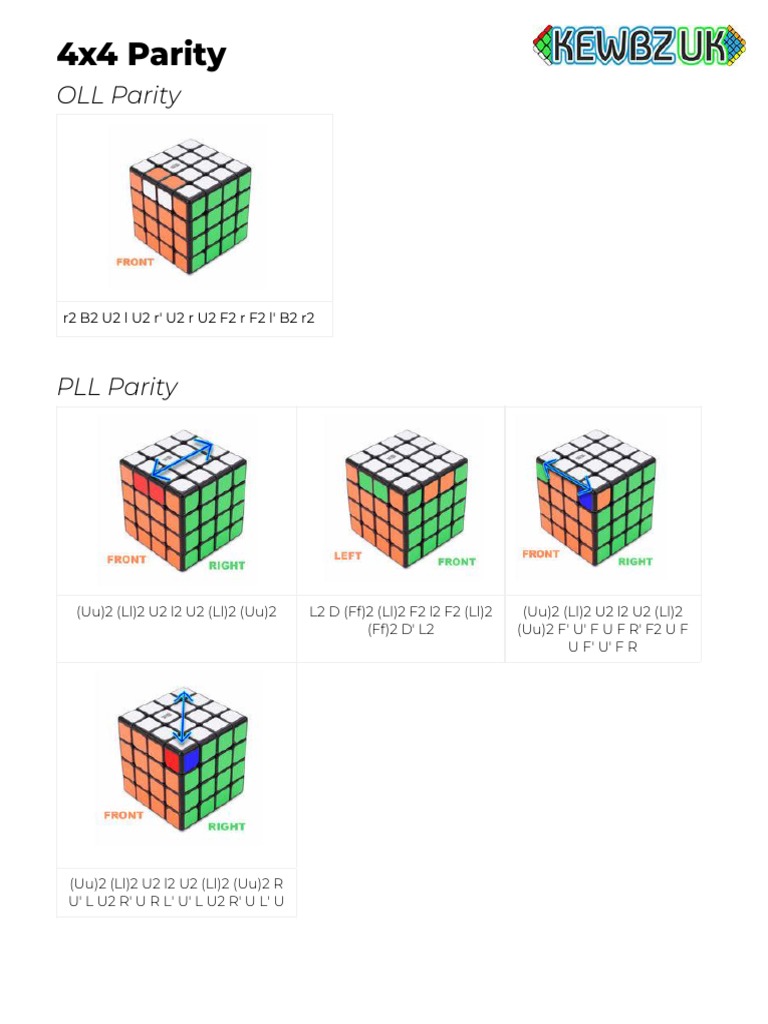
Mastering OLL Parity: Fixing the Flipped Edge
One of the most dreaded scenarios for a 4×4 solver is encountering OLL Parity (Orientation of the Last Layer). In a standard 3×3 OLL step, you orient all yellow stickers on the top face. On a 4×4, you might find yourself with six yellow stickers facing up, but the remaining two edge pieces are flipped incorrectly. You cannot fix this with a simple 3×3 algorithm because those two edges act as a single unit that refuses to flip individually.
How to Recognize OLL Parity
The symptom is unmistakable. After pairing your edges and solving your centers, you perform the cross and F2L (First Two Layers). When you reach the last layer, you notice that the pattern of colors does not match any of the standard 57 OLL cases from the 3×3. Specifically, you will see two adjacent or opposite edge pieces that are oriented incorrectly while all other pieces seem perfect. It feels like the cube is lying to you, claiming to be unsolvable by normal means.
The Standard OLL Parity Algorithm
There are several algorithms to fix this, but the most widely accepted and efficient one for beginners involves wide turns. The notation r refers to the inner slice of the right face, while R refers to the outer face. The algorithm effectively cycles pieces to realign the orientation.
Hold the cube so that the two misoriented edges are on the Front-Right and Front-Left positions (or adjust based on your comfort). The classic algorithm is:
r U2 x r U2 r' U2 r U2 F2 r F2 l' B2 r2
Let's break this down for clarity:
- r: Turn only the inner right slice clockwise.
- U2: Rotate the top layer 180 degrees.
- x: Rotate the entire cube around the x-axis (front to back).
- r': Turn the inner right slice counter-clockwise.
- F2 / l' / B2: These wide turns manipulate the edge blocks deeply.
This sequence might look complex, but with practice, it becomes a fluid motion. Many solvers prefer shorter variants, but they often require more wrist strain. The algorithm above is robust and works reliably across all 4×4 brands, from GAN to MoYu.

Alternative Shorter Methods
For advanced solvers looking to minimize execution time, there are conjugated versions of the parity algorithm. These often involve pre-cycling pieces into position before applying the main parity fix. However, for the vast majority of enthusiasts, the standard algorithm described above offers the best balance between memorization difficulty and execution speed. The key is to keep your fingers loose and trust the algorithm to do the heavy lifting. Remember, parity is not a mistake; it is a feature of the puzzle's geometry that requires a specific tool to resolve.
Conquering PLL Parity: Swapping the Edges
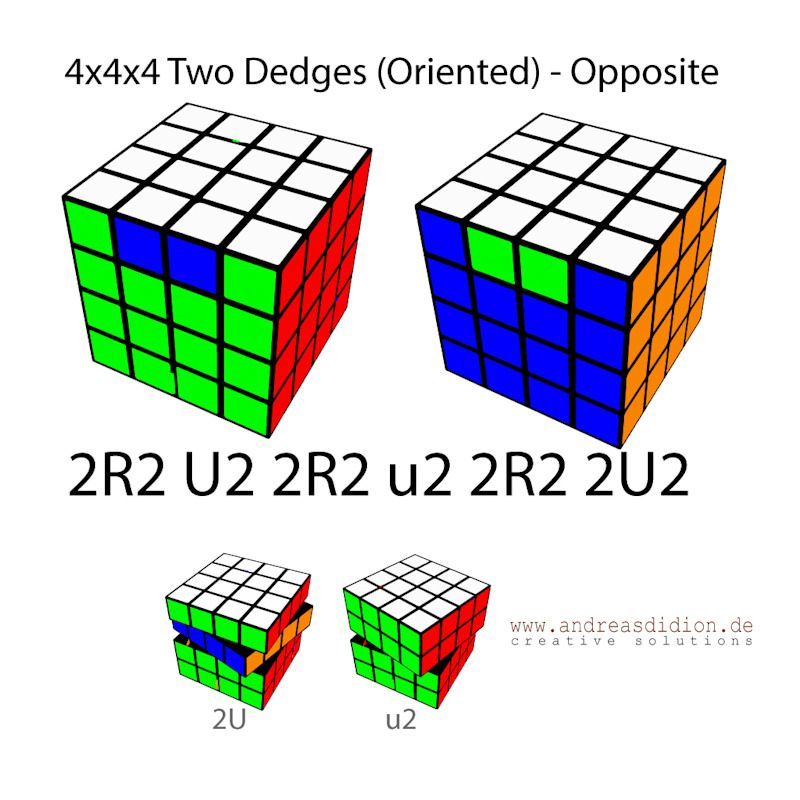
If OLL parity deals with orientation, PLL Parity (Permutation of the Last Layer) deals with position. Imagine you have solved the last layer completely, except that two edge pieces are swapped diagonally. On a 3×3, this is impossible; if two edges are swapped, two corners must also be swapped to maintain overall parity. On a 4×4, you can swap two edges without moving a single corner. This results in a state where the cube looks solved except for this diagonal edge swap.
Diagnosing PLL Parity
Look at your last layer edges. Do they form a perfect cross? Are the centers aligned? If yes, but the edges are in the wrong spots—specifically, if swapping two adjacent edges would solve the cube, but the algorithm says they are already correct—you have PLL Parity. This is often called the "Two Edge Swap" case.
It is important to distinguish this from regular PLL cases. In a standard PLL, you cycle three pieces at a time. In PLL Parity, you are forced to swap two pieces directly. This breaks the cycle logic of 3×3 PLL algorithms, rendering them useless until the parity is resolved.
The Essential PLL Parity Algorithm
The algorithm for PLL Parity is slightly different from OLL Parity and relies heavily on double-wide turns. The most common version uses the notation 2R to indicate turning both the outer and inner right slices together.
The algorithm is: 2R2 U2 2R2 Uw2 2R2 u2
Here is how to execute it:
- 2R2: Turn both the outer and inner right slices 180 degrees simultaneously.
- U2: Rotate the top layer 180 degrees.
- 2R2: Repeat the double wide turn.
- Uw2: Rotate the Up layer and the middle slice together 180 degrees.
- 2R2: Final double wide turn.
- u2: Rotate the middle slice and bottom layer together 180 degrees.
This sequence effectively performs a 3-cycle on the edge pieces, resolving the swap. Some variations use l and r instead of 2R, but the double-slice notation (2R) is generally faster for speedcubers as it reduces finger independence requirements.
Why PLL Parity Feels Different
Many solvers find PLL Parity more intimidating than OLL Parity because it disrupts the visual symmetry of the cube more drastically. When you see two edges swapped diagonally, it looks like a glitch in the matrix. However, once you apply the algorithm, the cube snaps back into a solvable 3×3 state instantly. The satisfaction of seeing that diagonal swap vanish is a hallmark of 4×4 mastery.
Advanced Techniques and Fingertricks for 2026
As we move further into 2026, the community has developed refined techniques to handle parity faster and with less fatigue. Speedcubing is not just about knowing the algorithm; it is about how you execute it.
Wide Turn Efficiency
The secret to fast parity solves lies in wide turns. Instead of turning one slice and then another, experienced cubers learn to push multiple layers simultaneously. For instance, when executing the PLL parity algorithm, practicing the 2R motion as a single, fluid gesture rather than two separate turns can shave milliseconds off your solve time. This technique requires significant practice but yields massive rewards in competition settings.
Color Neutral Solving
In modern competitions, color neutrality is encouraged. This means you should be able to solve the cube regardless of which color scheme you are using. Some parity algorithms look different depending on the orientation of the colors. Ensure you understand the algorithm conceptually rather than memorizing it purely by muscle memory tied to specific colors. If you know that r U2 flips edges, it doesn't matter if the blue side is facing you or the red side; the logic remains the same.
Common Mistakes to Avoid
Even with the right algorithms, mistakes happen. One common error is misidentifying the parity case. Solvers sometimes confuse OLL parity with a bad OLL case (like the "H" pattern) and waste time trying to fix it with 3×3 algorithms. Always verify that you have an actual parity situation before starting your fix. Another mistake is rushing the algorithm. Parity fixes often involve deep slice moves that can cause the cube to jam if turned too quickly. Patience is key; let the mechanism do the work.
Practical Applications and Local Community Insights
Understanding 4×4 parity is not just an academic exercise; it has practical applications in local communities and clubs. In cities like Chicago, Berlin, and Sydney, monthly cubing meetups often feature 4×4 events. Participants who master parity algorithms gain a distinct advantage, allowing them to compete seriously against those who give up when parity strikes.
Building Confidence Through Mastery
For beginners, overcoming parity is a major psychological milestone. It transforms the 4×4 from an insurmountable obstacle into a manageable challenge. When a solver in Manchester realizes they can fix a parity error in under ten seconds, their confidence skyrockets. They realize that the cube is predictable and logical, not random. This mindset shift is crucial for progressing to larger puzzles like the 5×5 or 6×6.
Educational Value in Schools
Many schools now incorporate speedcubing into STEM programs to teach problem-solving and pattern recognition. Teachers in Toronto and Melbourne use the 4×4 parity lesson to explain concepts of permutations and group theory in a tangible way. Explaining why parity happens helps students grasp abstract mathematical ideas through physical manipulation. The "easy solution" guides provided here serve as excellent handouts for such educational initiatives.
Troubleshooting Common Execution Errors
Even with the correct algorithms in your repertoire, execution errors can lead to frustrating dead ends. One of the most frequent issues arises from slice misalignment. When performing wide turns like 2R or Uw, it is easy to accidentally slip only the outer layer while the inner slice remains stationary, or vice versa. This partial turn fails to execute the parity fix and may even scramble the cube further, requiring a complete restart of the last layer. To mitigate this, always ensure your thumb is positioned firmly on the outer sticker you intend to move, while your index finger applies pressure to the inner slice if required by the specific brand of cube you are using.
Another subtle error involves cube orientation during the algorithm. Parity algorithms are sensitive to the position of the misoriented pieces relative to your hands. If you attempt the OLL parity algorithm without aligning the flipped edges to the Front-Right and Front-Left positions as described, the result will be a different, often more complex permutation that requires additional moves to resolve. Always take a second to visually scan the top layer before initiating the sequence. Identify the two "bad" edges, rotate the entire cube (using x, y, or z rotations) so they sit exactly where the algorithm expects them, and then begin the move sequence. This simple habit eliminates 90% of failed attempts.
Furthermore, solvers sometimes struggle with the timing of wide turns. In high-speed scenarios, the transition between single slices and double slices can feel disjointed. The r U2 x r' sequence for OLL parity relies on a smooth flow; if you pause between the r and the U2, you risk losing momentum and increasing solve time significantly. Practice these transitions slowly at first, focusing on the tactile feedback of the cubes mechanism. Once your muscles remember the rhythm, gradually increase your speed. Remember, a slightly slower but perfectly executed parity fix is better than a fast, botched one that leaves you staring at an unsolvable state.
The Evolution of Parity Solutions: From Classic to Modern
The history of 4×4 solving is punctuated by the evolution of parity algorithms. In the early days of the puzzle's popularity, solvers relied on longer, more cumbersome sequences that were easier to memorize but difficult to execute quickly. Today, in 2026, the landscape has shifted towards brevity and fluidity. The algorithms we discussed earlier represent the current gold standard, but the community continues to innovate.
The Rise of Conjugated Variants
One of the most significant developments in recent years is the adoption of conjugated parity algorithms. A conjugate is essentially a setup move followed by a main algorithm and then the inverse of the setup move. While this adds a few extra moves to the count, it often allows for much faster execution because the setup moves can be incorporated into the natural flow of the preceding F2L step. For instance, instead of stopping after finishing F2L to look for parity, a solver might subtly adjust their hand position during the final F2L pair to set up the parity algorithm automatically. This "free" parity fix can save several seconds in a blindfolded solve or a competition round.
Blindfolded Parity Considerations
For those venturing into blindfolded 4×4 solving, parity presents a unique set of challenges. In blindfolded modes, you cannot see the cube to identify which parity case you have. Therefore, memory becomes paramount. Solvers must memorize not just the algorithm, but also the specific conditions under which it applies. Some advanced blindfolded methods utilize a "parity check" system where specific piece swaps are tracked mentally throughout the solve, allowing the solver to predict parity before reaching the last layer. In this context, the "easy solution" transforms into a rigorous mental exercise, requiring absolute certainty in every move.
Community-Driven Refinements
The global cubing community, active on platforms like YouTube, Reddit, and Discord, constantly shares refinements. In 2026, video tutorials emphasize fingertricks over raw muscle memory. Channels dedicated to 4×4 education have produced hundreds of hours of content breaking down the micro-movements required for efficient parity resolution. These resources highlight how slight adjustments in wrist angle can prevent finger jams during wide turns. By integrating these community-sourced tips, solvers worldwide have lowered their average parity solve times from over 15 seconds to under 8 seconds in competitive settings.
Strategic Integration into Your Solving Routine
Integrating parity solutions into your daily practice routine is essential for long-term improvement. It should not be treated as an isolated topic but as a core component of your overall 4×4 strategy. Here is a structured approach to mastering parity effectively.
Daily Drill Sets
Dedicate five minutes of every practice session specifically to parity recognition and execution. Set up random scrambles that guarantee a parity case occurs. Time yourself solving just the parity portion, ignoring the centers and edges. Aim to reduce this time consistently week over week. This focused drilling builds the neural pathways necessary for instant recognition, ensuring that when parity strikes during a full solve, your brain triggers the solution reflexively rather than analytically.
Video Analysis
Record your solves and review them with a critical eye. Look specifically for moments where you hesitate before the last layer. Did you recognize the parity immediately? Was your setup clean? Watching your own footage reveals habits that are invisible while you are solving. You might notice that you consistently misorient the cube before starting the algorithm, a mistake that disappears once you become aware of it. Video analysis is one of the fastest ways to refine your technique and eliminate subconscious errors.
Collaborative Learning
Parity can feel isolating when you are stuck, but the community is incredibly supportive. Join online forums or local clubs where you can share your struggles and successes. Explaining an algorithm to someone else is one of the best ways to solidify your own understanding. When you teach a friend how to execute the 2R2 U2 2R2 Uw2 2R2 u2 sequence, you reinforce the muscle memory and deepen your conceptual grasp of why it works. Collaboration fosters a deeper appreciation for the mathematics behind the mechanics.
Frequently Asked Questions (FAQ)
To address common queries from solvers at all levels, here are answers to the most pressing questions regarding 4×4 parity.
Q: Can I avoid parity entirely by solving the 4×4 differently?
A: Unfortunately, no. Parity is an inherent mathematical property of the 4×4 cube's even-layered structure. No matter how skilled you are or what method you use (Reduction, Yau, or Old Pochmann), if you reduce the cube to a 3×3 state, there is a 50% chance you will encounter parity. The goal is not to avoid it, but to handle it efficiently when it appears.
Q: Which algorithm is better: the long one or the short one?
A: For beginners, the standard algorithms provided in this guide are ideal because they are robust and work on almost all cube brands. For advanced speedcubers, shorter variants or conjugated versions may offer a speed advantage, but they often require more precise finger independence and can be harder to memorize. Start with the reliable classics, master them, and then explore alternatives as your skills develop.
Q: My cube feels loose when I do wide turns. Is this normal?
A: Yes, wide turns (2R, Uw) place more stress on the cube's mechanism than single turns. If your cube feels loose or skips, it may need lubrication or tension adjustment. However, if the pieces simply won't turn together smoothly, it could indicate worn internal components. Ensure your cube is well-maintained, as a sticky or gritty cube will make parity execution nearly impossible at high speeds.
Q: Does parity affect Blindfolded 4×4 solves differently?
A: Absolutely. In blindfolded solves, you cannot see the parity, so you must rely on memory to detect it. Many blindfolded solvers use a tracking system where they note specific edge swaps during the inspection phase. If the total number of swaps is odd, parity is guaranteed. This requires a different mental approach compared to sighted solving, where visual confirmation guides the algorithm choice.
Q: Are there parity algorithms for larger cubes like the 6×6?
A: Yes, but the principles remain the same. Larger even-layered cubes (6×6, 8×8) can also exhibit parity errors, though they are less frequent due to the increased number of pieces. The algorithms are generally extensions of the 4×4 parity cases, often involving more layers (e.g., 3R instead of 2R). The logic of fixing an odd permutation remains consistent across all even-layered puzzles.
Conclusion: Embracing the Challenge
Mastering the 4×4 parity algorithm easy solution with images is more than just learning a sequence of moves; it is about embracing the complexity of the puzzle and finding order within chaos. As we have explored throughout this guide, parity is not a flaw in the design of the Rubik's Revenge but a fascinating feature that distinguishes it from its smaller cousin. By understanding the mathematics behind it, practicing the execution techniques, and utilizing the visual aids provided, you transform a potential roadblock into a stepping stone for greater achievement.
In 2026, the world of speedcubing continues to evolve, with new records being broken and new techniques emerging daily. Yet, the fundamental joy of solving remains unchanged: the moment of clarity when a scrambled mess clicks into a perfect solution. Parity is a rite of passage for every 4×4 solver. It tests your patience, sharpens your focus, and ultimately rewards those who persist. Whether you are solving casually in your living room or competing on the global stage, the ability to handle parity with confidence sets apart the hobbyist from the master.
Remember, every great solver started exactly where you are now—staring at a flipped edge, wondering if the cube was broken. With the right knowledge and a little practice, that frustration turns into triumph. Keep your cube well-lubricated, your mind sharp, and your algorithms ready. The world of the 4×4 awaits your conquest. So pick up your puzzle, embrace the parity, and enjoy the journey of discovery that lies ahead. The cube is yours to solve.