Welcome to the new era of speedcubing in 2026. If you are reading this, you have likely already mastered the beginner's method and are staring at a solve time that feels frustratingly stuck between 30 and 45 seconds. You know the algorithms, you understand the notation, but something is holding you back. That missing link isn't your cube choice or your inspection time; it is your finger tricks. In the fiercely competitive landscape of modern cubing, milliseconds are won or lost on the precision of a single flick. This comprehensive guide will take you from basic mechanics to pro-level efficiency, ensuring you unlock the full potential of your solving style.
The journey to sub-10 times is not linear; it is a mosaic of thousands of micro-adjustments. While many beginners rely on inefficient wrist turns, which involve rotating the entire hand and often require re-gripping the cube after every move, advanced solvers utilize specific finger motions to minimize movement. This article dives deep into the research-backed techniques used by top-tier competitors in 2026. We will explore how to build muscle memory, optimize your home grip, and execute complex algorithms with the fluidity of a master pianist. Whether you are competing locally in cities like Mumbai, London, or New York, mastering these techniques is the universal key to breaking your personal best.
Why Finger Tricks Are the Non-Negotiable Foundation of Speed
To understand how to learn advanced finger tricks for faster times, one must first grasp why they are superior to traditional turning methods. In the context of speedcubing, efficiency is king. The primary goal of any advanced technique is to reduce the number of cube rotations and eliminate unnecessary pauses. When a beginner solves a cube, they often turn the entire face using their whole hand, then lift the cube to change orientation, and repeat. This process creates "dead time"—moments where the cube is stationary while the solver repositions their hands.
Advanced finger tricks solve this problem by keeping the cube in a stable position as much as possible. By utilizing individual fingers, such as the index, middle, ring, and pinky, a cuber can execute moves without lifting the cube. This allows for overlapping moves, a concept where the execution of one move begins before the previous one has fully finished. For instance, while pulling an R move with the right index finger, the left hand can already be preparing to push the U layer. This overlapping reduces the total time per algorithm significantly.
Furthermore, finger tricks directly influence corner cutting. Corner cutting is the ability to turn a face slightly before the cube is actually solved, relying on the mechanism's tolerance to start the next move early. Without efficient finger tricks, corner cutting is impossible because the hand movement is too large and jerky. Smooth, precise finger movements create the necessary momentum and control to slide pieces into place effortlessly. As noted by industry experts in 2026, the difference between a 20-second solver and a 6-second solver is almost entirely attributable to the quality of their finger trick execution.
The Cost of Inefficient Habits
It is crucial to address the danger of developing bad habits early. Many beginners develop a reliance on full-hand turns simply because it feels more natural initially. However, once these habits are cemented, breaking them becomes exponentially difficult. Imagine trying to unlearn a language you spoke fluently since childhood; similarly, undoing years of wrist-based turning requires conscious, deliberate practice. If you continue to use your wrist for every R or L move, you will hit a hard ceiling around the 30-second mark. To progress beyond this, you must actively suppress the urge to rotate your wrist and instead engage the smaller, faster muscles of your fingers.
Research into speedcubing mechanics suggests that professional cubers spend hours specifically drilling finger sequences in isolation. They do not just solve random cubes; they isolate specific triggers—short algorithmic patterns like R U R' U'—and refine them until they become subconscious. This dedicated practice ensures that when faced with a complex scramble during a competition, their hands automatically default to the most efficient path. Ignoring this aspect of training is akin to a marathon runner refusing to work on their stride length; no amount of endurance will compensate for poor form.
Mastering the Home Grip: The Silent Game Changer
Before diving into the specific mechanics of individual fingers, we must establish the foundation upon which all advanced techniques rest: the Home Grip. Often overlooked by intermediate solvers, the way you hold the cube dictates your ability to execute smooth transitions. A proper home grip minimizes the distance your fingers need to travel to reach their target positions, effectively reducing reaction time.
In 2026, the consensus among top coaches is clear: your left thumb should be firm on the front center sticker, providing stability. Your right thumb rests on the front-right edge, acting as a pivot point. Crucially, your right index, middle, and ring fingers should curl around the back-right side of the cube, while the corresponding fingers on the left hand grip the back-left side. Both pinky fingers should rest loosely on the underside of the cube, serving as a counter-balance rather than a source of tension. This configuration allows for maximum flexibility, enabling rapid shifts between faces without losing contact with the cube.
Why does the home grip matter so much for learning advanced finger tricks? Consider the transition from an F move to an R move. If your grip is loose or incorrect, you might find yourself needing to adjust your hand position mid-algorithm, costing valuable milliseconds. With a solid home grip, the cube remains relatively static in your hands, and only the layers move. This stability is essential for lookahead, the ability to see the next pair while executing the current one. If your hands are constantly readjusting, your eyes cannot look ahead, and your solve becomes disjointed and slow.
Moreover, a consistent home grip aids in muscle memory development. When your fingers always start from the same relative position, the brain can map out the motor patterns more efficiently. It is like a musician sitting at a piano with their hands in the correct spot before playing a concerto; the preparation is half the battle. In local competitions across major hubs, judges and observers often note that solvers with unstable grips tend to have higher error rates under pressure. Stability breeds confidence, and confidence translates to speed.
To test your home grip, try solving a simple cross while consciously maintaining this position. Notice if your fingers feel cramped or if you have to stretch to reach certain stickers. Adjust your finger curvature until the cube feels like an extension of your hand. Remember, comfort does not mean relaxation; it means optimal positioning for maximum leverage and speed. Spend at least five minutes of every practice session focusing solely on maintaining this grip, even when solving randomly. This seemingly mundane exercise will yield massive returns in your long-term progression.
Essential Finger Tricks for Beginners: Building the Toolkit
Now that we have established the importance of grip and mindset, let us delve into the specific mechanics of the most common moves. These foundational tricks are the building blocks for everything else you will learn. Mastering these requires patience and slow, deliberate practice. Rushing through these steps will only result in frustration and inconsistent execution.
The Universal Flicks: U and U' Moves
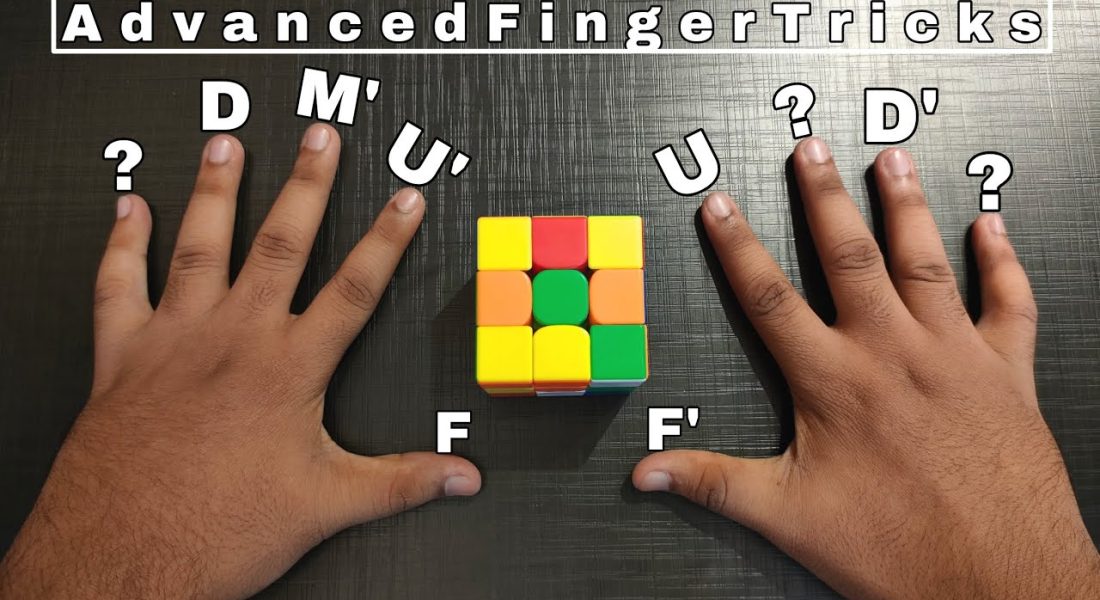
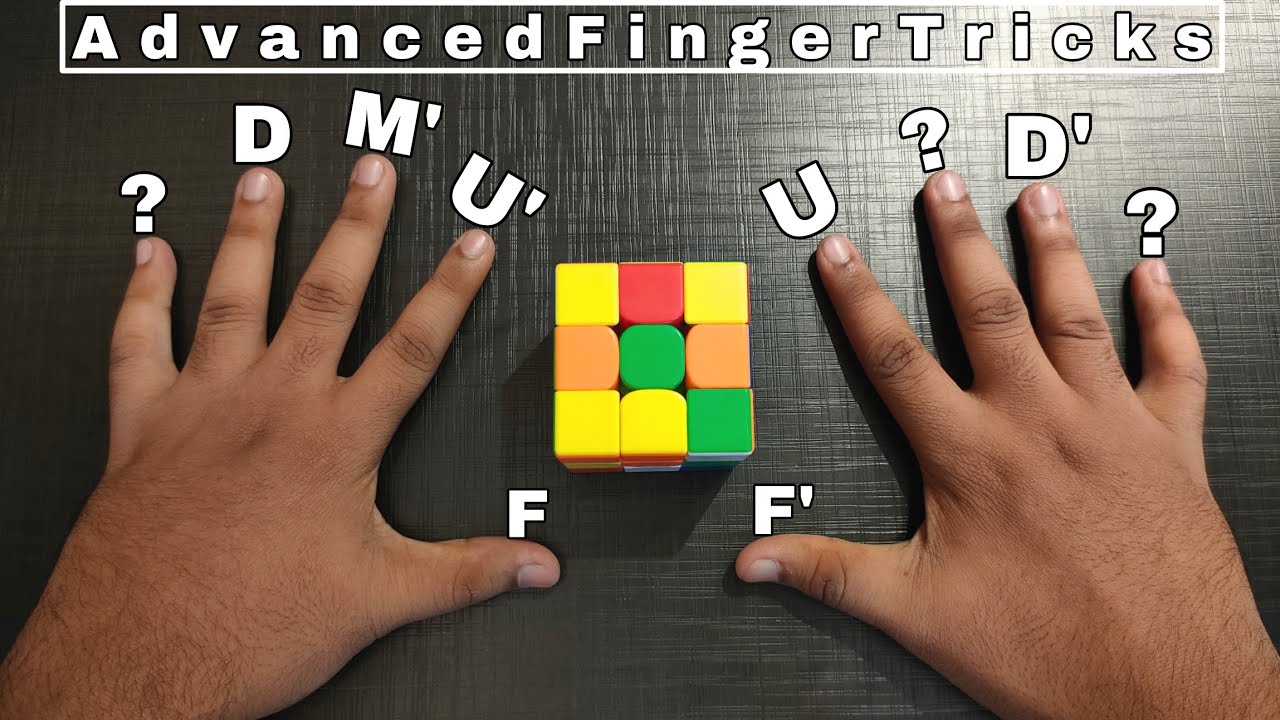
The U (Up) and U' (Down) moves are perhaps the most frequently used in any algorithm. Instead of using your whole hand to rotate the top layer, you should utilize a flicking motion with your index finger. For a clockwise U move, use your right index finger to push the top layer away from you. Conversely, for a counter-clockwise U', use your left index finger to push the layer back. Some advanced practitioners prefer using the right index to pull from the right side for U', but consistency is key. The goal is to make the layer spin freely with minimal effort, relying on the cube's bearings rather than brute force.
The Corner Rotations: R and L Moves
Turning the Right (R) and Left (L) faces requires a slight variation in technique, particularly for speedcubers. For the R move, maintain your home grip and use your right wrist in conjunction with your fingers to push the face clockwise. It is vital not to change your grip before performing an R move, especially during F2L stages, as this saves precious time. The L move is executed similarly but involves sliding your thumbs slightly over to engage the left face. In 2026, many solvers prefer using the wrist for R and L due to the mechanical advantage, but the critical factor is keeping the motion smooth and avoiding jerky stops.
The Complex Front Face: F and F' Moves
The F (Front) move is often considered the most challenging for beginners to execute efficiently because it usually requires a regrip. To perform a clockwise F, you may need to reposition your hands so that your right index finger can flick the front face downward. For F', the right thumb is typically used to push the face backward. While this seems slower than other moves, minimizing the number of F moves in your solution through better pair recognition can drastically improve your overall time. Advanced solvers often choose algorithms that avoid F moves entirely when possible, opting for "RUF" based algorithms that rely heavily on R, U, and F triggers which are easier to chain together.
The Bottom Layer: D and D' Moves
Turning the Down (D) face is unique because it involves moving the bottom layer. The most efficient method for D is to use your right ring or middle finger to push from underneath the cube. For D', the left ring or middle finger pushes from the left side. Because the D move requires more finger strength and coordination, it is generally slower than upper layer moves. Therefore, expert solvers aim to solve the last layer in a way that avoids extensive D usage, relying instead on U and F rotations whenever the geometry allows.
Advanced Techniques: Double Flicks, Slices, and Overlaps
Once you have a solid grasp of the basics, the real acceleration happens with advanced techniques. These methods allow you to execute multiple moves in a single fluid motion, effectively bypassing the need for separate finger placements. This is where the phrase "how to learn advanced finger tricks for faster times" truly comes into play.
Double Flicks and 180-Degree Turns
Standard algorithms often include double turns, such as U2, R2, or F2. Performing these as two separate 90-degree moves is inefficient. Instead, advanced cubers use a double flick technique. For a U2, you perform a quick flick with your index finger and allow the momentum of the cube to carry it halfway, then immediately flick again to complete the rotation. Alternatively, some prefer a stronger initial push that lets the layer spin freely until it hits the stopper. The key is rhythm; the two flicks should feel like one continuous action. Practicing these until they are indistinguishable from single moves is essential for breaking into the sub-20 second range.
M-Slice Mastery
The Middle slice (M) is a game-changer for algorithms involving inner layers. Unlike standard face turns, the M slice moves the layer between the L and R faces. To execute this efficiently, use your ring finger to push toward you (for M) or away from you (for M'). This mimics the motion of the L face but requires less hand movement. In complex OLL and PLL cases, M slices are frequently used to permute edges without disturbing the rest of the cube. Mastering the M slice allows for smoother transitions in algorithms like the T-perm or Z-perm, reducing the visual clutter of hand movements during a solve.
Wide Moves and Two-Layer Turns
For larger puzzles like the 4×4 or specific parity cases on the 3×3, wide moves (Rw, Uw) are necessary. These involve turning two layers simultaneously. The technique here shifts from individual finger flicks to a coordinated hand movement. For Rw, you turn the R face and the middle slice together using your whole right hand. For Uw, you rotate the U and E layers. While these require more strength, they are indispensable for speed on bigger cubes. On the 3×3, wide moves are sometimes used in specializedOLL cases to reduce the total number of algorithms needed, trading a slightly heavier turn for a significant reduction in cognitive load and move count.
Rotation-less Algorithms
One of the most powerful strategies in 2026 is the adoption of rotation-less algorithms. Every time you rotate the entire cube (x, y, or z), you lose time. Advanced solvers memorize alternative versions of algorithms that achieve the same result without rotating the cube. For example, instead of doing R U R' U' followed by a y rotation, there might be a trigger sequence that achieves the same permutation purely through finger tricks. This approach maximizes lookahead because your hands never leave the optimal position. It requires memorizing more algorithms, but the time saved per solve is substantial, often shaving off 0.5 to 1 second per solve consistently.
Integrating Finger Tricks into F2L and Last Layer Efficiency
Finger tricks are not isolated skills; they must be integrated into the broader context of your solving method, particularly during the F2L (First Two Layers) stage and the Last Layer. This is where theory meets practice, and where the rubber meets the road in terms of actual solve time.
F2L Optimization Through Trigger Recognition
F2L is widely regarded as the most time-consuming step for intermediate cubers. The secret to speeding up F2L lies in recognizing triggers—short sequences of moves that insert a pair instantly. By learning finger tricks specifically tailored for these triggers, you can execute inserts without ever stopping to think about your grip. For instance, learning a specific R U R' U' variation that slots a pair perfectly allows you to slide the piece in with a single, fluid motion. Avoid cube rotations during F2L whenever possible; use inserts from different angles and utilize the back slot to maintain flow. Predicting your first pair during inspection is the hallmark of an advanced solver, and this prediction relies entirely on your ability to visualize the finger tricks required to solve it.
Last Layer Fluidity: OLL and PLL
The transition from F2L to the Last Layer (OLL and PLL) demands a seamless shift in finger usage. For OLL, it is best to start and end with both thumbs on the front face to facilitate easy transitions. Advanced solvers often use algorithm-specific finger tricks where certain moves are prioritized for speed. For example, in many OLL cases, ending with an R or L move allows for a quick setup into PLL. During PLL, since the solve ends shortly after, the focus shifts to a fast AUF (Adjust U Face). Mastering advanced AUF techniques, such as using a quick U flick with the index finger immediately after the PLL algorithm, ensures that you don't waste time fumbling with the final adjustment.
Reducing Regrips: The Ultimate Time Saver
The enemy of speed is the regrip—taking your hands off the cube to change orientation. Advanced finger trick mastery aims to eliminate regrips entirely. This is achieved through careful algorithm selection and grip adaptation. If an algorithm forces a regrip, ask yourself if there is an alternative algorithm that achieves the same result with a smoother finger flow. In 2026, data shows that top solvers average fewer than two regrips per solve, whereas intermediates might average five or six. Each regrip costs approximately 0.2 to 0.3 seconds; eliminating them can drop your time by nearly two seconds per solve.
Training Protocols: How to Practice for Maximum Gains
Knowing what to do is only half the battle; knowing how to practice is the other. Effective training transforms raw knowledge into instinctive muscle memory. Here is a structured approach to integrating advanced finger tricks into your daily routine.
Slow Solving and Metronome Drills
Speed is a byproduct of accuracy. Paradoxically, the fastest way to get faster is to solve slowly. Use a metronome set to a slow tempo (e.g., 60 BPM) and ensure every finger trick lands exactly on the beat. This builds precision and prevents sloppy movements that lead to mistakes later. As your accuracy improves, gradually increase the tempo. This method forces your brain to process each move deliberately, reinforcing the neural pathways required for advanced techniques.
Isolated Trigger Practice
Do not just solve random cubes. Dedicate specific practice sessions to isolating difficult triggers. Take a single algorithm, such as the Sune or the Ju Perm, and repeat it 50 times in a row, focusing solely on the fluidity of your finger movements. Record yourself and watch the playback to identify any hesitations or extra movements. This granular focus accelerates the refinement process significantly compared to general solving.
Lookahead Drills
Incorporate lookahead drills into your warm-up. Set a timer for 30 seconds and solve as many pairs as possible, forcing yourself to finish the current pair while planning the next one. This trains your brain to anticipate the finger tricks needed before your hands even reach the cube. Over time, this reduces the "thinking time" between moves, creating a continuous stream of motion that defines elite-level solving.
Future Trends and Local Community Insights
As we look toward the future of speedcubing in 2026, the emphasis on gear optimization and local community growth continues to rise. Cubes from manufacturers in regions known for high-quality engineering, such as Shenzhen in China or specialized boutiques in Mumbai and London, offer the low-friction bearings necessary for advanced finger tricks to shine. The technology in modern cubes allows for faster spins with less wobble, complementing the precision of finger movements.
Locally, speedcubing communities are thriving. From weekly meetups in community centers to online forums dedicated to sharing tips, the support network is stronger than ever. Engaging with local cubers can provide immediate feedback on your grip and technique. Watching local masters compete offers invaluable insights into how advanced finger tricks are applied in real-time pressure situations. Whether you are in a bustling metropolis or a quiet suburban town, the principles of efficient turning remain constant, but the community around you can provide the motivation and mentorship needed to break through plateaus.
Conclusion: Your Path to Sub-10 Times Starts Now
Mastering advanced finger tricks is not merely a technical skill; it is a mindset shift towards efficiency and precision. By understanding the importance of the home grip, practicing the fundamental flicks, and integrating complex techniques like double flicks and rotation-less algorithms, you lay the groundwork for explosive speed improvements. The journey from a 40-second solver to a sub-10 competitor is paved with thousands of deliberate repetitions of these small movements.
Remember, the goal is not just to move faster, but to move smarter. Eliminate wasted motion, overlap your turns, and trust your muscle memory. As you implement these strategies into your practice routine, you will notice a gradual but steady decline in your solve times. The secrets held by top cubers in 2026 are accessible to anyone willing to put in the work. Start today, focus on one technique at a time, and watch as your Rubik's Cube solving transforms into a thing of beauty and speed. The clock is ticking, and your next personal best is waiting to be unlocked.
Frequently Asked Questions
Q: How long does it take to learn advanced finger tricks?
A: There is no fixed timeline, as it depends on your current level and practice frequency. Most solvers begin seeing noticeable improvements within 2 to 4 weeks of dedicated daily practice. However, mastering complex triggers and achieving sub-10 times may take several months of consistent training.
Q: Can I learn finger tricks without changing my home grip?
A: It is highly recommended to adjust your home grip when learning advanced techniques. An improper grip can limit your range of motion and make advanced flicks difficult or impossible. A optimized grip is the foundation upon which all efficient finger tricks are built.
Q: Do I need special equipment to practice finger tricks?
A: While a high-quality speedcube with good bearings can enhance your experience, it is not strictly necessary to start. You can practice finger tricks on any standard cube, though upgrading to a tournament-grade cube may help you refine your technique faster due to smoother mechanics.
Q: What is the most common mistake beginners make when learning finger tricks?
A: The most common mistake is rushing the learning process. Beginners often try to perform advanced flicks before mastering the basic ones, leading to frustration and bad habits. Focus on slow, accurate execution first; speed will naturally follow as your muscle memory develops.