The Great Debate: Why Choosing a Method Matters
For any aspiring speedcuber, the choice between CFOP and Roux is often the first major fork in the road. Both methods have produced world-record holders and are capable of sub-5-second solves, yet they operate on fundamentally different philosophies. Understanding which one suits your cognitive style and finger-trick preferences is essential for long-term improvement. While CFOP is the king of popularity, Roux has carved out a dedicated following among those who value efficiency and reduced move counts.
CFOP, an acronym for Cross, F2L, OLL, and PLL, is the most widely used method in the world. It is highly structured, algorithm-heavy, and benefits from a massive library of resources. In contrast, Roux, developed by Gilles Roux, focuses on block-building and intuitive manipulation. It requires fewer moves but demands a higher level of look-ahead and spatial awareness. Choosing the right path depends on whether you prefer memorizing patterns or developing fluid, intuitive piece-tracking skills.
Day 1: Experimenting with the CFOP Philosophy
When I first started testing CFOP, the structure felt incredibly logical. It follows a step-by-step progression that makes tracking progress very satisfying. You start by solving a cross on the bottom, then pair up corner-edge pieces for the first two layers, and finally orient and permute the last layer using specific algorithms. The predictability of this system is what makes it the standard for most competition-level cubers.
- The cross step provides a stable foundation for the rest of the solve, acting as an anchor.
- F2L (First Two Layers) is the longest phase but allows for very fast, rhythmic finger-tricks.
- OLL (Orientation of the Last Layer) ensures all top pieces are the correct color, which is visually satisfying.
- PLL (Permutation of the Last Layer) shifts the final pieces into their solved positions using refined algorithms.
- Most tutorials for beginners, such as the 3x3 Rubik's Cube CFOP Method for Beginners, provide excellent starting points for this style.
- The reliance on algorithms means that once you learn the sequences, you can execute them without deep cognitive processing, which is vital for speed.
Week 1: Diving into the Intuitive World of Roux
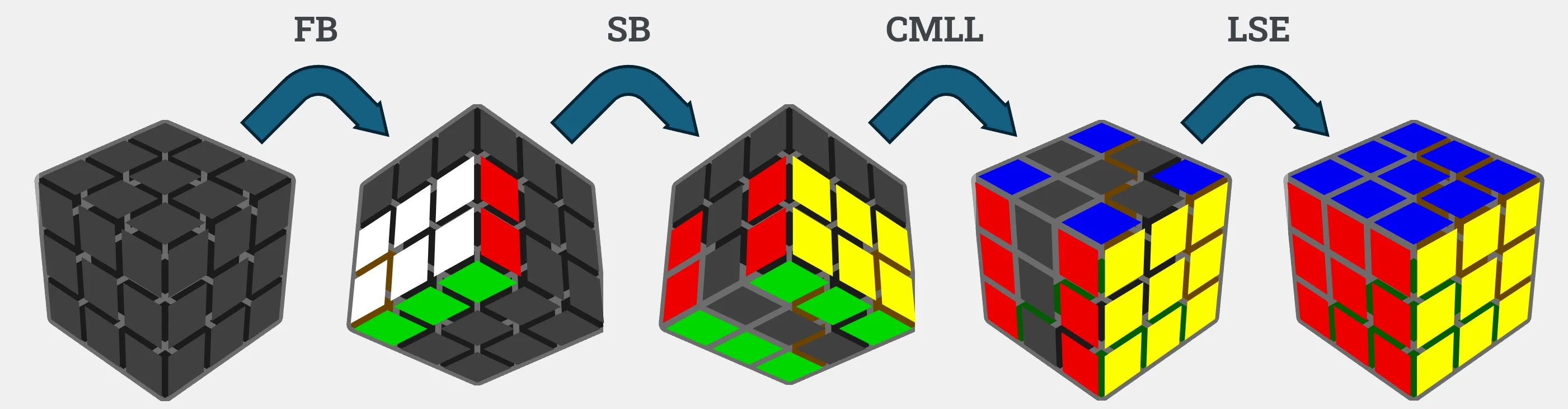
Switching to Roux felt like learning a completely different game. Instead of building layer by layer, I had to learn to build two 1x2x3 blocks on the left and right sides. This method feels more "organic" because you are not tied to rigid algorithms for the majority of the solve. You are essentially sculpting the cube into a solved state rather than forcing it through a series of predefined algebraic steps.
- Build the first 1x2x3 block on the left side of the cube, focusing on piece tracking.
- Build the second 1x2x3 block on the right side of the cube, being mindful of the first block's orientation.
- Orient the corners of the top layer using a short set of algorithms to prepare for the final steps.
- Solve the remaining edges and corners using the M-slice move, which is the signature of the Roux method.
- Enjoy the freedom of having the M-slice available for most of the solve, which allows for unique and fluid movement patterns that are rarely seen in CFOP.
- Refine your M-slice speed, as this is where the bulk of your time gains will occur during the final stages of the solve.
Comparing the Two: Performance Metrics
| Feature | CFOP | Roux |
|---|---|---|
| Average Move Count | High (55-60) | Low (45-50) |
| Algorithm Count | Very High (78+) | Low (42) |
| Look-ahead Pressure | Moderate | High |
| Intuition Required | Low | High |
| Ease of Transition | Easy for beginners | Harder for beginners |
| Scalability | High | High |
Why Move Count Matters for Speed
One of the primary arguments for Roux is its lower move count. Because the method avoids the traditional layer-by-layer approach, you generally need fewer turns to solve the cube. This can be a massive advantage for cubers who have slower turning speeds but excel at planning ahead and visualizing the cube in three dimensions. Lower move counts also mean less potential for mechanical lockups, which can be a common issue when turning at high speeds.
CFOP, however, makes up for its higher move count with sheer turn speed. Because F2L algorithms are so repetitive and well-optimized, top-tier cubers can execute them at blistering speeds. While a Roux user might take fewer moves to solve, a CFOP user might finish the solve in the same amount of time by turning the cube faster. It is a classic trade-off between efficiency and raw speed, and both are viable paths to the podium.
The best method is the one you enjoy practicing the most. While hardware can impact your times, your dedication to a specific method will have a far greater effect on your ultimate potential as a speedcuber.
The Learning Curve: Which is Easier to Master?
Most beginners find CFOP easier to pick up because the steps are clearly defined and the algorithm sets are well-documented. You can find a wealth of information online regarding every single case in the last layer. If you get stuck, there is almost certainly a YouTube video or a forum post that explains exactly how to fix your specific error. This accessibility is why CFOP remains the dominant teaching method.
Roux, while having fewer algorithms, is often considered harder to master because of the block-building phase. Developing the intuition to see blocks before they are built is a skill that takes months, if not years, to refine. You cannot simply memorize your way to success; you must train your eyes to track pieces across the cube in three dimensions, which is a much more demanding cognitive load than simple algorithm memorization.
Common Pitfalls and Mistakes
Even with a structured approach, many beginners fall into traps that hinder their speed. Avoiding these common errors early on can save you hundreds of hours of practice. Whether you choose CFOP or Roux, consider these points to avoid plateauing:
- Relying too heavily on look-ahead before mastering the fundamental algorithms is a recipe for disaster.
- Ignoring the importance of cross-color neutrality or block-building flexibility limits your potential for efficient starts.
- Failing to learn proper finger-tricks makes your execution sluggish and prone to physical lockups.
- Over-memorizing algorithms without understanding the underlying piece movement is counter-productive in the long run.
- Neglecting to practice efficiency in the early stages leads to bad habits that are difficult to unlearn later.
The Role of Finger-Tricks in Method Selection
Your physical style is a hidden factor in which method you will prefer. CFOP involves a lot of R, U, and L moves that feel very natural to most people because they utilize the standard grip. If your hands are comfortable with these standard rotations, CFOP will feel like a natural extension of your movement. You will find that most cubers find the standard CFOP trigger moves to be very ergonomic.
Roux relies heavily on the M-slice, which requires significant dexterity in the ring and middle fingers. If you struggle with middle-finger movements, you might find Roux physically exhausting or frustrating to practice. Take a moment to experiment with M-slice moves; if they feel clunky, you may prefer the standard rotation focus of CFOP. It is worth noting that some modern cube designs are optimized for M-slice movement, which has made Roux more popular in recent years.
Can You Switch Between Methods?
Many cubers start with CFOP and eventually try Roux, or vice versa. There is no rule stating you must stick to one forever. In fact, learning both can make you a more well-rounded cuber. Understanding how pieces interact in the block-building phase of Roux can actually help you improve your F2L efficiency in CFOP. It opens up your perspective on how the cube can be disassembled and reassembled mentally.
However, if your goal is to break records, consistency is key. Switching methods too frequently can stall your progress as you struggle to build muscle memory for two completely different styles. Pick one as your primary, and use the other as a fun side project to keep your brain engaged with different puzzle-solving techniques. This approach keeps your mind sharp without sacrificing your primary goals.
The Hardware Factor: Does Your Cube Matter?
Modern speedcubes are incredibly versatile, meaning both CFOP and Roux can be performed on almost any high-quality magnetic cube. You do not need a specialized cube for either method. Focus on finding a tension and magnet strength that feels good to you, and don't worry about the "method-specific" hardware hype that sometimes appears in community forums. A well-lubricated cube with a stable tension is all you need to reach world-class times, regardless of your chosen solving style.
How to Measure Your Progress Effectively
Regardless of the method, you need to track your performance objectively. Use a simple timer or a mobile app to log your solves. Focus on your "Average of 5" (Ao5) and "Average of 100" (Ao100) to see how your speed is evolving over time. Tracking data allows you to identify exactly where you are losing time.
- Record every single solve for one week to establish a reliable baseline of your current speed.
- Identify which phase of the solve is taking the most time using a split timer or a smart cube.
- If you are using CFOP, focus on reducing your F2L pauses and transition times.
- If you are using Roux, focus on building your blocks with fewer moves by planning further ahead.
- Once a month, compare your progress to your previous records to adjust your training plan accordingly.
Why Some Experts Prefer Roux
There is a growing community of Roux enthusiasts who argue that it is the more "mathematical" method. Because you don't have to solve the last layer using 78+ algorithms, the cognitive load is lower during the final stage of the solve. This allows some cubers to maintain higher speeds under the pressure of a competition, as they are not reliant on complex memory recall when their nerves are high.
Furthermore, Roux is often seen as more "future-proof" because it relies on fewer algorithms that can change over time. As new finger-trick techniques are discovered, the Roux method adapts naturally, whereas CFOP users are often tied to the specific algorithms they learned years ago. This flexibility is a major draw for those who enjoy exploring the theory behind the puzzle.
What I Would Repeat in My Training
If I were to start over, I would prioritize these specific actions to speed up my learning process and ensure I didn't develop bad habits:
- Start with slow, methodical practice rather than trying to turn as fast as possible from day one.
- Watch professional solve videos to see how they handle transitions between steps and look-ahead.
- Join local cubing clubs or online communities to get feedback on my turning style from more experienced members.
- Dedicate at least 15 minutes a day to practicing specific algorithms or block-building patterns consistently.
- Stop worrying about "which is better" and focus entirely on improving my own consistency and efficiency.