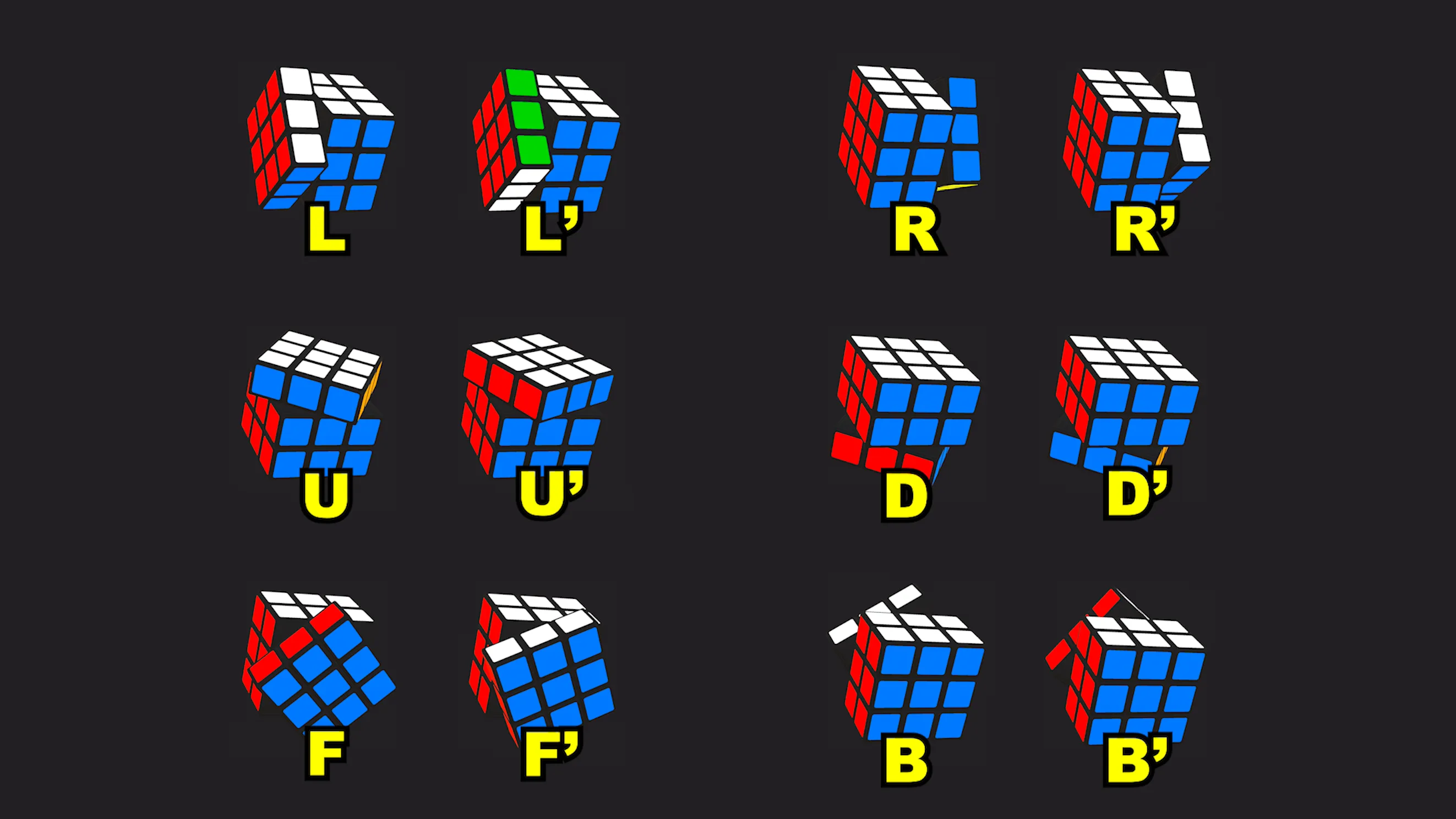
Understanding the Basics of Rubik's Cube Notation
When you first decide to learn how to solve a Rubik's Cube, you will inevitably encounter a series of letters and symbols that look like a secret code. This is known as cubing notation. It is a standardized language used by puzzle enthusiasts worldwide to describe specific turns and sequences, known as algorithms. Understanding this system is the single most important step in moving beyond the basic intuitive methods.
Think of notation as the written version of physical moves. Just as sheet music tells a musician which notes to play, notation tells a cuber exactly how to rotate the faces of the cube to achieve a specific outcome. Without this language, you are limited to what you can figure out on your own; with it, you can access the vast library of patterns developed by experts over the last several decades.
The Six Core Faces and Their Letter Designations
Every standard 3x3 Rubik's Cube has six faces, and in the world of notation, each face is represented by a single capital letter. These letters are derived from the English names for the sides of the cube. When you hold the cube, you must choose one face to be the front, which then determines the orientation of all other sides.
- R (Right): This refers to the face on the right side of the cube relative to your perspective.
- L (Left): This refers to the face on the left side of the cube.
- U (Up): This is the top face of the cube, which you look down upon while solving.
- D (Down): This is the bottom face, located at the base of the cube.
- F (Front): This is the face directly facing you as you hold the cube in your hands.
- B (Back): This is the face on the opposite side of the front, hidden from your direct view.
It is important to remember that these letters define the face being moved, not the physical piece currently occupying that spot. If you move the 'Up' face, you are rotating the entire top layer, regardless of which colors are currently on that layer.
Clockwise vs. Counter-Clockwise: The Directional Rules
Knowing which face to move is only half the battle; you also need to know which direction to turn it. The fundamental rule of cubing notation is that all single-letter moves (like R, U, or F) indicate a 90-degree turn in a clockwise direction. This direction is determined by looking directly at the face you are turning.
However, many algorithms require counter-clockwise turns. To indicate this, a small apostrophe symbol (often called a prime) is added after the letter. For example, R' means you turn the right face 90 degrees counter-clockwise. If you see a number 2 after a letter, such as U2, it means you should perform a 180-degree turn—two 90-degree rotations—in either direction, as the result is the same.
Pro Tip: A helpful way to visualize the direction is to imagine a clock face on the side you are turning. If you are looking at the Front face, a clockwise move turns the top piece toward the right, just as the hands of a clock move.
Comparing Move Types and Their Notational Symbols
To help you distinguish between the different types of moves, the following table summarizes how symbols translate into physical actions on your puzzle. Keeping this reference handy while you practice will accelerate your learning process significantly.
| Symbol | Meaning | Rotation Type | Degrees |
|---|---|---|---|
| R | Right face | Clockwise | 90 |
| R' | Right face | Counter-clockwise | 90 |
| R2 | Right face | Double move | 180 |
| U | Up face | Clockwise | 90 |
| U' | Up face | Counter-clockwise | 90 |
| U2 | Up face | Double move | 180 |
Common Mistakes Beginners Make with Notation
Many beginners struggle with notation because they fail to maintain a consistent orientation. If you rotate the entire cube in your hands while reading an algorithm, the 'Front' face changes, and the algorithm will no longer work as intended. Always keep the same face pointing toward you unless the notation specifically calls for a cube rotation.
- Losing Orientation: The biggest mistake is rotating the cube body during an algorithm.
- Confusing R and L: Remember that L moves are mirrored; a clockwise turn on the left side moves the top piece toward you, not away.
- Ignoring Primes: Beginners often overlook the apostrophe, leading to incorrect moves that scramble the cube further.
- Over-tightening: Beginners sometimes grip the cube too hard, making smooth turns difficult.
- Misinterpreting 180s: Performing two 90-degree turns when one fluid 180-degree flick is faster and more accurate.
How to Execute Wide Moves and Slice Moves
As you advance, you will encounter 'wide' moves, which involve moving two layers at once. These are denoted by a lowercase 'w' following the face letter. For instance, Rw means you turn both the right face and the adjacent inner slice together. This is a common technique used to simplify complex patterns.
Slice moves are another category, represented by letters like M (Middle), E (Equatorial), and S (Standing). The M move, for example, involves the middle layer between the Left and Right faces. These are essential for more advanced solving methods like CFOP, which you can learn more about in this guide on speedcubing techniques.
The Importance of Cube Rotations (x, y, z)
Sometimes an algorithm requires you to rotate the entire cube in your hands. These are called rotations and are indicated by the axes of the cube: x, y, and z. The 'x' rotation follows the R face, 'y' follows the U face, and 'z' follows the F face. These moves do not change the position of the pieces relative to each other, but they change your perspective of the cube.
When you see an 'x' in an algorithm, you tilt the entire cube upward, as if you were performing an R turn with the whole object. Mastering these rotations is crucial for fluidity. If you are struggling with the basics of solving, you might want to review the foundational steps of cube solving to ensure your base knowledge is solid before adding rotation complexity.
Practice Exercises for Notation Mastery
The best way to learn is by doing. Start by performing simple sequences and observing how the pieces move. Try executing the following sequence: R U R' U'. This is a classic "sexy move" used in many algorithms. Repeat this six times, and you will find that the cube returns to its original solved state.
- Hold your cube in a solved state.
- Apply the sequence R U R' U' slowly.
- Observe which pieces move to which positions.
- Repeat the sequence until you can perform it without looking at your notes.
- Try the reverse: U R U' R'.
- Notice how the reverse sequence undoes the changes made by the first.
Implementing Algorithms in Your Solving Routine
Once you are comfortable with individual moves, you can start applying full algorithms. Algorithms are essentially strings of notation that solve specific problems, such as orienting the final layer corners. You can explore a variety of essential beginner algorithms to start building your repertoire.
Always practice algorithms in chunks. Don't try to memorize a 15-move sequence all at once. Break it down into groups of three or four moves. Practice the first group until it is muscle memory, then add the next group. This method ensures that you don't just memorize the letters, but you also develop the physical coordination required for speed.
Comparing Standard Notation to Intuitive Solving
Is it better to solve intuitively or by using notation-based algorithms? Both have their place. Intuitive solving helps you understand the mechanics of the cube, while algorithms allow for speed and efficiency. The table below compares the two approaches to help you decide when to use each.
| Feature | Intuitive Solving | Algorithm Solving |
|---|---|---|
| Speed | Slow | Fast |
| Learning Curve | Gentle | Steep |
| Consistency | Low | High |
| Application | First two layers | Last layer |
Advanced Notation Concepts for Speedcubing
Once you reach a certain level of proficiency, you will start looking at notation in terms of 'triggers'. A trigger is a short, frequently used sequence of moves that functions as a single unit in your brain. For example, instead of thinking "R, U, R prime, U prime," you think "Sexy Move."
This cognitive shift is vital for speed. When you stop processing individual letters and start processing whole sequences, your execution speed will skyrocket. This is how competitive cubers solve the cube in under ten seconds. They aren't thinking about individual turns; they are executing pre-learned blocks of moves through muscle memory.
Troubleshooting Common Notation Confusion
If you find that your cube is not solving correctly despite following the notation, check your orientation. A very common issue is holding the cube with a different color on the front than the algorithm expects. If the instructions say "F," make sure you are looking at the face that was originally in the front position.
Another potential issue is the interpretation of the 'prime' symbol. If you are doing a counter-clockwise turn but the pieces seem to be moving in the wrong direction, double-check your perspective. Always ensure you are looking directly at the face being turned. If you are looking at the Front face and trying to move the Back face, your clockwise and counter-clockwise directions will be inverted relative to your view.
Resources to Further Your Cubing Journey
There are many online resources available to help you master these concepts. Websites like the World Cube Association provide comprehensive documentation on official notation standards. Additionally, video tutorials can be incredibly helpful for visualizing moves that are difficult to grasp through text alone.
- Follow along with community forums to ask questions when you get stuck.
- Use cube simulators to test out new algorithms without scrambling your physical cube.
- Keep a physical log of algorithms you have memorized.
- Join local cubing clubs to learn from more experienced solvers in person.
- Watch slow-motion videos of expert solvers to see how they handle wide and slice moves.
Final Tips for Consistent Progress
Consistency is key. Spend 15 minutes a day practicing your notation rather than two hours once a week. Muscle memory requires regular repetition to solidify. If you find yourself getting frustrated, take a break. The Rubik's Cube is a puzzle meant to be enjoyed, not a chore to be completed.
Remember to keep your cube lubricated and clean. A sticky or stiff cube makes it much harder to perform accurate moves, which can lead to mistakes in your notation execution. A well-maintained cube will respond to your fingers with precision, allowing you to focus on the algorithm rather than fighting the hardware.