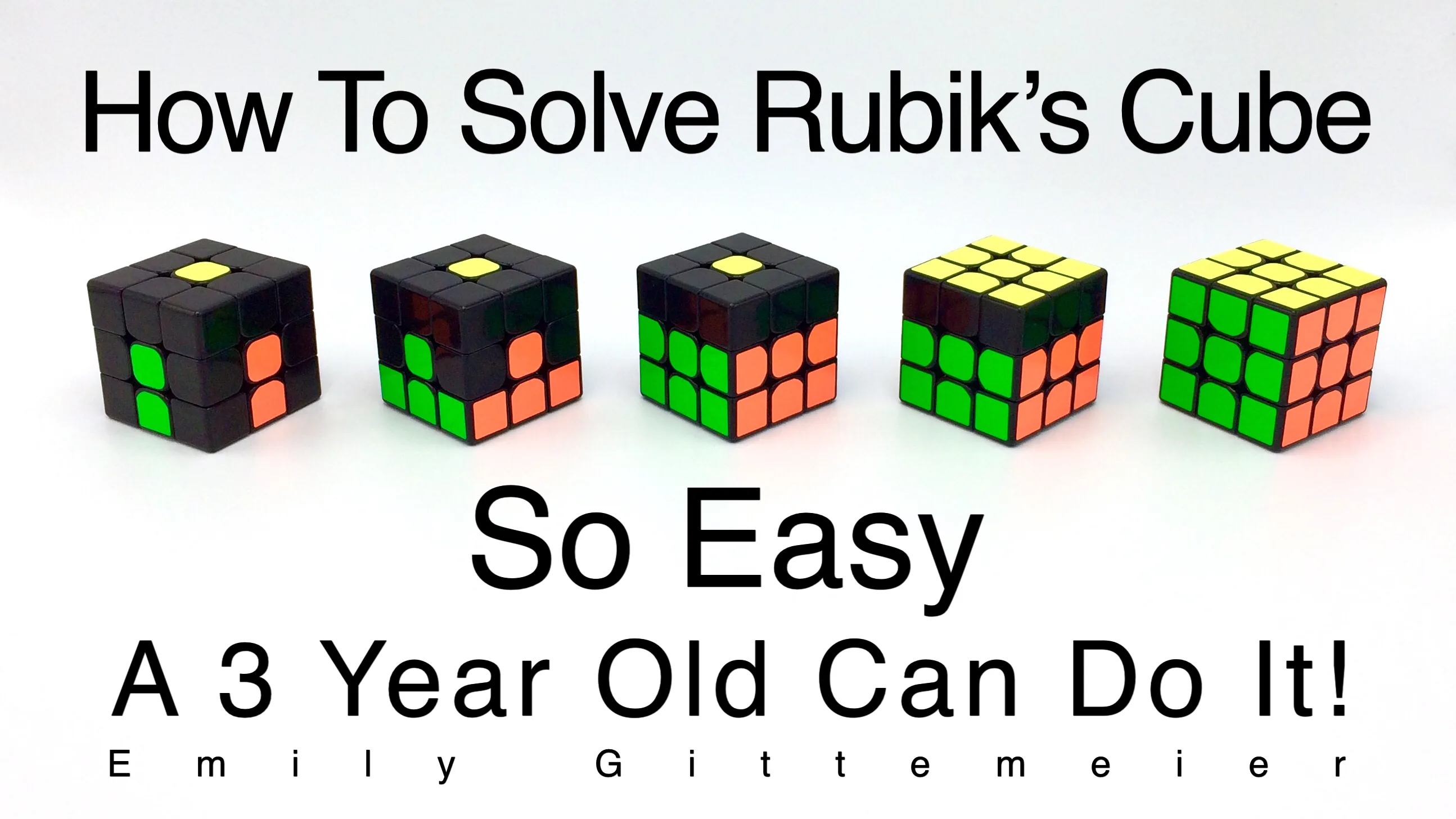
Unlocking the Mystery of the Cube Without Rote Memorization
Solving a Rubik's cube without memorizing algorithms might sound impossible to anyone who has stared blankly at a scrambled puzzle and panicked. Most traditional tutorials demand that you commit dozens of complex sequences to memory, turning a fun spatial puzzle into a grueling test of rote recall. Fortunately, you can bypass the flashcards completely by shifting your focus toward intuitive logic and mechanical understanding. This comprehensive guide explores how you can manipulate the cube using natural spatial reasoning, tactile experimentation, and fundamental geometric principles rather than blind memorization.
When you strip away the intimidating notation systems like R U R' U', the Rubik's cube reveals itself as a physical puzzle governed by predictable spatial relationships. Instead of asking yourself which sequence of turns to execute next, you will learn to ask what happens to specific pieces when you shift adjacent layers. According to historical accounts documented on Wikipedia's Rubik's Cube overview, the creator Ernő Rubik himself spent a month trying to figure out his own creation, relying on structural experimentation rather than pre-determined formulas. You can replicate this exploratory mindset to master the puzzle on your own terms.
The Core Anatomy: Understanding Fixed Centers and Movable Pieces
Before attempting any intuitive solving methods, you must develop a deep understanding of the cube's underlying anatomical structure. A standard 3x3 Rubik's cube is not a collection of individual free-floating stickers, but rather a complex mechanical core holding three distinct types of physical components:
- Center Pieces: These six single-faceted squares are anchored permanently to the internal core and dictate the absolute color of each respective face.
- Edge Pieces: These twelve dual-faceted pieces sit between the centers and form the primary bridges connecting opposite sides of the puzzle.
- Corner Pieces: These eight triple-faceted components anchor the eight distinct corners of the cube and link three adjacent faces together.
- Internal Core: The hidden mechanical framework that holds the entire assembly together while allowing smooth axial rotation.
- Fixed Axis Relationship: White is always opposite yellow, red is always opposite orange, and blue is always opposite green on standard color schemes.
- Movable Shells: The outer layers rotate freely around the fixed center axes, changing positions while preserving the immutable core structure.
Differentiating Pieces and Centers
Recognizing that center pieces never change their relative positions to one another is your first major breakthrough. When you twist the front face, the red center stays right where it is, meaning red will always be your front reference point. This realization eliminates guesswork and anchors your visual tracking during every stage of manipulation.
Shifting from Blind Memorization to Intuitive Logic
Transitioning away from memorized algorithms requires retraining your brain to view the cube as a canvas of movable relationships rather than a sequence of rigid steps. When you stop relying on muscle memory, you open yourself up to genuine spatial comprehension. Here is how you can build that intuitive foundation:
- Observe the immediate effect of a single quarter-turn on the top and adjacent layers before making any secondary moves.
- Identify isolated target pieces that need repositioning without disturbing the rest of the solved portions of your cube.
- Formulate miniature hypotheses, such as predicting whether rotating the right face upward will lift a target corner into place.
- Test your hypotheses through slow, deliberate physical turns, paying close attention to every shifting sticker.
- Analyze the resulting state and reverse your actions immediately if the movement disrupts your progress.
- Isolate specific sub-assemblies, like pairing an edge and corner together before moving them into their designated slots.
- Refine your physical technique to minimize accidental turns of adjacent layers while experimenting with new patterns.
Mastering the First Layer Through Natural Grouping
The first layer of the puzzle can be solved entirely through common sense and tactile exploration, entirely avoiding the need for formulaic sequences. By treating the bottom face as your foundation, you can build a solid cross and drop corners into place naturally. If you want a structured companion reference while practicing this foundational phase, check out this detailed walkthrough on solving a Rubik's cube for beginners to compare different pacing strategies.
- Scan the entire scrambled cube for edge pieces containing your chosen base color, such as white.
- Bring those edge pieces to the middle layer using simple quarter-turns without worrying about secondary alignment.
- Rotate the middle layer until the side sticker of your chosen edge matches the adjacent center piece color.
- Flip the matching edge directly down to the bottom face, instantly establishing one arm of your foundational cross.
- Repeat this straightforward extraction and insertion process for the remaining three edge pieces.
- Locate corner pieces in the upper layers that feature your base color combined with two adjacent face colors.
- Position each target corner directly above its intended slot between the matching center pieces.
- Drop the corner gently into the bottom layer using basic vertical and horizontal rotations.
Comparing Memorization vs. Intuitive Spatial Problem Solving
Many cubers wonder whether abandoning algorithms slows down their progress or limits their ultimate potential. The table below outlines the core differences between relying purely on memorized sequences versus developing a deep, intuitive understanding of the cube's mechanics.
| Solving Approach | Primary Skill Required | Adaptability to Scrambles | Learning Curve |
|---|---|---|---|
| Algorithmic Memorization | Muscle memory and sequence recall | Rigid; fails if a step is forgotten | Fast initial progress, hard to master |
| Intuitive Logic | Spatial reasoning and pattern recognition | High; handles any unexpected scramble | Steep initial learning curve, deeply rewarding |
| Hybrid Approach | Basic intuition paired with short triggers | Moderate; flexible in most common scenarios | Balanced and beginner-friendly |
Understanding Reversible Moves and Inverse Operations
One of the most powerful conceptual tools in non-algorithmic solving is the mastery of reversible moves. Every time you push a piece out of its home position to make room for another, you can reverse those exact motions to restore your progress. This principle is fundamental to advanced techniques and helps demystify how puzzle designers intended the cube to be manipulated.
For instance, if you push the right face up and the top face to the left, your inverse operation is moving the top face to the right and bringing the right face down. Embracing this concept allows you to experiment freely because you always hold the key to undoing your experimental turns. It transforms a frustrating trial-and-error process into a controlled scientific investigation of spatial geometry.
Creating Your Own Temporary Insertion Triggers
Instead of learning pre-packaged algorithms developed by other speedcubers, you can invent your own short, repeatable movement sequences called triggers. A trigger is simply a brief three-to-four-move sequence that accomplishes a specific micro-task, such as temporarily lifting an edge out of a jammed slot so you can redirect it.
- Identify a recurring frustrating scenario where a piece is trapped facing the wrong direction in the middle layer.
- Design a simple three-step sequence that pops the trapped piece out to the top layer without ruining your bottom layer.
- Test your custom sequence multiple times from different angles to ensure it works reliably in various orientations.
- Write down your custom trigger using simple descriptive language rather than formal notation symbols.
- Integrate your custom trigger into your daily practice routine until your fingers execute it smoothly.
- Modify your trigger slightly to see how changing the final rotation alters the final destination of the target piece.
- Share your custom discoveries with other puzzle enthusiasts to compare notes on intuitive problem-solving methods.
Navigating the Middle Layer Without Formulaic Sequences
Once your bottom layer is fully assembled, the middle layer requires you to place edge pieces between the centers without disturbing your hard-earned foundation. This is where many beginners panic and reach for textbook algorithms. However, you can achieve this by pairing edges with corners and inserting them together.
Imagine you need to place a red-and-blue edge into the slot between the red and blue centers. You can move that edge to the top layer, align it so it sits directly above the matching center, and then use a gentle side-step maneuver to tuck it into the slot while safely preserving your bottom cross and corners. If you ever feel stuck during this phase, reviewing the concepts in the easiest way to solve a Rubik's cube for beginners can offer fresh perspectives on keeping your steps manageable.
Deconstructing the Final Layer Through Pattern Recognition
The final layer is notorious for intimidating learners because it represents the most complex part of the puzzle. Without algorithms, tackling the top face requires treating it as a puzzle within a puzzle. You will focus first on orienting the top face pieces so they all display the target color upward, and then permuting them into their final rightful positions.
- Puzzles and Hobbies
- Analyze the current pattern of stickers facing upward on the top layer to identify familiar shapes like lines, dots, or small L-shapes.
- Use your understanding of reversible triggers to alter the orientation of edge pieces without breaking the first two completed layers.
- Rotate the top layer continuously to check how different starting orientations affect the placement of corner pieces.
- Isolate any two corners that are already in their correct relative positions to each other as a working anchor point.
- Apply gentle exploratory twists to cycle the remaining misplaced corners around the top axis until they snap into alignment.
- Check your progress frequently by looking at all four side profiles simultaneously rather than focusing exclusively on the top face.
- Make minor micro-adjustments to settle the final edge pieces into their absolute completed positions.
Common Pitfalls When Learning Without Algorithms
Approaching the Rubik's cube intuitively is immensely rewarding, but it does come with a few common stumbling blocks that frustrate newcomers. Being aware of these traps will save you hours of unnecessary frustration and keep your practice sessions productive and enjoyable.
- Overcomplicating Simple Moves: Trying to execute long, complicated sequences of turns when a simple two-move adjustment would suffice.
- Ignoring Fixed Centers: Forgetting which center piece corresponds to which color, leading to misaligned final layers.
- Impatience with Trial and Error: Giving up too quickly when an experimental turn scrambles a previously solved section of the cube.
- Failing to Undo Mistakes: Continuing to twist the cube randomly after a mistake instead of immediately reversing the moves.
- Tunnel Vision: Staring only at the face you are working on while accidentally ruining the opposite side of the puzzle.
Developing Muscle Memory Through Natural Repetition
Even though you are avoiding formal algorithmic memorization, your hands will naturally develop a subtle form of muscle memory the more you practice. This organic muscle memory is entirely different from rote memorization because it arises from understanding why your fingers are moving rather than blindly following a sequence written on a cheat sheet.
True mastery of a puzzle comes not from remembering someone else's solution, but from developing a personal dialogue with the mechanics of the object in your hands.
When your hands learn the tactile feedback of a smooth corner insertion or the satisfying click of a final edge snapping into place, solving the puzzle becomes an effortless meditation. You stop thinking about individual turns and start experiencing the flow of spatial geometry in real time.
Practical Daily Drills for Intuitive Problem Solving
To solidify your intuitive problem-solving skills, incorporate targeted daily drills into your puzzle routine. These exercises are designed to sharpen your spatial awareness and build confidence in your ability to manipulate the cube without relying on external reference guides.
- Scramble only the top two layers of a partially solved cube and practice restoring them using pure logic.
- Blindly twist one corner and one edge out of place, then restore them using the fewest possible moves.
- Solve the bottom layer while wearing a blindfold or keeping your eyes closed to test your tactile memory.
- Time yourself while solving the cube strictly without algorithms, aiming for smooth, uninterrupted physical motion.
- Teach a friend the intuitive method by explaining the physical relationships rather than giving them a cheat sheet.
- Experiment with different starting color choices to break reliance on always solving the white face first.
- Disassemble and reassemble a physical cube to thoroughly understand its internal mechanical linkages and constraints.