Transitioning from Beginner Method to Fridrich CFOP
If you want to know how to solve a rubik's cube faster, moving away from the slow layer-by-layer beginner approach is your absolute first priority. Most beginners solve the puzzle by inserting corners and edges one by one, which requires far too many awkward rotations and hand adjustments. Speedcubers rely on the CFOP method—which stands for Cross, F2L (First Two Layers), OLL (Orientation of the Last Layer), and PLL (Permutation of the Last Layer). This structured framework reduces the total number of moves and allows you to execute fluent sequences without stopping to think. Understanding this fundamental shift changes your mindset from simply finishing the puzzle to optimizing every single turn you make.
Adopting CFOP requires patience because your average solving time will initially get worse before it gets better. When you first abandon your familiar beginner habits, your brain has to consciously process new algorithms and finger placements. However, this temporary setback is entirely normal and necessary for long-term speed improvement. Practice each stage of CFOP in isolation rather than trying to perform full solves right away. Spend days just drilling your cross on the bottom, then dedicate hours to mastering intuitive F2L pairs.
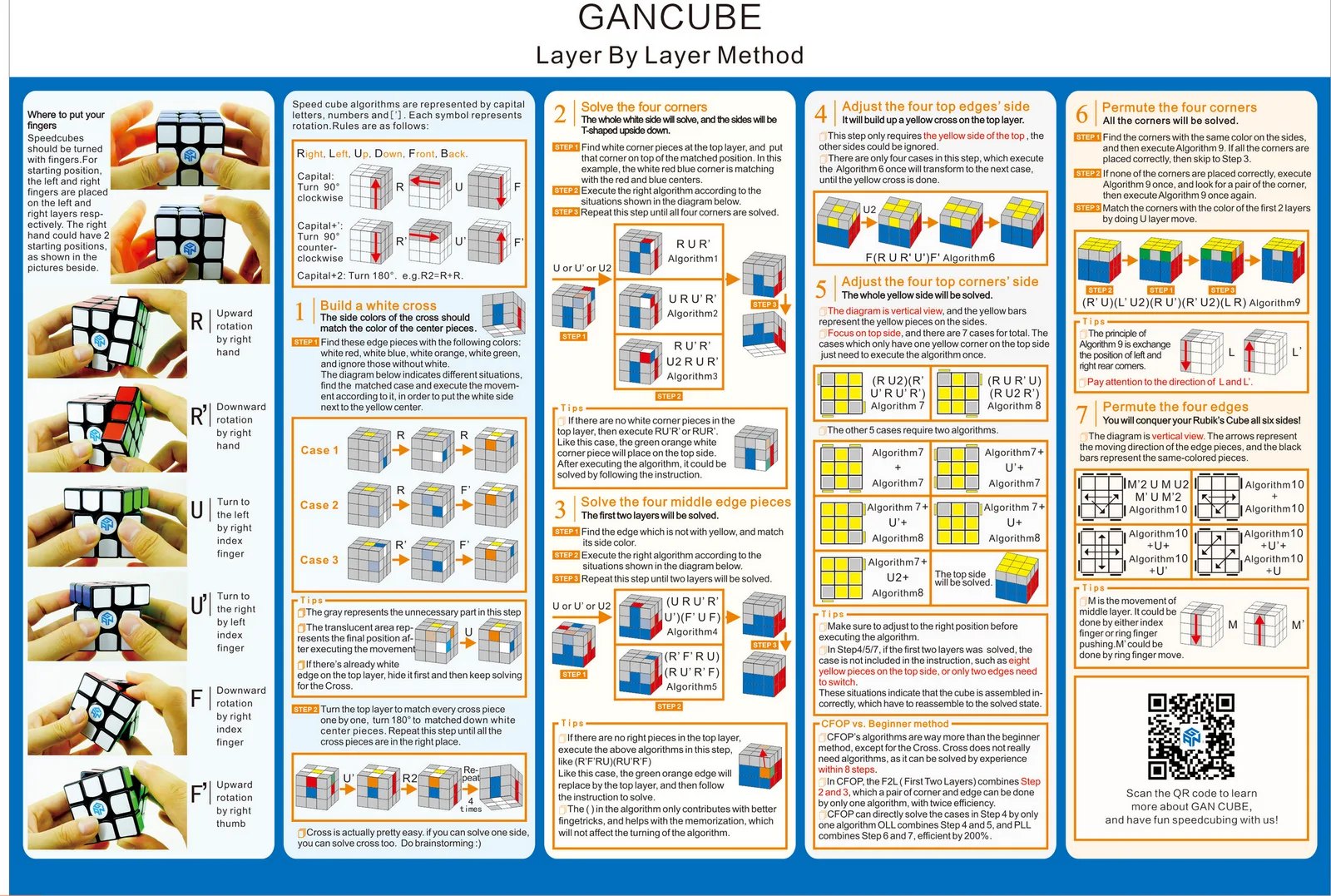
- Abandon the slow layer-by-layer approach used in standard beginner tutorials like How to Solve a Rubik's Cube for Beginners: A Step-by-Step Guide to build a foundation for high-speed solving.
- Commit to learning the four distinct phases of the CFOP system: Cross, First Two Layers, Orientation, and Permutation.
- Expect a temporary drop in your solving speed as your muscle memory adapts to entirely new movement patterns.
- Practice individual steps in isolation rather than constantly timing complete solves from scratch.
- Keep a dedicated scratchpad or digital log of your daily algorithm practice to track which triggers feel sluggish.
- Transition your mindset from reacting to each piece to planning three or four moves ahead continuously.
Mastering an Efficient Inspection Phase
The 15-second inspection period allowed in official World Cube Association competitions is your secret weapon for dropping precious seconds off your average solve. Instead of aimlessly picking up the puzzle, use these precious seconds to plan your entire cross and even track your very first F2L pair. Speedcubers often talk about blind cross execution, meaning you close your eyes or look away from the cube right as you start turning the first face. This level of preparation ensures that your hands never stutter during the critical opening moments of the solve.
To build effective inspection habits, you must practice with a strict countdown timer and force yourself to start turning without hesitation when time expires. Start by finding all four cross edge pieces during inspection, determining their relative positions, and mapping out the finger rotations needed to place them. Once you master the cross, push yourself to locate the white-red or white-blue corner piece while planning those initial moves. This advanced habit completely eliminates the dreaded pause between finishing your cross and hunting for your first corner-edge pair.
- Pick up the scrambled cube during the inspection window and immediately locate all four white cross edges.
- Calculate the exact rotation sequence required to drop all four edges into place on the bottom face without looking down.
- Identify the orientation of the cross edges relative to their respective center pieces to avoid misalignment.
- Try to spot the first F2L corner and edge pair while you are still tracking your cross movements.
- Practice closing your eyes after inspection and executing the entire cross purely from memory and spatial visualization.
- Gradually decrease your inspection reliance on visual searching by drilling common scrambles repeatedly.
- Maintain a calm, focused breathing rhythm during inspection to prevent rushing your physical execution.
Optimizing Finger Tricks for Maximum Fluidity
Finger tricks are the physical mechanics of speedcubing, allowing you to flick layers with your fingers and wrists rather than rotating your entire wrist or arm awkwardly. Poor finger mechanics will create a hard speed ceiling, no matter how fast your brain can recognize patterns and algorithms. You should use your index fingers, ring fingers, and thumbs to push layers in smooth, continuous arcs. For instance, executing a standard right-hand trigger should feel like a fluid snapping motion rather than a series of robotic, isolated pushes.
Essential Finger Mechanics
Every fast solver relies on specific finger placements for common moves like R, U, and L. Keeping your fingers resting naturally on the cube minimizes travel time between turns.
- Flick the upper face using your right index finger for clockwise turns and your left index finger for counter-clockwise adjustments.
- Pull the upper face toward you using your right ring finger for quick double-layer turns.
- Use your thumb to push front-face layers when executing specific algorithms that require deep cuts.
- Keep your palms relatively stationary against the cube core to reduce unnecessary physical stabilization movements.
- Avoid regripping the cube whenever possible by utilizing index and pinky flicks to adjust side angles.
- Lubricate your hardware with silicone-based fluids to ensure your finger tricks meet zero mechanical resistance.
Building Intuitive First Two Layers (F2L) Mastery
First Two Layers, commonly known as F2L, represents the longest and most important phase of a standard speed solve. While beginners insert corners and edges separately, F2L pairs up a corner piece and a middle-layer edge piece before inserting them together into their correct slot. Mastering F2L is less about memorizing dozens of rigid algorithms and more about developing an intuitive spatial understanding of how pieces interact. You must learn how to manipulate the top layer to hide pieces, separate connected pairs, and bring them together effortlessly.
A common trap for intermediate cubers is pausing for several seconds between F2L pairs while scanning the cube for the next pieces. This habit, known as poor lookahead, destroys your solve times even if your finger speed is exceptionally fast. To fix this, you must practice turning your cube significantly slower while actively tracking the next pair of pieces with your eyes. By keeping your turning pace smooth and continuous, your brain gains the necessary processing time to plan your next move before your current algorithm finishes.
| F2L Scenario | Complexity Level | Key Technique | Average Time Impact |
|---|---|---|---|
| Pieces separated in top layer | Beginner | Bring together via simple U turns | Fast |
| Corner stuck in bottom slot | Intermediate | Lift out using basic R U R' sequence | Medium |
| Edge flipped in correct slot | Advanced | Remove, reorient, and re-insert smoothly | Slow |
| Connected pair in back slots | Expert | Blind slotting with zero rotation | Minimal |
Advanced Lookahead and Elimination of Pauses
Lookahead is what separates average solvers from elite speedcubers who consistently average under ten seconds per solve. When you look ahead, your eyes actively scan the rest of the puzzle for your next set of pieces while your fingers are still executing the final moves of your current algorithm. If your fingers stop moving while your brain searches for the next target, your time suffers dramatically. Developing this skill requires dropping your turning speed down to a crawl so that your cognitive load shifts from mechanical execution to visual tracking.
You can train your lookahead effectively by practicing solves while wearing computer glasses with blurred lenses or by simply closing your eyes during the middle of an algorithm. Another great training method is to say the name of your next pieces out loud before your current F2L pair is fully inserted. This verbal forcing function trains your neural pathways to prioritize future planning over watching your current finger movements. Over weeks of consistent practice, lookahead becomes second nature, transforming your solves into a single unbroken stream of motion.
- Practice slow solves where your turning speed never exceeds two turns per second to force visual tracking.
- Identify your target pieces for the next step before finishing your current trigger or algorithm.
- Eliminate the habit of staring intensely at the specific slot you are currently filling.
- Use peripheral vision to monitor the front and right faces while your hands execute the back slots.
- Record your solves on video and review them specifically to count how many times your hands pause.
- Maintain consistent lighting on your puzzle surface to ensure piece colors remain instantly recognizable.
- Learn from professional resources and dedicated speedcubing communities to refine your technique.
Hardware Tuning and Cube Maintenance for Speed
Your hardware plays a monumental role in your potential solving speed. A dry, poorly tensioned cube will constantly catch, lock up, and cause frustrating corner twists that ruin stellar solves. Modern speedcubes feature advanced dual-adjustment systems, adjustable magnets, and frosted or UV-coated exterior plastic designed to maximize grip during high-velocity solves. Proper maintenance ensures that your puzzle responds instantly to the lightest finger touch without requiring excessive physical force.
Essential Hardware Checklist
Keeping your cube in peak competitive condition requires regular cleaning, lubrication, and tension adjustments to match your turning style.
- Disassemble your cube every few months to clean out accumulated dust, skin oils, and debris from the internal tracks.
- Apply heavy silicone core lube to the metal screws and springs to eliminate annoying spring noises and maintain smooth rotation resistance.
- Use fast, water-based or medium-viscosity silicone lubes on the piece contact surfaces to reduce friction during rapid turning sequences.
- Adjust your core tensions symmetrically across all faces to prevent uneven corner-cutting performance and unexpected lockups.
- Experiment with different magnet strengths if your puzzle supports adjustable magnet settings to find your ideal stability balance.
- Store your speedcube in a protective case or pouch when traveling to prevent accidental drop damage and exterior scratching.
Psychological Resilience and Managing Competition Nerves
Even if your mechanical technique and algorithm execution are flawless, competition anxiety can severely degrade your performance. Many cubers notice a massive gap between their comfortable home averages and their official World Cube Association results simply due to nerves. Managing your mental state is just as crucial as learning fifty-seven OLL algorithms or practicing F2L pairs. Developing robust psychological stamina helps you stay composed even after pulling a messy scramble or messing up the cross.
A great way to simulate competition pressure during practice is to host mock averages with friends or record your solves while streaming. When you know someone is watching or a timer is actively running, your heart rate naturally increases, forcing you to adapt to adrenaline rushes. Focus entirely on breathing deeply between solves and never let a bad average ruin your mental momentum for the upcoming rounds. Consistent mental conditioning ensures your hands perform automatically regardless of the surrounding environment.